
Say what you want about the proficiency of the ANC, the one skill it has truly mastered is that of political tedium, if its repetitive January 8 statement is anything to go by. The document, released annually, is effectively the party’s new year’s resolution – its laundry list of tasks for the year.
And while it is true that new year’s resolutions are often circular, with the same promises cropping up year after year only to be sacrificed on the altar of real life within a few months, you’d have hoped for more from a party trying to revive its wheezing fortunes after losing its majority 18 months ago.
Take its six priorities for 2026:
- Fixing local government and improving basic services;
- Speeding up economic transformation, inclusive growth and job creation;
- Waging war on crime and corruption, and gender-based violence and femicide as a national disaster;
- Building a South Africa that belongs to all through the national dialogue and the 30th anniversary of the constitution;
- Making organisational renewal visible and irreversible; and
- Building a better Africa and a better world.
Worthy goals, sure. The problem is, they’re a replica of 2025, which tells you a lot about the crisis of imagination and dynamism in the country’s largest political organisation.
Of course, cribbing from previous years makes the document a breeze to write after Ke Dezemba. The list of the six priorities, at least, is reminiscent of those student assignments that simply change the order of lists and substitute words here and there to avoid the dread charge of plagiarism.
The only real pretence of something new, or at least novel adjacent, that I could find was in the commemorations and contextual sections upfront. This part of the January 8 statement provides an opportunity to include some current events and give the document a veneer of originality.
In this case, the 50-year anniversary of the 1976 Soweto Uprising, and the 30-year anniversary of the constitution make it sound new. So too, to be fair, did the references to the global assault on the values of democracy, equality, inclusion and the like, and to local remoras like AfriForum hitching themselves to that particular narrative in proclaiming a “white genocide”.
It allowed President Cyril Ramaphosa, in delivering the speech this weekend outlining these “new” priorities, to make at least one decisive declaration: “We will not be bullied.”
New year, old ideas
But aside from standing up to the playground bully, it’s just the same rehash of priorities and tasks from previous years.
There is, however, a slightly more elaborate declaration on local government than last year – as one might expect in a municipal election year. But even that is backward looking (it speaks of how the electricity crisis has been mitigated, for example) while it lauds decisions already taken, like planned infrastructure investment, or expanding internet accessibility through SA Connect.
The rest is just so obvious: ringfence water and electricity revenue; fix billing and collection systems; secure private investment; create ethical and capable administrations. There is all of one whole paragraph devoted to fulfilling basic service delivery obligations – something you’d think would be the most important thing in a local government election year.
So much for local government priorities.
First prize for stating the obvious goes to prioritising the economy and the need for industrialisation and private sector investment (while asserting state control, mind you). It’s no great epiphany given the fact that GDP growth last year may have barely scraped past 1%, if we’re lucky. Again, there’s no real detail on how.
Equally unsurprising was the ANC’s defence of BEE, or that it is still evidently trying to figure out land reform. Other than waving in the general direction of youth unemployment, or existing public employment programmes, there’s not much there.
As for crime and corruption, the ANC’s call for implementing findings from various commissions – including, ahem, the years-old Zondo recommendations – is rich coming from a party so mired in corruption that even football association Fifa would blush.
In the document, the ANC also speaks about the “national dialogue”, but this looks brazenly opportunistic from a partly looking to hijack a societal process for political mileage.
In case you wonder why “renew or perish” sounds familiar, it’s because it was a headline from last year’s January 8 statement. So evidently there hasn’t been all that much “renewing” in the past year.
This is another backward-looking section, focused on the political education and accountability frameworks already in place, with little else concrete to offer.
The ANC’s take on Africa and the world is just as you’d expect: support for Gaza, Western Sahara, Cuba and, now, Venezuela.
Come for the cake, stay for the ceremony
Part of the problem with the January 8 statement is its lack of conceptual clarity; it at once tries to keep alive the chimera of the state-party divide, while also treating it as a statement of past government performance and action.
The vacuity of the statement makes it feel like an ideological add-on to what would otherwise just be a birthday party. To be honest, it would be refreshing if the ANC had simply celebrated its 114th birthday in the absence of this particular pomp.
Tellingly, South Africans seem to have quickly seen it for what it is; a rehash of tired ideas from a tired party that has run out of anything new to offer.
This was clear from the fact that the Moruleng stadium was a study in empty seats. The ANC blamed traffic jams from the single-lane ingress road, and the stifling heat for the low attendance.
But don’t worry if you were among the party faithful who didn’t make it to the event; you’ll be able to relive it all again next January.
ALSO READ:
- Mbalula’s Marie Antoinette moment
- Cyril, and the soft art of the empty promise
- Oh goody! More talking!
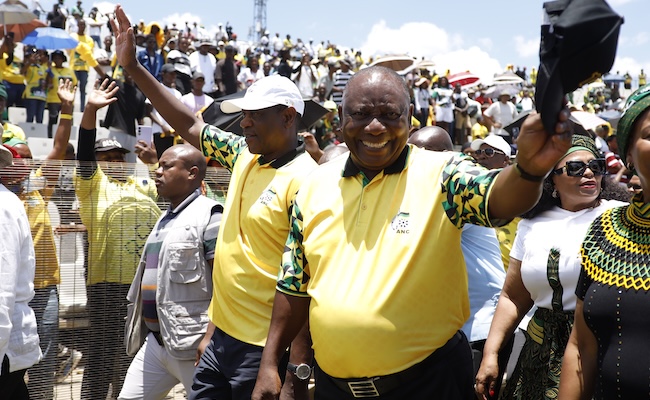
Top image: President Cyril Ramaphosa arrives to deliver the ANC’s January 8 statement at Moruleng stadium in Rustenburg. Picture: Gallo Images/Sharon Seretlo.
Sign up to Currency’s weekly newsletters to receive your own bulletin of weekday news and weekend treats. Register here.