

On February 24, on the fourth anniversary of Russia’s invasion of Ukraine, South Africa was among the 51 countries that abstained on a UN General Assembly resolution calling for a lasting peace.
One hundred and seven countries voted in favour of the resolution, which affirmed support for Ukraine’s territorial integrity and sovereignty within its internationally recognised borders. A dirty dozen voted against, including Eritrea, Mali, Burkina Faso, Burundi, Niger and Sudan, along with North Korea, Iran, Cuba, Nicaragua, Belarus and, of course, Russia.
Some 23 countries (of 193 UN members) failed to vote.
South Africa was on this occasion in unusual company. Before the vote, the US had tabled a motion for division seeking to delete two essential pillars from the resolution: the reference to territorial integrity and the explicit grounding of peace in international law. This omission could make an agreement easier to trade land for peace, but would also weaken its legal foundations.
The same day as the UN vote, President Donald J Trump gave a 107-minute state of the union speech, the longest ever. Aside from his usual self-congratulatory tone (“My first 10 months I ended eight wars”), and interspersed with countless standing ovations, the foreign policy component focused on Iran, seemingly to create a pretext for an attack.
“They have already developed missiles that can threaten Europe and our bases overseas,” he said. “And they are working to build missiles that will soon reach the United States of America.”
Trump added that he wanted to hear the Iranians deny that they wanted to build a nuclear weapon. “We haven’t heard those secret words ‘We will never have a nuclear weapon.’”
There is doubt that the Iranians have either this capacity or intention, not least since Trump has said many times how he destroyed Iran’s nuclear capability in America’s bunker-busting strike in June last year.
But what is certain is that Iran is a violent and authoritarian regime.
No shortage of irony
South Africa, predictably, urged restraint on Iran. Shortly after hosting the Iranian navy to a naval drill off Simon’s Town in January, and in the midst of Tehran’s bloody suppression of domestic protests against rising prices, which may have claimed as many as 35,000 lives, the department of international relations and co-operation (Dirco) issued a statement at the 39th special session of the UN Human Rights Council on January 23.
“South Africa reiterates its commitment to multilateralism and stands for the firm adherence to the international rule of law,” it read without a hint of irony on Ukraine.
“South Africa believes that the right to peaceful protest, freedom of expression, and freedom of association are universal rights that must be upheld and protected, as enshrined in international human rights law. In this regard, all efforts must be expended to ensure the protection of the right to life, which remains sacrosanct.”
The statement went on to warn of “the need to adhere to the UN Charter, which mandates all member states to refrain from the threat or use of force against the territorial integrity or political independence of any state. These developments only serve to fuel instability, which is of no benefit to the Iranian people, nor to the security of the region or the world.”
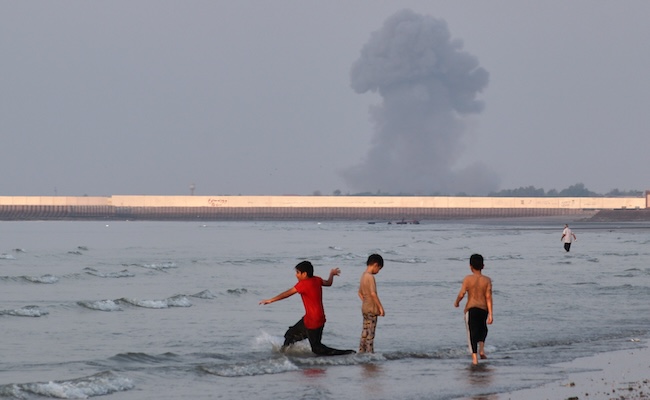
Now Trump has proven true to his word, with the co-ordinated Israeli-US attacks starting February 28 with his stated intention of regime change.
At least he is consistent in seeing conflict as something akin to a real estate deal, swapping pieces of land for peace in Ukraine, perhaps, with the swagger of a braggadocious bully.
But in South Africa’s case, it amounts to one rule for Iran and another for Ukraine.
Party above people
It’s not certain anyway what is in it for South Africa in defending the mullahs’ murderous rule. Perhaps for MTN, or for those seeking mineral concessions in the Islamic Republic, but not for the majority of South Africans.
It may be the need to keep the Brics intact, which is presumably why its fellow members India, China, the United Arab Emirates, Indonesia, Saudi Arabia and Ethiopia all abstained in the Ukraine vote, though Egypt voted in favour of the UN resolution.
But South Africa’s position most likely reflects a combination of the interests of party personalities and a means of maintaining ideological opposition to notions of US imperialism.
There are other, pricey impacts. Given the inevitable lack of bandwidth, other more important and pressing foreign policy problems fall away as priority considerations.
There is one right next door about which there is not a peep from Tshwane; too busy, it seems, with taking up the cudgels on behalf of Moscow and Tehran.
Zimbabwe’s democratic demise
On Monday February 16, following a cabinet meeting chaired by President Emmerson Mnangagwa, the government in Harare announced that the Constitution of Zimbabwe Amendment Bill (No 3) 2026 had been published in an extraordinary government gazette. This announcement formally started a 90-day public consultation period before it goes to parliament.
The bill creates significant changes for the way in which the president is elected, and on checks and balances on executive power.
It proposes that the president will no longer be directly elected, but will instead be chosen by members of parliament where, due to a long history of gerrymandering, the ruling party is almost certainly assured a majority.
Among its 21 changes, the bill also proposes that the presidential term of office be extended from five to seven years, meaning that the next election will be pushed out to 2030. It gives the president the power to appoint 10 more senators, bringing the number to 90, removes the public interview process for judicial appointments, and moves the voter’s roll from the (nominally) independent electoral commission closer to the heart of government in the registrar-general’s office.
All this is to be achieved, the government hopes, without a national referendum, where there is a history of citizen participation and obduracy. In February 2000 a constitutional referendum unexpectedly rejected then president Robert Mugabe’s proposals, notable for giving power to the government to seize farms. This was taken as a personal rebuff by Mugabe and signalled the political arrival of the newly formed Movement for Democratic Change (MDC).
The MDC went on, from most credible accounts, to win the March 2008 election before slowly disintegrating given a cocktail of state pressure, personal co-option and bad judgment.
Zimbabwe’s current constitution was adopted by 94.5% of Zimbabweans after a national referendum in March 2013.
Jurisprudential gymnastics
Two cases have now been brought before the Constitutional Court to determine whether a referendum is necessary, one seemingly only to muddy the legal waters, given its dubious origins from an opposition spoiler.
As Tendai Biti, the former finance minister in the unity government (2009-13) and a leading figure in the Constitutional Defence Forum (CDF) has put it: “The nation faces a constitutional crisis that will determine whether we remain governed by the will of the people, or slide back into unchecked executive dominance. The proposed amendments attack the existence of the social contract that has existed in Zimbabwe since April 18 1980 when the Union Jack was lowered.”
The government has tried to sell this as part of the need to ensure continuity of government. But this is precisely what Zimbabwe doesn’t need, given what the ruling party has done to the economy over the past 45 years.
Its unchecked rule has been enabled not least by the ANC, which has done everything in its power to ensure the perpetuation of Zanu authority, including Thabo Mbeki’s cobbling together of a unity government after 2008 when the people of Zimbabwe had voted for something different.
David Coltart, the former minister of education in that government and now mayor of Bulawayo, was equally scathing: “The amendments destroy the balance between the executive, judiciary and legislature, without which there will not be a semblance of free and fair elections going forward. There will be nothing to hinder further rubber-stamping of executive authority in the future. To steer Zimbabwe onto a better path, there is a need to focus on issues over personalities, both in government and the opposition.”
This may prove the moment where the CDF converts itself into a political party. Or it may prove the death knell for any hope of a change to a regime where, as the activist Samkeliso Tshuma observes, young people are painfully marginalised. Now “they are going to be begging for breadcrumbs just to survive”.
The power of leverage
For South Africa this is not just about the priority of ensuring that Zimbabwe’s economy gets back to rude health, in so doing relieving the pressure of accommodating perhaps as many as 5-million Zimbabwean economic migrants. It is also about creating leverage for South Africa globally if Tshwane can actually solve problems in its own region.
And trouble is brewing beyond Zimbabwe. In Tanzania, following the massacre of 3,000 people in a travesty of an election in October last year, a repressive autocracy is in place. In Uganda a similarly rigged election on January 15 has kept an octogenarian autocrat in office.
In both countries, opposition leaders are on trial on trumped-up treason charges.
Even the normally flaccid UN has been moved to call for Tanzanian opposition leader, Tundu Lissu, to be released and compensated for his unjust detention. The call was made by its Human Rights Council working group on arbitrary detention.
In Uganda, a military tribunal is trying opposition leader Dr Kizza Besigye for treason in a sham trial, while the head of the armed forces (and son of President Yoweri Museveni) promises to kill the opposition leader, Robert Kyagulanyi Ssentamu, popularly known as Bobi Wine.
Dirco’s dubious theatrics
While Dirco devotes its energy to posturing in favour of the Iranian autocrats, these very serious African challenges to democracy and human rights go unremarked. South Africa apparently doesn’t really care about the state of democracy. There’s probably no money in that for the elites.
One of the persistent foreign policy themes of the post-Cold War years is in the notion that countries should position themselves to “punch above their weight”, a term coined by the then British foreign secretary Douglas Hurd.
Post-apartheid South Africa was, in its early days, seen to punch above its weight by dint of its transition from apartheid and its relative economic sophistication in Africa. The authority of its moral position gained it a place at the top diplomatic table, reflecting the stature of Nelson Mandela, and the reconciliation he personified.
Now, with a frayed transition at home and stained foreign policy legacy, the ANC should sharpen its external policy priorities and think of people over party.
Shades of grey
Finnish President Alexander Stubb provides a useful foreign policy framework in this regard: “Foreign policy is never black and white. It involves many shades of grey. Finland’s interests call us to see the world as it is, not only as we would like it to be. This means we have to be honest with ourselves. Finland’s foreign policy is not based on moral posturing or identity politics. It is based on values, interests and actions. An active foreign policy and sensible solutions increase Finland’s influence.”
Consequently, Finland’s modus operandi is to strengthen and deepen relations with those countries with which it shares interests and values: in its case, Europe and the Nordic countries especially.
Transposed to South Africa, this would involve those countries that share a democratic tradition, trade and investment interests, a concern for the human rights of others, and in upholding the multilateral system. There is also a self-interest in promoting regional integration, not only for reasons of market prosperity, but also in a manner that promotes stability and these values.
For lightweights to punch as foreign policy heavyweights, to follow Hurd’s thinking, they have to base their diplomacy on achievements at home, and the company that they keep.
Hartley and Mills are with the Platform for African Democrats.
ALSO READ:
- South Africa’s hypocrisy is not just laughable – it’s Trumpian
- How South Africa can win in the new world order
- Israel and South Africa: Nostalgia is not a strategy
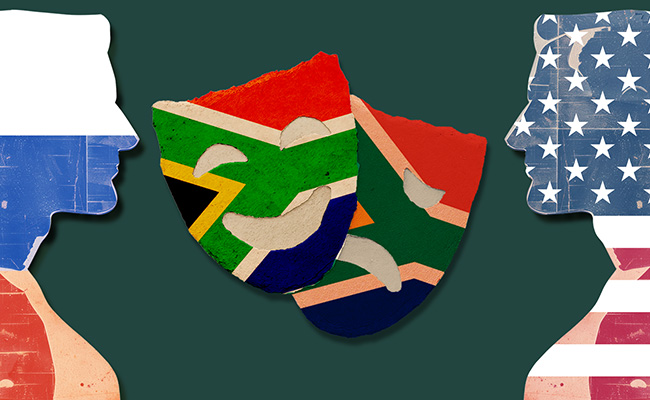
Top image: Rawpixel/Currency collage.
Sign up to Currency’s weekly newsletters to receive your own bulletin of weekday news and weekend treats. Register here.