
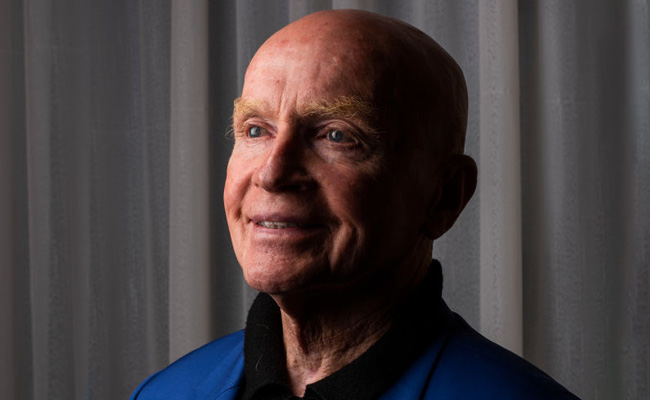

Mark Mobius always looked a little as though he had come from somewhere else. Which, usually, he had.
There he was on television in one of those pale suits, tanned, shaved head gleaming, talking cheerfully about Brazil or Thailand or Turkey or South Africa as though the whole world were not a tangle of risk, corruption, regulation, coups, commodity prices and bad airport coffee, but actually … an enormous, unruly treasure hunt.
Other fund managers often look as though they’ve been trapped in conference rooms. Mobius looked as though he had just eaten something alarming in a market outside Ho Chi Minh City and found a mispriced bank on the way back to the hotel.
He died last week at 89, and with him goes one of the great characters of global fund management: part investor, part evangelist, part travelling salesman for the proposition that the world beyond the rich countries was not a danger zone with stock tickers, but a place full of businesses worth owning.
For South Africans, the phrase “emerging markets” has always had an odd double life. On the one hand, it is a category investors use when they don’t want to bother with the details. On the other, it has been one of the great routes by which countries like South Africa entered the portfolios – and imaginations – of global capital. Mobius did as much as anyone to make that happen.
‘Interesting and interested’
Mobius joined Franklin Templeton in 1987 to launch one of the first dedicated emerging-market funds, and by the time he retired in 2018, the operation had grown from a $100m fund into a sprawling emerging-markets business with more than $40bn under management across 70 countries. That is a huge institutional achievement, obviously. But it is also a feat of narrative. He did not just manage money; he made a whole style of investing sound glamorous, adventurous and morally cheerful.
Jean Pierre Verster, the chief executive of Protea Capital Management, remembers him exactly that way.
“I found him very acute and interesting and interested,” Verster tells Currency. For fund managers, he says, Mobius was above all “an example of widening their horizons and an example of the power of optimism”.
Mobius was not just buying shares in emerging markets; he was widening the psychological borders of investing. Before people like him, a lot of developed-market managers stuck to the US or Britain or Europe, and regarded much of the rest of the world as professionally unnecessary. Mobius climbed on planes and went looking. He visited 112 countries over the course of his career, from Thai rubber plantations to battered provincial roads in China, trying to see what other investors preferred to summarise darkly in strategy notes.
As Verster puts it, Mobius understood that “you can extend your horizons and look at shares, companies in emerging markets”, and that once you got there, you discovered people “all around the world are more similar than what you think”. Their “core needs and aspirations are similar”, he says, which means you could find entrepreneurs almost anywhere if the legal system was just good enough to let business breathe.
A natural performer
That, in retrospect, was Mobius’s real trick. He was always looking past the category towards the company. Countries were scary; businesses were often rather good. The flag might be alarming. The valuation might be marvellous.
This is also why he was such a natural television performer. Verster says the role suited him perfectly: “an optimistic pioneer” is often also “a bit of a showman … a good storyteller, a good narrator”. Mobius, he says, knew that people might dismiss his story unless he first “grabbed their attention”.
He certainly did that. The shaved head. The white clothes. The easy way with journalists. He was forever on CNBC, forever game for another interview, forever ready with a quote. Mobius seemed to enjoy it. He understood that being right was useful, but being memorable was also a kind of asset.
And yet, behind the performance, there was always the slightly awkward question: yes, but how good was he really?
This is where Verster is refreshingly blunt. Outperforming is very hard, he says. That is the business. But it is not the only thing investors buy. Mobius’s returns, he suggests, could at times look a little ordinary – “sometimes outperforming, sometimes underperforming” – but that was not the whole point. Investors also bought the story, the commentary, the sense that by investing with Mobius they were travelling with him, peering into far-flung companies and hearing about markets nobody else cared to visit.
Combining salesmanship with substance
“He did not do a terrible job at managing the money,” Verster says. In fact, one of the more revealing things about Mobius is that he managed to be both showman and serious operator. If he had just been the man in the white suit with a good line in frontier-market romance, the assets would not have kept coming. They came because he combined the salesmanship with enough substance to make people stay.
Under Mobius, the flagship Templeton Emerging Markets Investment Trust returned an average 13.4% a year from 1989 until his retirement, according to Morningstar data cited by multiple outlets. From 2001, when the MSCI emerging markets index became the reference point, the fund beat that benchmark by about 1.9 percentage points a year on average. The post-Franklin vehicle tied to the firm he co-founded, Mobius Investment Trust, had a respectable run overall – its 2025 report said annualised net asset value total return since launch in October 2018 was 7.5% versus 6.4% for its comparator index.
Verster says Mobius was, in broad terms, a value investor in safari gear. “A value investor basically looks for assets that other people ignore,” he says. In Mobius’s case, what others ignored were not just unloved companies, but whole countries. Other investors took one look at the politics and backed away. Mobius got on a plane.
‘The world belongs to optimists’
Was he too bullish? Almost certainly in tone. He was a professional optimist. He believed emerging markets would catch up; that capitalism, ownership rights and the rule of law would spread; that entrepreneurs in poorer countries would do what entrepreneurs always do if given half a chance. History has been less tidy than that, and the past decade has been especially unkind to the emerging-markets dream. But Verster makes a fair point: some large part of that optimism did come true.
Today, it is entirely normal for a fund manager sitting at a desk in Cape Town, London or New York to buy companies around the world with a few clicks and relatively little fear that the share certificate will vanish into a filing cabinet or a revolution. That world did not create itself.
Verster says the people who owe Mobius the biggest thank you may not be the investors, but the entrepreneurs – and even countries. “He brought them investments,” he says. He brought capital into companies and countries that might otherwise have been ignored. For a local audience, that rings especially true. We know what it means to be reduced to a macro story. Mobius, at his best, insisted on looking beneath it.
The Wall Street Journal reports he was still working deep into his 80s, and he began his career very late in life. He had done a talent agency, taught communications, marketed Snoopy merchandise in Asia, worked as a consultant, run a research business, and only became a fund manager in his 50s, which is absurdly late for a profession that usually treats 38-year-olds as grizzled veterans.
He seemed to regard all of this not as a career path but as an ongoing experiment. “The world belongs to optimists,” he said last year. Echo that.
ALSO READ:
- Keeping his shorts: Hedge fund OG Jean Pierre Verster
- Don’t let JSE nostalgia overrule your investment choices
- High yields, less drama: The case for South African bonds
Top image: Aalok Soni/Getty Images.
Sign up to Currency’s weekly newsletters to receive your own bulletin of weekday news and weekend treats. Register here.








I was the GM of investor relations at Sasol during the years Mark Möbius visited SA regularly. Time with him talking about not just Sasol, but about anything he chatted about, was the high point of the year during my involvement with investors. Truely an amazing man never to be forgotten. Mike Tisdall.