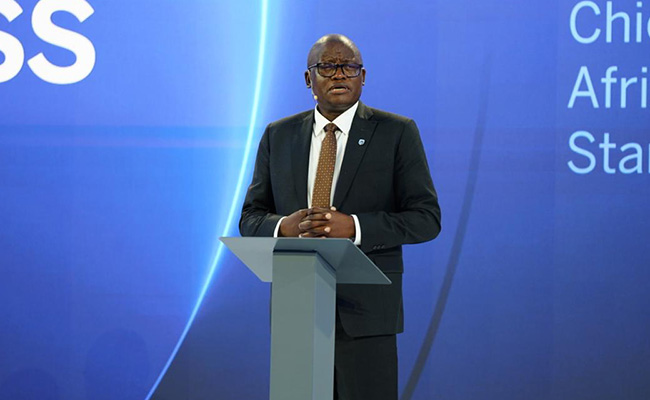

African fintech’s most valuable companies didn’t overcome their constraints. They turned them into moats, Michael Jordaan, founder of Montegray Capital, partner at Chronos Capital and former FNB CEO, told the RMB Think Summit on Tuesday.
“An African fintech that wins is a fintech that is designed for the constraint instead of waiting for the constraint to disappear,” he said, distinguishing African fintech development from many other successful fintech innovations around the world.
Jordaan’s thesis, drawn from his own investment portfolio, is compact enough to fit on a Post-It note: in African fintech, the constraint is the moat. The thing that looks like the problem – the cheap phone, the absent credit record, the patchy data coverage, the labyrinthine regulatory paperwork – is not merely the market condition you need to survive, he said, it is the strategic asset that protects you once you have. The harder the constraint is to design around, the less likely your rivals will bother.
Most African fintechs have died in a specific, predictable way: beautiful app, wrong customer, he said. Someone builds a sleek product for a smartphone the user doesn’t own, backed by a credit card the user doesn’t have, to solve a problem the user didn’t actually experience.
An underserved market
The irony is that the market itself is enormous and genuinely underserved. In 2025, more than $1.4-trillion moved through mobile-money wallets in Sub-Saharan Africa, about two-thirds of global mobile-money transaction value, across a continent that now dominates both transaction value and volume.
Last year, more than $1.4-trillion flowed through 127 mobile-money services and digital wallets across Africa, a 27% increase on the year before, representing roughly two-thirds of the entire planet’s mobile monetary value and three-quarters of global mobile-money transaction volume. All on one continent. About 40% of Sub-Saharan adults hold a financial account, and for one in five of them, it’s the only one they have.
So, while development economists and regulators fret about retail bank rollout in underserved regions, the money has already gone digital. It just didn’t go to a bank branch, and it didn’t go through a Visa card. The payment rails exist. They are simply not the rails that were assumed.
Africa’s banking branch network, Jordaan argued, wasn’t built by banks. It was built by shopkeepers: the spaza shops, the tuck shops, the kiosks, the woman selling vouchers from a cooler box. “Distribution is destiny,” he said. “If you’re in the shop, you win. If you try to replace it, you lose.”
There is also the demographic context that tends to get acknowledged in passing and then ignored. Africa’s median age in most countries is under 20. The continent’s population is the youngest, fastest-growing consumer market on earth – and one with no legacy banking habits to unlearn. No chequebook nostalgia. No branch-relationship conditioning. Whatever financial behaviour you can make work on a phone becomes the default.
Strategic choices
Jordaan organised his talk around four strategic choices that distinguish the companies that work from the ones that demo well and quietly expire.
1. Build for the device people actually own
Not the latest smartphone. Not the aspirational device. The one already in the customer’s hand, even if that is a basic-feature phone. The canonical example here is M-Pesa, which has been quietly correct about this for 19 years by betting on USSD, despite its clunky star-hash menu, that runs on every phone ever made with no app, no data and no smartphone required. It is unpleasant to use. It is also the only channel that reaches the entire continent simultaneously.
2. Don’t try to be the bank – sit behind it
This is, Jordaan argued, the architectural principle underlying almost every African fintech that actually works. The customer faces a licensed entity they already trust – a bank, a mobile operator, a wallet. The fintech sits behind it, carrying the technology and often the risk, invisible to the end user. Unglamorous. No logo on the billboard. But also no banking licence required, no branch network, no need for anyone’s permission to exist.
Optasia is his purest example. It distributes more than $30m per day across more than 32-million loan transactions – at an average loan size of roughly US40c. “No conventional lender on earth can underwrite those economics” he says. “Optasia does it by functioning as a credit-scoring brain layered on top of mobile network operator data.” How regularly someone tops up airtime. Whether data usage is consistent or erratic. Whether they receive calls from a broad, stable network.
These signals reveal financial reliability in ways traditional credit bureaus cannot access, because traditional credit bureaus have no data on these customers at all.
3. Treat the constraint as the moat, not the problem
Here Jordaan reached his thesis explicitly, illustrated through two structural examples.
Until 2025, a card payment between two people standing on the same street in Lagos was very likely processed through infrastructure in the US or Europe. Fees were paid in dollars. Transaction data sat in foreign jurisdictions. African payments were leaving Africa just to come back. This was universally described as an infrastructure problem. The interesting companies saw it as unclaimed territory.
Mercury, the African Export-Import Bank, and the Pan-African Payment and Settlement System, PAPSS, launched the first card scheme that clears African transactions inside Africa, called PAPSS Card. Building a card scheme required years of certification, regulatory sign-off, central bank participation, bank-by-bank integration, and the kind of exhaustive documentation that would defeat most people.
That is precisely the point. “You cannot out-fund paperwork,” Jordaan noted, “and you cannot disrupt certification.” The moat is, in this case, the sheer tedium of the work required to build it.
MyPinPad’s SoftPOS certification took five years and produced every relevant payment industry credential for mobile soft-POS on commercial, off-the-shelf devices. Today, a well-funded competitor with a brilliant team could write the software in a week. It would still need the same five years for certification, which money cannot buy. “The thing that made it nearly impossible to build is the very thing that makes it nearly impossible to copy.”
Bank Zero illustrates a different flavour of the same instinct. Rather than acquiring a full commercial banking licence, it used a mutual bank licence requiring approximately 85 times less capital. The strategy follows directly from that: a bank with a cost base perhaps a thousand times lower than traditional competitors, no credit offering, but fee transactions at a fraction of standard costs – enabling it to charge at zero while generating revenue from interchange.
4. Make the unit economics work, relentlessly
This is the least glamorous of the four choices, and Jordaan made no apology for that. Africa’s transaction volumes are enormous; ticket sizes are tiny. The 92-billion mobile-money transactions processed last year had an average value of about $15 – and the distribution was heavily skewed towards amounts well below that.
At this scale, any inefficiency in cost per transaction doesn’t get averaged away by volume. Volume makes it worse faster. Anything with fat margins per transaction “was never going to survive here”, Jordaan said. The companies that live are those that treat every fraction of a cent as if it is the only thing that matters – because it is.
PawaTech runs the payment and engagement layer behind mobile gaming at 1,800 wallet transactions per second, built for cheap phones and unreliable networks, accepting exactly one payment method: mobile money. This sounds like a limitation until you understand that accepting mobile money across Africa requires approximately 50 separate payment rail integrations. PawaTech has those integrations. The constraint – accepting only what the customer has – is also the technical barrier that keeps competitors out.
Zaru, a rand-denominated stablecoin, addresses the emerging problem of micropayments at genuinely micro scale. The payment rails designed in 1960 for meaningful transaction amounts break completely when you try to pay US5c for a service and the transaction fee is US15c. On Solana, a transaction costs approximately SOL0.000005 – about 0.01% of a US5c payment rather than 300%.
Zaru was launched by a consortium including Luno, EasyEquities and Lesaka, with reserves managed by Sanlam Specialist Asset Manager. It is pegged one-to-one to the rand and backed by bank deposits and South African government bonds, with monthly audits. The defensible use case is domestic rand automation: gig worker payouts, supplier settlements, energy micropayments, automated insurance claims. Cross-border dollar stablecoins have already won that race. “Pretending otherwise is how you light money on fire,” Jordaan said.
Spreading bets
In African fintech, the received VC wisdom – find the best founder, hand them a large cheque, wait for disruption – tends to get you burnt early. The better play, he has learnt, is to back 12 reasonably good founders building 12 slightly different versions of the same payment terminal, and then quietly buy them all.
Jordaan riffs on the Frank Sinatra lyric, “if you can make it here, you’ll make it anywhere”. The fintech companies that survived did so by doing something that sounds obvious in retrospect and is genuinely difficult in practice: they designed for the world as it was, not the world they wished it were. Every one of them was built on the exact thing that everybody thought would sink it.
ALSO READ:
- The PAPSS promise: faster, cheaper Africa payments
- Borders without banks: how necessity forged Africa’s fintech boom
- Digital payments: can regulation keep up with innovation?
Top image: Michael Jordaan. Picture: StephenC Photography/RMB.
Sign up to Currency’s weekly newsletters to receive your own bulletin of weekday news and weekend treats. Register here.