
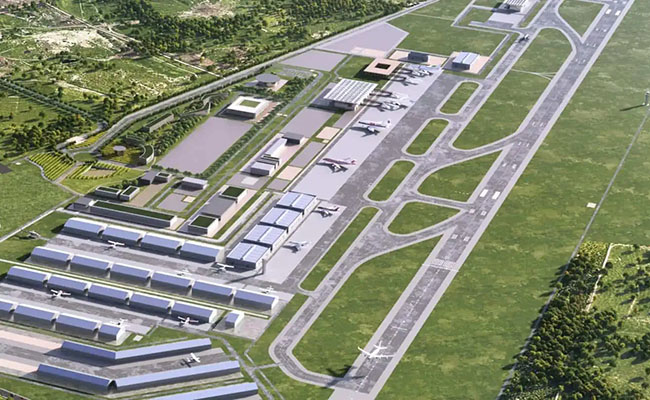

Environmental approvals done. Construction partner secured. Board assembled. Cape Town’s proposed second international airport now just needs to be rezoned, secure final funding for construction, and a runway – all by 2027.
RSA Aero expects to break ground early next year after Western Cape environment minister Anton Bredell dismissed appeals against the project and approved the environmental management programme in May. His decision found both public participation and the mitigation measures adequate: noise would be controlled through aircraft noise abatement procedures, upgrades to surrounding roads would address traffic congestion, and the airport’s design was adapted to protect adjacent poultry farms from encroachment.
Situated about 13km northeast of Durbanville, at the Fisantekraal airfield, Cape Winelands Airport (CWA) plans to open in 2028, aiming to move 2-million passengers a year by 2030. Growthpoint Properties, which has invested an undisclosed amount in the project, will be the development and managing partner, while WBHO has been appointed to handle construction.
The development comes amid rapid growth in Africa’s aviation markets. The International Air Transport Association forecasts passenger volumes will more than double to reach about 300-million annually by 2040. Cape Town, South Africa’s top tourist destination, also desperately needs a secondary gateway to relieve growing passenger congestion at its primary airport, 25km away, and eliminate the heavy, costly fuel reserves that international flights must currently carry in case of a 1,200km diversion to Joburg.
At a recent presentation, RSA Aero managing director Deon Cloete said an international port of entry licence application is also in process.
Four rounds of consultations
CWA initially received environmental impact assessment (EIA) approvals in October 2025. Of the 1,500 registered respondents in the process, six filed appeals; one appellant later withdrew. The objections delayed the project by about six months.
The EIA included four rounds of public consultation, two open days, a town-hall meeting, and more than 40 specialist studies. Cloete notes that refining designs in response to the poultry concerns showed the process worked: objections forced practical improvements without derailing the project.
The one remaining statutory hurdle is a rezoning application with the relevant municipality. The total build is expected to take roughly two years at a capital cost of about R8bn.
A board built from inside South Africa
The board RSA Aero has assembled includes two former CEOs of Airports Company South Africa (Acsa) – one who ran Acsa from 1996 to 2000, another from 2001 to 2011 – the chair of FlySafair, a former chair of the Tourism Business Council of South Africa, a former chief of the South African Air Force (2012-2020), and a private equity specialist.
Cloete brings 30 years of experience in aviation and airport general management. The group head for governance is a former BHP COO with 30 years of experience. The head of aviation and assets security is a former colonel in the SAPS border control ports division with 40 years in the field. Other partners include Munich Airport International Consulting, Investec, Stellenbosch University, Wesgro and the Commercial Aviation Association of Southern Africa.
What the airport will do
The site sits at 400 feet elevation – higher than Cape Town International – which RSA Aero says gives it a meaningful weather advantage. The master plan includes a 3,500m runway built to Code 4F specification, capable of handling an A380. Traffic forecasts rise to 3.8-million by 2040 and 5.2-million by 2050.
CWA is being positioned as a multimodal transport hub. An existing rail link runs through the property, connecting the Port of Cape Town with the Port of Saldanha, and it has never stopped operating. RSA Aero intends to use that infrastructure to move agricultural produce from the Boland to market faster, and to import aviation fuel by rail rather than road.
The diversion argument
Under international aviation regulations, every departing airline must designate an alternative airport for reserve fuel planning. Currently, airlines flying into Cape Town International must designate one that may be hours away, meaning substantial reserve fuel and a sacrificed payload. If CWA holds an international port of entry licence, airlines could nominate it as their designated alternative – thereby dramatically reducing the required fuel reserve.
RSA Aero’s modelling suggests this could reduce total fuel uplift by up to 110-million kilograms and reduce CO2 emissions by up to 60-million kilograms. The estimated 2027 industry value of this proposition is R1.2bn. This commercial logic, packaged under the company’s GreenSkies partnership programme, positions CWA as a contributor to airlines’ net-zero emissions targets by 2050.
Green and off-grid
RSA Aero is explicit that sustainability is built into the operating model. The ambition is for the airport to go completely off grid. CWA will be South Africa’s first airport to use a digital air traffic control tower – cameras and transmitters on the airfield allow controllers to manage five or six aircraft from a single remote control room. The model is already operational at airports in Europe and Scandinavia.
The next six months
What happens next will be determined by two things running in parallel: the rezoning decision and securing construction funding. Both need to move before the spades go into the ground. For a country that has watched major infrastructure proposals stall at precisely these stages, the next six months will say a great deal about whether CWA is a project or just a very good presentation.
ALSO READ:
- How FlySafair’s strike exposed the crunch in South African aviation
- Cape Town scoops airport awards – but what’s your favourite terminal?
- How Brazil’s classroom-to-cockpit vision shows what South Africa has lost
Top image: capewinelands.aero.
Sign up to Currency’s weekly newsletters to receive your own bulletin of weekday news and weekend treats. Register here.







I was part of the construction team of KSIA and more precisely the aprons, taxilanes and taxiways. The 25 month completion depends on your passenger terminal and the cargo terminal. The runway and taxiways can be completed in time. One of the problems experienced during construction was that the electrical, data sleeves were not given a invert level. During the layers works the surrounding area is not at final ground level and the above items were placed at a given depth below ground level. This level was often as much as 500mm below the level during construction. Sleeves and cables where often hooked and damaged.