
One of the more extraordinary facts underlying the National Treasury’s latest confrontation with local government is not merely that it has temporarily withheld July’s equitable share transfers to 69 municipalities. It is that nearly half of South Africa’s municipalities have apparently thought it perfectly acceptable to pass budgets they had no realistic prospect of funding.
You almost have to admire the optimism.
The Treasury says 116 municipalities adopted unfunded budgets in 2024/25, up from 113 the previous year. One hundred and sixteen. Out of South Africa’s 257 municipalities, that is 45% of the local government system deciding that arithmetic was, at best, an advisory service.
This is the sort of statistic that deserves to be read twice.
Imagine if nearly half of South Africa’s listed companies presented annual budgets based not on money they expected to earn but on money they rather hoped might turn up if the universe developed a more positive attitude.
Municipalities, it seems, have been doing a version of precisely this, by the dozen.
An unfunded budget is a wonderfully deceptive document. It balances beautifully on paper because the assumptions have become detached from reality. The spreadsheet balances. The bank account does not, and this is where reality intervenes.
By the end of December, South African municipalities collectively reported R161bn in creditors, including R110.5bn owed to Eskom and R21.2bn owed to water boards. This is what an unfunded budget eventually becomes: not a financial plan but a list of institutions and suppliers that have involuntarily agreed to finance local government.
Eskom isn’t paid. Water boards aren’t paid. Contractors aren’t paid. Maintenance is postponed. Roads crumble. Sewage plants fail.
It is a little like deciding to buy a Ferrari because you fully intend to win the lottery.
Liz and the lettuce
The comparison that kept occurring to me this week was Britain’s shortest-serving prime minister, Liz Truss.
You may remember Truss unveiling roughly £45bn of tax cuts in September 2022 without a convincing explanation of how the resulting increase in borrowing would be managed. Investors did what investors generally do when politicians announce that arithmetic has become optional: they demanded a higher price for believing them. Government bond yields surged, sterling fell, leveraged pension funds were thrown into crisis and the Bank of England was forced into an emergency intervention to stabilise the gilt market.
The Economist remarked that Truss’s political shelf life was about that of a lettuce. The Daily Star responded by buying an actual iceberg lettuce and livestreaming the contest. The lettuce won.
There is, of course, an obvious difference. Britain is a sovereign state. Governments can borrow, provided investors are willing to lend. South African municipalities operate under the Municipal Finance Management Act, which requires annual budgets to be funded from realistically anticipated revenue, cash-backed reserves and legitimate borrowing. Municipal councils are not legally entitled to fill the gap with optimism.
But there is also a striking similarity. Both cases involve pretending that difficult choices can somehow be avoided.
Truss hoped faster economic growth would eventually justify today’s promises. Many municipalities appear to hope that revenue collections will eventually catch up with spending commitments already made. Both approaches postpone the unpleasant encounter with arithmetic until somebody else is forced to confront it.
The remarkable thing is not merely that this has happened. It is how long it has apparently been tolerated.
No pleasant options
According to the auditor-general, 91 of the 113 municipalities that adopted unfunded budgets in 2023/24 – 81% of them – went on to incur unauthorised expenditure. Surprise! Across the municipal system as a whole, 174 municipalities incurred R31.8bn of unauthorised expenditure that year.
This is not an unfortunate coincidence. It is almost the definition of an unfunded budget.
The Treasury’s decision to withhold equitable share transfers is obviously unpopular, but it is born of desperation.
The Treasury occupies the least enviable role in government. Which explains why the political reaction has been so predictable.
Municipal leaders argue that withholding transfers will damage service delivery. They are right, in the short term. But approving budgets that cannot possibly be financed damages service delivery in the long term, which is rather worse because eventually the pipes still burst, the electricity still fails and the bills still remain unpaid.
There is no pleasant option left once municipalities have voted themselves a fantasy.
Perhaps the most astonishing aspect of the affair is not that the Treasury has finally acted. It is that it took this long.
The latest Treasury figures show municipalities and their entities have accumulated R145bn in irregular expenditure, R118bn in unauthorised expenditure and R24bn in fruitless and wasteful expenditure since 2021/22. Those are not merely accounting categories. They are a measure of a local government system that has become accustomed to believing that budgets are aspirations rather than constraints.
Truss discovered that financial reality can arrive at the speed of the bond market. South Africa’s municipalities are discovering that it travels more slowly.
Unfortunately, it is just as punctual.
ALSO READ:
- Treasury draws a line on failing municipalities
- Why Godongwana had to rebuke Morero on Joburg’s debt crisis
- Political suicide for the ANC in Joburg
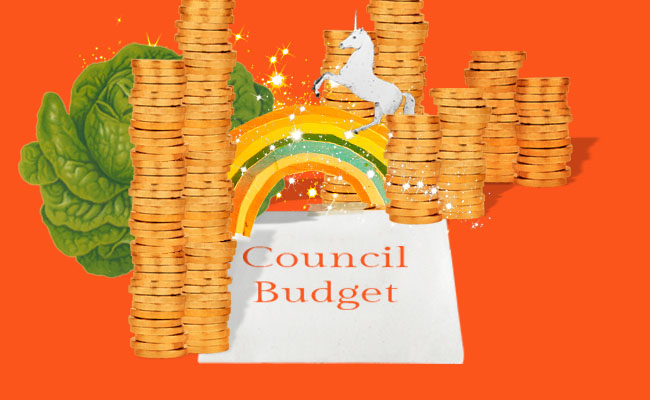
Top image collage: Rawpixel; Currency.
Sign up to Currency’s weekly newsletters to receive your own bulletin of weekday news and weekend treats. Register here.