

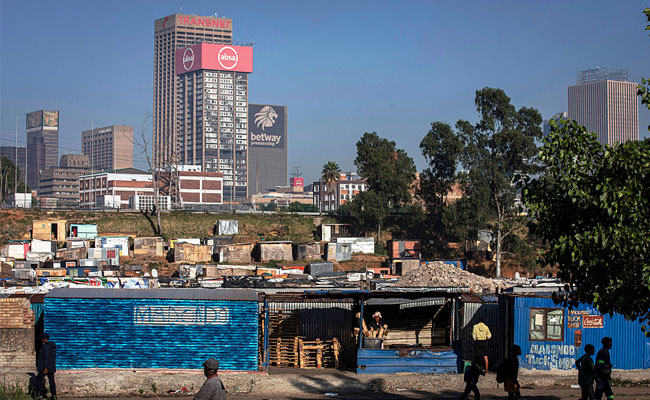

For some time, Ian Scott, a portfolio manager at Chartis Asset Management, has been arguing that the bond market has Joburg badly wrong. The city’s finances, in his view, are far worse than the ratings agencies and fixed-income investors are pricing – and Joburg’s debt should be trading much deeper into junk than it currently does.
Finance minister Enoch Godongwana is effectively agreeing with him.
In a letter to Joburg mayor Dada Morero dated April 23 and reported by Bloomberg and Daily Maverick, Godongwana slams the ANC-appointed mayor for “illegally” signing a R10.3bn wage agreement with the South African Municipal Workers’ Union. “You very well know this city can’t afford this agreement,” the minister told him.
Joburg’s creditors are owed R25.2bn – a 48% jump from the R17bn outstanding at the end of the 2022/23 financial year – against cash and cash equivalents of just R3.9bn. “This is a marker of severe financial distress,” Godongwana points out in his letter. In other words, the city doesn’t have enough cash to pay its debt and, as a result, the National Treasury will withhold roughly R8bn – close to 10% of the city’s annual budget – unless the pay deal is reversed.
The municipal union has shown no signs of backing off either, saying in March that the wage pact is an effort to correct long-standing salary disparities and threatening service delivery against a legal challenge brought by the DA.
For Scott, none of this is a surprise. “The question the bond market has had for quite a while, except for the city of Cape Town, is, of all these municipalities, which one is going to default first?” he tells Currency.
Last instalment
Joburg’s bonds due in June this year were trading at a yield of about 11.45% before they were suspended by the JSE at the end of March, after the city failed to submit its annual financial statements for the year ended June 30 2025. That’s a spread of about 2.25 percentage points, or 225 basis points, over 10-year national government debt. The metro has to repay R1.44bn next month, the last instalment of a 2016 debt programme.
Tshwane bonds yield about 23.6%.
To understand the risks attached to the different metros in South Africa, it is important to understand how ratings agencies view them, and right now Moody’s is the only major international agency that keeps watch. All four reside in “junk” territory, which means they aren’t investment grade. At least, on a global level.
Cape Town currently holds the strongest position at Ba2, which is two notches below the investment-grade threshold of Baa3 and is capped by the national sovereign rating. Joburg sits one level lower at Ba3 and is currently on review for downgrade due to governance and reporting delays. Tshwane is at Caa2, a deeply speculative rating that is eight notches below investment grade, indicating a very high level of credit risk and poor financial standing. Similarly, the City of Ekurhuleni was historically rated in the Caa range before its ratings were recently withdrawn. It narrowly avoided JSE suspension after filing its returns late, and received a qualified audit opinion.
“The ratings agencies are behind the curve again,” Scott says. The ratings indicate “there’s a high probability that these guys will repay their loans, but I’m saying that probability is much lower than you think”.
Elevated credit risk
Casey Sprake, a market strategist at Anchor Capital, takes a much more measured view.
“The market is pricing elevated credit risk – particularly around governance, audit integrity and the technical acceleration risk – but not an imminent payment default on any of the three,” she tells Currency, referring to Gauteng’s metros of Joburg, Tshwane and Ekurhuleni.
Bonds account for only 13% of Joburg’s debt stack; bank loans make up the other 87%.
A default on a JSE-listed bond – the kind of event that typically triggers a sharp market repricing – is therefore unlikely to be the first symptom of trouble. A loan covenant breach is. There is also the question of state support. As South Africa’s economic hub, Joburg is widely seen as too important to fail outright, reinforcing expectations that the Treasury would step in before any disorderly default.
The city has until May 31 to deliver its financials. If city bosses miss that deadline, says Sprake, the downgrade “is a given”, which could be enough to trigger covenants on its bank loans, potentially accelerating repayment demands. “That is the scenario where the market would move from ‘wide spreads’ to ‘distressed’,” she says.
The JSE suspension, the city said in a statement at the time, was a “technical compliance matter related to reporting timelines, not an indication of financial distress or instability”, and it “remains financially operational and continues to meet all its debt servicing and financial obligations without interruption”. By Wednesday afternoon it had not publicly responded to Godongwana’s letter.
Debt cascade
If the cascade does come, the mechanics are unforgiving. The pari passu principle means a coupon miss on a single bond turns the entire debt stack acceleratable.
In other words, “when you default on a bond all your debts become payable. That’s all your bank loans, development finance loans and overdrafts because they all sit at the same senior unsecured level of the capital structure,” Scott warns. Any bank, in other words, would have the right to call in what it is owed.
What follows is uncharted.
“No JSE-listed metro has defaulted on a coupon in the post-MFMA era, so the bondholder playbook under chapter 13 of the [Municipal Finance Management Act] is largely theoretical,” Sprake says. The act envisages the province stepping in alongside National Treasury to develop a financial recovery plan, with the power to dissolve the council and appoint an administrator until a new one is elected. The plan could include the sale of municipal assets and the “termination” of staff, subject to the municipality maintaining a minimum level of basic services.
South Africa’s outstanding municipal bond debt is relatively contained at R5bn by Scott’s estimate – small enough for a Treasury bailout to be manageable.
Still, “what type of precedent are you setting?” asks Scott. “You’re placing a National Treasury taxpayer put under a municipality and you’re saying: ‘Go and be reckless with taxpayer money and we’ll just bail you out.’ You’re paying twice for their indiscretions.”
ALSO READ:
- Borrow now, pay later: Joburg’s budgetary balancing act
- When business becomes government’s crutch
- How Joburg set fire to your money
Top image: Per-Anders Pettersson/Getty Images.
Sign up to Currency’s weekly newsletters to receive your own bulletin of weekday news and weekend treats. Register here.






Its an absolute debacle how the ANC/EFF has run Joburg into the ground. Is it any wonder most jobs are now being created in Cape Town? Who wants to live in a decaying city? The forthcoming LGE is our last hope. If the DA gets in we’ll have a shot at turning this place around. If not, it’s doom and gloom all the way to the bottom.
But wait, it’s not just jhb.
ANC is bankrupt at an organisation level.
Claimed to be corrupt at a national level.
Why is there even a debate if they can run a municipality