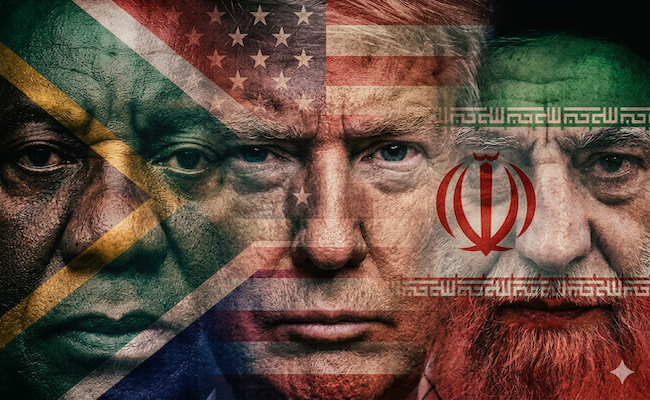

The government of national unity (GNU) was always going to have to confront the foreign policy course charted by the ANC for South Africa. The Iran war presents a perfect opportunity to reset this.
For more than three decades, Pretoria’s international posture has largely reflected the party’s liberation roots – formed by the years many ANC leaders spent in exile during apartheid in countries such as China and Russia.
The unity government is supposed to speak for all 11 of its parties, representing the different traditions and priorities of their voters – anchored by the majority former ruling party and, to a lesser extent, the DA. Yet, since its formation in June 2024, the GNU has largely spoken only with the voice of the ANC.
For years, the ANC has framed its diplomacy around the ideals of the Non-Aligned Movement – a bloc of mostly post-colonial nations formed in 1961 that eschewed alignment with either Western (US-led) or Eastern (Soviet-led) powers.
The party often argues that South Africa should play a mediating role in global conflicts and promote dialogue over confrontation. That vision draws on South Africa’s own transition from apartheid, which was achieved through negotiations rather than war. However, critics say the country is no longer viewed as neutral in several international disputes.
After the end of segregated rule in 1994, Nelson Mandela’s government rebuilt relations with Iran because Tehran shared the ANC’s anti-imperialist outlook, with the late president also visiting Cuban president Fidel Castro and Libyan leader Muammar Gaddafi.
But the world has changed dramatically since the early years of democracy.
Old ideological ties have economic consequences
South Africa’s economy remains deeply linked to Western markets, trade systems and investment flows. Access to programmes such as the African Growth and Opportunity Act (Agoa) remain vital for exports and employment.
Foreign policy choices that appear ideological could therefore carry economic consequences. This is where the GNU should make a difference.
Coalition politics requires compromise and balance. The DA, for example, traditionally takes a more pro-Western stance and has openly supported Israel in the Middle East conflict.
Yet the party’s voice has not been clearly reflected in the unity government’s current foreign policy posture. Key diplomatic decisions continue to be driven mainly through the department of international relations and co-operation and the presidency. Tellingly, both deputy ministers in the department are from the ANC, where in most other ministries at least one deputy comes from another party.
The DA, through its former international relations spokesperson Emma Powell, has repeatedly complained about being entirely shut out of foreign policymaking. South Africa is still paying the price for its decision to take Israel to the International Court of Justice (ICJ) in late 2023, accusing it of genocide in Gaza – a move that has placed it squarely in the crosshairs of Donald Trump.
Regardless of where one stands on the ICJ decision, the question remains whether such a significant step still reflects the collective position of the unity government’s partners. The coalition agreement states that new initiatives should be pursued through consultation and consensus. That principle should also apply to foreign policy.
Reducing risk
A more balanced approach could help reduce geopolitical risks while allowing South Africa to focus on its pressing domestic challenges.
The country faces stubborn unemployment, rising inequality and slow economic growth. Foreign policy should support efforts to attract investment, grow exports and strengthen economic partnerships.
Ideological alignment with distant geopolitical blocs does little to address these urgent problems. The tensions surrounding Iran illustrate the complexity of the situation.
Few observers would defend the methods Trump used to confront Tehran’s regional ambitions. Yet it is equally clear that Iran’s expanding military influence has heightened instability across the Middle East.
Iran has been involved in military actions and proxy conflicts across several countries in the region. It has also been accused of backing militant organisations such as Hezbollah, Hamas and Palestinian Islamic Jihad.
These developments have intensified tensions between Iran, Israel and the US. Despite the scale of these confrontations, South Africa’s official response has largely focused on condemning the actions of Israel and the Trump administration.
President Cyril Ramaphosa expressed concern about rising tensions following strikes that killed Iran’s supreme leader, Ayatollah Ali Khamenei. Pretoria emphasised the need for diplomacy and warned against what it described as anticipatory self-defence.
South Africa’s message was clear: dialogue must remain the path to peace.
But critics have long argued that the country’s position often appears selective, particularly when it comes to condemning actions by countries with which the ANC has long-standing political ties – take, for example, its silence on Russia’s invasion of Ukraine.
Tone deaf military?
At the same time, there are signs that some within the ANC recognise the need for a more cautious approach. Ramaphosa recently opposed South Africa’s participation in joint naval exercises in January that involved Iran alongside other Brics partners.
The exercises, known as Will for Peace 2026, took place off the coast near Cape Town and included Russia and China. Iran was initially expected to participate with warships. However, Ramaphosa issued directives to exclude or downgrade Iran’s role because of concerns about damaging relations with the US.
Those concerns were not trivial.
South Africa’s trade relationship with the US remains critical. While China is the country’s largest trading partner, the US ranks second (usurped only when the EU is included as a bloc). Ties to the American market are pivotal for parts of the automotive sector and for Western Cape citrus, where the potential revocation of preferential access under Agoa threatens thousands of jobs. Trade with Russia and Iran hardly registers in scale.
Yet reports later suggested that Iranian vessels still participated in the exercises, raising questions about whether elements within the South African National Defence Force (SANDF) ignored the president’s instructions.
It was not the first time the SANDF appeared to defy the president. In August 2025, defence force chief Rudzani Maphwanya visited Tehran, touring military facilities and meeting senior commanders, declaring that South Africa and Iran “have common goals” – all while Pretoria was simultaneously attempting to smooth over its relations with Washington. The presidency was forced to distance itself from his remarks, saying it had neither known about nor sanctioned the trip.
South Africa first
These episodes highlight the broader challenge facing South Africa’s foreign policy. The country must navigate an increasingly polarised world while protecting its national interests. That means prioritising the wellbeing of South Africans above historical loyalties or ideological symbolism.
If coalition partners are serious about governing together, they should also shape a foreign policy that reflects the nation’s shared interests. South Africa does not need to abandon its principles or its commitment to peace and dialogue.
But it does need a pragmatic strategy that puts the country’s economy, stability and global credibility first. Foreign policy should serve South Africa’s future, not the political instincts of the past.
Catch more viewpoints from Real Politics at Scrolla.Africa, a mobile-first news site covering breaking stories fast from communities across South Africa, with no paywalls, in English and isiZulu.
ALSO READ:
- South African foreign policy: Vrot with contradiction
- How South Africa can win in the new world order
- Why Iran is sowing regional chaos
Top image: AI render.
Sign up to Currency’s weekly newsletters to receive your own bulletin of weekday news and weekend treats. Register here.