
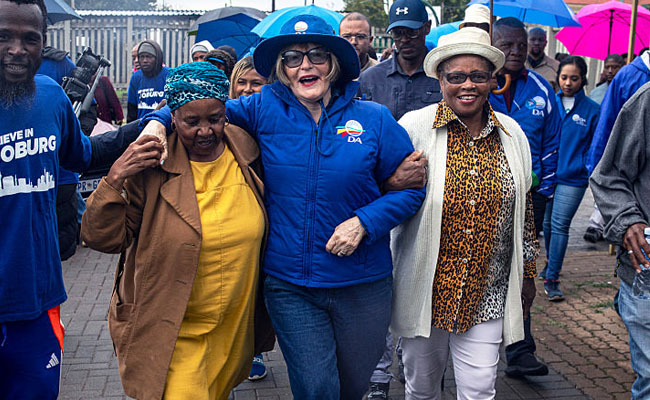

The Joburg mayoral campaign of DA politician Helen Zille is doing something South African politics has not done often enough in recent years, or maybe not at all.
It feels like a campaign: it has a clear emotional proposition, a city-sized promise, and a recognisable attempt to speak to exhaustion, frustration and civic grief in a language that reaches beyond policy detail.
Zille’s slogan – “Believe in Joburg” – carries more weight than its simplicity suggests.
It is attached to five practical pledges on water, roads, jobs, corruption and a functioning city government, which give it structure as well as sentiment. The campaign is asking residents to imagine recovery in a city where decline has become ordinary.
Last week, I was in Davos, Switzerland, for the Davos Communications Summit, where Lord Evans of Sealand, the former UK Labour Party general secretary, was one of the speakers.
As I listened to him, I found myself thinking back to his appearance last year, when he spoke about how the UK’s Labour Party rebuilt itself into an election-winning machine by getting closer to voters who felt unheard, disrespected and estranged from the party that once assumed their loyalty.
Last week, as he spoke about belief, trust and the modern crisis of credibility, I found myself returning to Zille’s campaign and to the political intelligence embedded in the word “believe”.
Evans’ keynote sharpened the idea. We live, he argued, in a world where it has never been easier to communicate and harder to be believed. That line explains far more than the crisis of politics; it explains the conditions in which politics now has to operate, where information is abundant, attention is cheap, and trust is scarce.
Audiences hear every message through a filter of suspicion, fatigue and prior disappointment. They do not only ask whether something is true; they ask why they should believe the person saying it, the institution behind it, and the motives wrapped around it.
This is where the parallel with Joburg becomes interesting.
“Believe in Joburg” works because it understands, instinctively or strategically, that the city’s crisis is larger than infrastructure failure, corruption or administrative decay.
Joburg has a crisis of belief. Residents have lived through so much disappointment, decline and civic embarrassment that the political task now is not only to persuade them that a plan exists, but to persuade them that improvement is still possible, that the city is worth emotional investment, and that public leadership can still carry force in their lives.
Campaigns like this create possibilities by reopening the psychological space where change can once again feel real.
That was also one of the most useful lessons in Evans’ remarks. He spoke about how people respond in two ways: instrumentally, when they are choosing outcomes, and expressively, when they are expressing fear, anger, identity, grievance and hope.
Politics has spent years talking to people in an instrumental register while voters have increasingly been responding in an expressive one. That is why so many polished policy messages feel bloodless, why so many technically correct statements fail to land, and why people can reject messages that are rationally sound but emotionally dead.
The great strength of campaigns built around belief is that they meet people in that expressive space without abandoning the practical ground of delivery.
That is what Labour learnt in the UK. The party had to recognise that working-class voters did not simply disagree with Labour, they felt it no longer understood them. The repair, then, had to begin with recognition before it could ask for trust. It had to speak to economic insecurity, order, community and everyday pressure before it could reach for higher abstractions.
Zille’s campaign appears to be reaching for a similar structure, even though the politics is different; the architecture of persuasion carries a family resemblance.
Start with what people experience, speak to disorder, malfunction and insecurity in a language that feels close to life. Offer a narrative of restoration. Give people something emotionally legible to hold onto, then build the case for competence.
This is why such campaigns create possibilities – they recognise the environments that people live in.
Heightened bullshit detection
South Africa’s trust landscape is harsh. The Institute for Justice and Reconciliation’s 2025 South African Reconciliation Barometer found low confidence in local government, and public agreement that political leaders are disconnected from ordinary people and cannot be trusted to mostly do the right thing.
In an atmosphere like that, campaigns cannot rely on legacy, ideology or visibility alone; they have to rebuild permission. They have to show they understand reality before they try to sell aspiration.
Evans put this another way. He warned against the drift into overclaiming, overpolishing, and the language of purpose, which sounds impressive yet detached from how people actually live.
Audiences, Evans argued, have developed an acute instinct for bullshit. They may never conduct a formal fact-check, but they know when a message feels synthetic.
That observation matters a great deal in South Africa, where citizens have been trained by experience to interrogate promises with a hard eye and a tired spirit.
A campaign framed around belief has a chance of cutting through because it does not begin by asking people to admire a manifesto. It begins by acknowledging a wound.
Joburg is a city whose residents have watched dysfunction become normalised. Anger has become ambient. Cities run on more than budgets, infrastructure and technical plans, they also run on confidence, legitimacy and a shared sense that public systems can still be made to work.
When belief collapses, its consequences permeate a city’s economic life and investment confidence, and the civic mood turns defensive.
A city that cannot command belief struggles to command momentum.
I am less interested, at this stage, in predicting whether Zille will win Joburg than in what her campaign highlights about the phase of politics we may be entering.
It suggests that South African campaigns may have to become more emotionally intelligent, coherent and grounded in experience. It also suggests that relevance may matter more than volume, and that belief has become a political resource in its own right.
In a low-trust environment, the side that understands how people are hearing the message gains an advantage over the side that keeps refining the message itself. Campaigns create possibilities when they close the distance between political language and lived experience.
Evans ended with a line he credited to the general secretary of the Danish Labour Party, who had reworked Michelle Obama’s famous phrase into something that feels especially sharp for this moment: when they go low, we go relevant.
Joburg may be one of the first places where we see exactly how powerful that idea can be.
Lebo Madiba is a reputation management strategist and the managing director of PR Powerhouse.
ALSO READ:
- Zille at 39% for Jozi, ANC voters want Motsepe
- When certainty fails and risk rises, are CEOs ready?
- 490,000 voters to win Joburg? Inside Sarupen’s grand plans
Top image: Helen Zille campaigning, April 13. Picture: Per-Anders Pettersson/Getty Images.
Sign up to Currency’s weekly newsletters to receive your own bulletin of weekday news and weekend treats. Register here.






Very good arguments. All projects start with a belief even if it is very slight.