

Analysed in purely military terms, the joint Israeli-US attack on Iran is going about as well as can be expected, if not as well as President Donald Trump and Prime Minister Benjamin Netanyahu had imagined at the outset. They have been reminded that in war, your opponent has a vote – and of the exponential advantage of geography and time, and of the value of Iran’s large and youthful population of 92-million, coupled with an apparently careless attitude towards casualties
But it’s the strategic winners and losers – so far – that are much more interesting. It’s hard to tell, of course, exactly what is going on, because Trump is consistent only in his mixed messaging – winding down while hitting Tehran harder, while engaging in talks and winning, while adding more troops – and Iran is largely a closed book, having seldom permitted media oversight and especially not now.
The losers
With this analytical health warning in mind, the following stand out as losers:
The Ukrainians
While they earned some kudos for their offer to assist the West and the Gulf in mounting (low-cost) defences against drones, overall this is likely to curtail further arms transfers to Ukraine. It’s also benefited the Russians in ways that were unimaginable before this war.
The Iranian people
Casualty numbers remain relatively low given the precision nature of the bombing campaign against mostly military targets, but there is always collateral damage, especially in urban areas and where things go awry, such as with the bombing of the Shajareh Tayyebeh girls’ elementary school in Minab in southern Iran. But the real cost to Iranians may yet be felt. Operation Epic Fury is likely to have further reduced democratic space and given legitimacy to the mullahs and their agents, given the existential and external nature of the threat – always a useful pretext for nationalism. At this juncture, it seems that justice for the estimated 35,000 protestors killed in the January violence is some way off.
The Gulf states and Saudi Arabia
While a high oil price might help in the long run, for now the Saudis are in retreat. Not consulted by the US and home to American bases, a target for Iran and yet uninvolved directly (at least) in the war, they have all of the downside and little of the upside. It remains unclear how long it will take their economies – dependent on oil and services, notably air flights – to recover.
Donald J Trump
So far, he has blathered and blustered his way through the war seemingly largely cost free. But he may be punished in the US midterm elections if he is unable to bring the war to a close. He has also alienated superfans such as Tucker Carlson and other “MAGA bros” who are instinctually anti-war and America-first. By the midterms on November 3, in which the Democrats can conceivably flip both the House of Representatives and the Senate, he will either need to have won decisively or, at least, declared victory.
Trump’s standing has been substantially diminished across the globe as traditional Nato allies question the wisdom of his decision to attack Iran after he failed to consult them. Whatever the outcome of the conflict, there is now a major trust deficit between the US and its traditional allies, which it ultimately needs, whether Trump likes it or not.
Africa
Higher oil prices will fuel inflation. Given that most African countries are price-takers in oil, this has impacts not just on fuel, but on food and fertiliser costs. Expect greater humanitarian needs across the continent, especially in fragile regions such as that sweeping from Sudan across the Sahel to West Africa. The higher prices and increased tensions may have domestic political impacts both in Africa and outside.
Weak states
The weak are both diminished as a prospective ally of the US, and rendered vulnerable by this weakness. This new world, where the rule of the jungle is more important than international law, can only be a spur to greater arms proliferation, and especially weapons of mass destruction. Why would you give up your weapons programmes as Ukraine, Saddam Hussein’s Iraq or Muammar Gaddafi’s Libya did, when the outcome is invasion?
Perceptions of pervasive American power
The relatively bloodless and speedy nature of the toppling of Venezuelan strongman Nicolás Maduro in January was a carefully synchronised exhibition of American technical and military prowess. The Iranian operation has been anything but, and has reminded us once more of the power possessed even by much weaker adversaries, given sufficient will and appetite for casualties. Autocratic, or more specifically, theocratic regimes run according to different metrics than democracies.
Democracy
The world is now in its third decade of democratic regression. While Trump’s antics may lead, in the medium term, to a democratic rebound, given the strength of American institutions and checks and balances, the same does not apply to those regions with fragile democracies that require a degree of international policing and support.
With Europe and the US turning inward, albeit for different reasons, democrats in Africa are likely to be hard hit, as has already been seen in violent sham elections in Tanzania and Uganda, and the Zimbabwe constitutional amendment aimed at extending the presidential term.
In this environment, where critical minerals add a special premium, countries are not measured any longer by the nature of their systems of government and respect for individual rights, but by what they can offer in transactional terms. Good for business, maybe, but bad for the ordinary person, especially given the higher prices that have accompanied this war.
The winners
The winners are more difficult to discern, but for now include unusual bedfellows:
Vladimir Putin
Higher oil prices and permiting Russian exports while taking one’s eye off Ukraine can only help the Russian strongman. Russia is expected to benefit to the tune of $13bn per month from a higher oil price, having budgeted for a price of $59 per barrel. At these prices, oil will make up about half of Russia’s exports by value.
Netanyahu’s Israel
For now, Netanyahu has bolstered his position by (temporarily at least) neutering the Iranian nuclear and proxy threat. However, he is under pressure to conclude the war. Running such a long war on various fronts, however successful it may be, is a dead-end without a diplomatic vision and plan. And he does not possess one.
Long term, the continued rule of the revolutionary regimes is an existential disaster for Israel. A lack of symbolic progress in a settlement with the Palestinians will make it hard for Israel to stabilise an alliance with Saudi Arabia and moderate Muslim countries. And Israel’s global standing in the world, generally and especially in the US, has been hammered by what’s happened in Gaza and is now happening in Lebanon and Iran. An election in Israel may be the only way out, and only if that brings leadership change.
The US military
The military campaign has demonstrated beyond doubt the technological and strategic prowess of the US military, which has flown tens of thousands of sorties far away from home, established air dominance and destroyed Iran’s conventional military infrastructure. The test it now faces is whether or not it can pivot from these conventional victories to succeeding in the war’s unconventional, asymmetric phase, which involves drone and missile assaults, and a dispersed and mobile Iranian force.
Iran’s mullahs and Islamic Revolutionary Guard Corps
Though firmly in the loser column when it comes to leadership casualties, Iran’s extremist leadership is unexpectedly weathering the storm.
Whether the war has emboldened both the Revolutionary Guard and the mullahs, or just one over the other, remains to be seen, and is dependent on the final outcome. For now, it seems as if the guard has tightened its grip, though it’s always hard to tell in a country where information is so tightly controlled.
What is more certain is that the Iranians have learnt lessons after Operation Midnight Hammer in June 2025 and dispersed their military assets effectively. They’ve also displayed an impressive – and somewhat unexpected – resilience despite the more than 11,000 targets struck in 30 days.
The Europeans and Nato
“We’ve been huge beneficiaries of an incredibly generous security guarantee of the US over decades,” says Sir Alex Younger, the former chief of MI6. “But we have actually been infantilised by it, we have been prepared to outsource the most fundamental duty of government, which is security, to another nation, which is a close ally but doesn’t have identical objectives.”
This presents a good opportunity as a galvaniser to Europe to “amend our relationship with hard power”, he says, “and understand that without that we are just going to be prey to other people’s ambitions”. If Europe can redevelop this capacity, it will likely “have a better relationship with America”. The continent may yet turn out to be a winner, depending on how it responds to the challenge led by Trump.
Winning the cup
The outcome of war is routinely determined by the outcome in the intersection of politics and economics. One metric is the relationship between Iran and the US-Israeli nexus, but it’s also about the damage done to the other political relationships in the process, most notably Nato and the Ukrainians. In that sense, the US under Trump has already lost.
So far, it looks like a draw, and that is not good enough for Trump or, especially, Israel. Iran only needs a draw to win the cup. It is difficult to see Trump and Netanyahu winning, however, given their absence of strategic understanding or vision.
Greg Mills and Ray Hartley are with the Platform for African Democrats.
ALSO READ:
- What Iran’s war means for African economies
- US’s ‘new’ 15‑point plan is a sign that it fears it is losing the war
- What if Trump is (annoyingly) right?
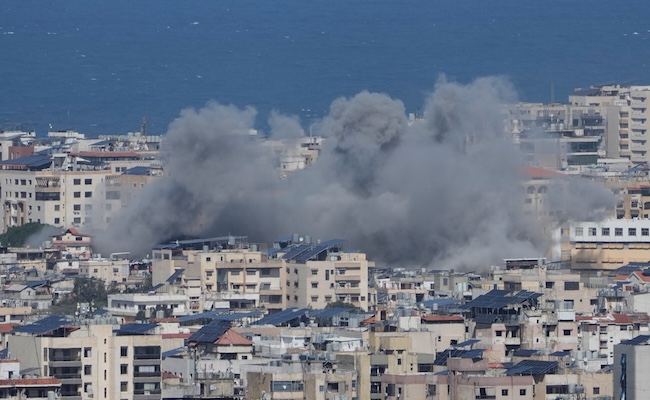
Top image: Smoke rises following an Israeli airstrike in Dahiyeh in Beirut’s southern suburbs on March 30. Picture: AP Photo/Bilal Hussein.
Sign up to Currency’s weekly newsletters to receive your own bulletin of weekday news and weekend treats. Register here.