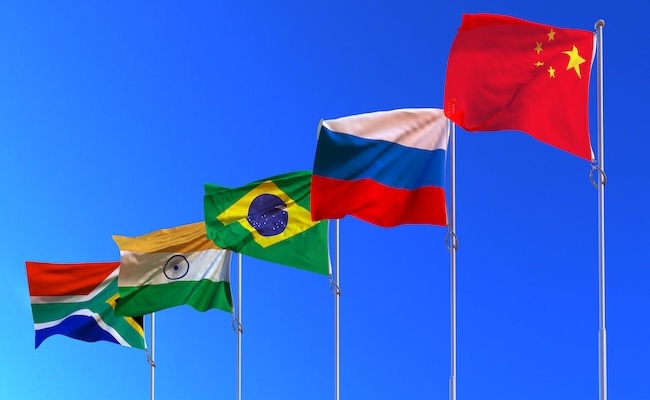


You might have missed it if your web crawler is set to “news that actually matters”, but there was a vast meeting of Brics foreign ministers and their entourages in New Delhi last week.
The “CS Ministers of Foreign Affairs” agreed on no less than “63 points” and outlined “a co-ordinated position on a range of global and regional issues”.
This is but one of four (if form is anything to go by) shindigs ahead of the upcoming Brics summit, which will be held in India in September, where the heads of government of the Brics nations and their even larger entourages will gather to stretch the diplomatic elastic.
That summit will be held under the heading “Building for Resilience, Innovation, Co-operation and Sustainability”, which sounds like something AI would spew out if you prompted: “Develop a parody slogan in the style of Monty Python.”
What is clear is that Brics is having a serious identity crisis.
It was originally conceived as a group of emerging-market countries on the make, with South Africa included as an afterthought despite its smaller population and economy. But, instead of forging a free-trade network and focusing on how these countries could finally attain the elusive goal of “inclusive growth”, Brics veered off course.
It became a platform for grievances against the rules-based world order (particularly the rules that said governments should be democratically elected and accountable). It became a forum where Russia could defend its war on Ukraine, China could advance its soft power, and where South Africa could mainstream its dodgy relationships with autocracies.
This was underscored by South Africa’s successful effort to admit its good friend, Iran, to Brics at the summit in Sandton in August 2023, while overlooking African powerhouses such as Nigeria and Kenya.
Embracing contradiction
But even this limited political role now seems out of the reach of Brics, and it has nothing of any substance to say about anything.
Among the 63 points is the hardy annual, the “reform of the UN”, which boils down to a bid to extend the Security Council to make it “more democratic, representative and effective”. This can apparently be achieved by “including Brics members within the Council, which would strengthen the voice of the Global South”. But Brics, which includes two major northern powers – China and Russia – and super-rich Gulf states, has a very poor claim to represent the “Global South”.
Also on the agenda is “strengthening food security”, something which can apparently be achieved despite Russia’s missile assaults on Ukrainian grain silos and its efforts to hawk stolen Ukrainian grain on the global markets. Despite – or because of – this wrinkle, Brics has come up with a great idea: a “Brics grain exchange”.
Brics pronounced itself in favour of “preserving global biodiversity”, a curious tangent given the group now includes the world’s largest producers and consumers of hydrocarbons. “The ministers highlighted the need to combat desertification,” the statement said, though it might be too late for Saudi Arabia, the United Arab Emirates (UAE) and Iran.
They agreed on “co-operation in healthcare”, but singled out the need for special co-operation on “nuclear medicine”. Why was this particular form of medicine, which does not deal with the major diseases of the “Global South” (malaria or HIV, for example) and which requires the shipment of radioactive isotopes across borders, singled out? Your guess is as good as ours.
Missing the point
Perhaps the crowning glory of the statement came under the heading “Artificial Intelligence (AI) for Sustainable Development”. That was the sound of George Orwell turning in his grave. In Russia, the people are banned from using the internet in case they post an image that shows there is a war with Ukraine, and China is the world’s premier surveillance state. Whatever plans they have for AI, they are likely to be focused on national security and the prevention of civilian discontent, not on pulling peasants up by their bootstraps.
What was absent from the statement was any meaningful comment on the biggest issue of the day: the war between the US and Iran. This was not possible because Iran has been hitting its fellow Brics members, the UAE and Saudi Arabia, with missiles and drones, which can make diplomacy awkward.
The cost of this whole edifice of meaninglessness runs into the hundreds of millions of dollars. The preparatory meetings with their entourages flying about and staying in posh hotels while drawing per diems are overshadowed for bling by the summit itself, which pulls out all the stops.
This would be a little more justifiable if you could show that the economic results were powerful. But there are no trade deals, and the dream of a common currency (read: the Chinese renminbi) taking over from the dollar remains just that.
Even as the foreign ministers were meeting in India, Xi Jinping and Donald Trump were holding a bilateral summit. Any guess which was more important to China?
Ray Hartley and Greg Mills are with the Platform for African Democrats.
ALSO READ:
- ‘Malignment’: The direction of South Africa’s foreign relations
- How South Africa can win in the new world order
- Now the party is over, who washes the G20 dishes?
Top image: Li Qingsheng/VCG via Getty Images.
Sign up to Currency’s weekly newsletters to receive your own bulletin of weekday news and weekend treats. Register here.