

The largest initial public offering, in history, ever, kicked off last week. Elon Musk’s SpaceX is expected to list in June this year, potentially on the billionaire’s 55th birthday, offering investors the chance to buy into a company that promises to push the boundaries of humanity out into the galaxy. What an exciting time to be alive!
The gravity of this moment shouldn’t be understated. That’s because SpaceX has essentially brought private capital to what was traditionally the exclusive domain of governments. Not to mention opening the door for cost efficiency and profit (a concept unfamiliar to most governments). While stock markets have long hosted aerospace giants and satellite operators, such as Boeing or Viasat, this marks the first time that investors can gain direct access to the vision of a multi-planetary, space-faring human race. The investment case here is simple: you are buying the infrastructure of a new orbital economy, with all the potential upside that comes with going where others will not or cannot tread (yet).
In case you’ve been living under a rock
SpaceX, Elon Musk’s pet project to take humanity to Mars, presents an interesting investment case that doesn’t fit neatly into any of the traditional sector classifications.
You could argue that with Starlink (the satellite internet service that SpaceX owns) it’s a telecommunications company. With Twitter (now X) in the mix, it’s part tech/social media. And with xAI, it’s a play on the most profound technological shift in decades. Perhaps, though, the real optionality is the next generation of cloud computing with data centres in space. Or maybe it’s mineral exploration?
The point is that SpaceX is and can be all of these things. The optionality is broad, concerning where the next decade’s worth of revenue may come from, while at present Starlink offers a compelling case for where revenue will likely be generated in the near future. The tech mantra of “build it and they will come” is an essential mindset for any potential investor.
We often talk about “unknown unknowns”. These are the industries, like asteroid mining or orbital manufacturing, that don’t exist yet but could become viable in the future. This makes SpaceX less of a traditional, industry-specific stock and more of a call option on the future expansion of humanity.
A category of one
At present, and despite all the talk, would-be competitors aren’t anywhere close, and SpaceX has a near monopoly on moving cargo to and from space, at a lower cost ratio than anyone else.
NASA, Amazon’s Leo (recently rebranded from Project Kuiper) and everyone else on earth are miles behind, and while NASA and Amazon may be capable of getting cargo or Katy Perry into space, few are able to do it as reliably and cheaply as SpaceX – vital to economic success in this space race. Bear in mind that Amazon actually pays SpaceX to launch its satellites because it has no other reliable way to get them into orbit. This is the ultimate “moat”: when your biggest rivals are also your customers, you have already won the first phase of the war.
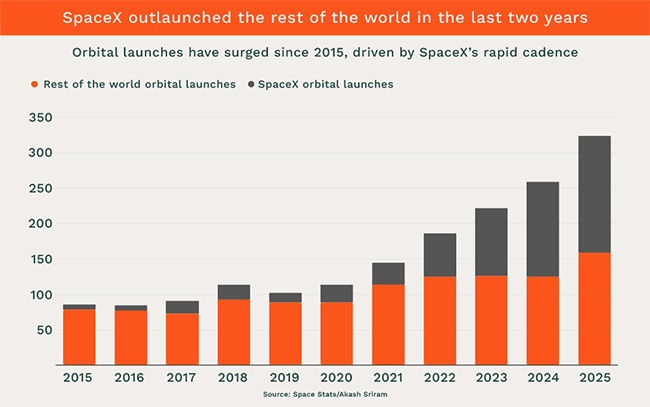
This efficiency has enabled Starlink to build a constellation of more than 10,000 satellites, bringing high-speed internet to all corners of the globe, from rural areas to cityscapes and even airplanes mid-flight. The telecommunications industry appears to be largely ignoring the danger, or is perhaps incapable of countering it, but we are only a few technological breakthroughs away from your devices communicating directly with satellites. When that day comes, SpaceX could stand to profit from every connected device on the planet.
The audacity
The barriers to entry are extremely high and, aside from the cost of launching cargo into space, the learning curve is also exponentially steep. For example, SpaceX and Blue Origin are the only companies that have managed to successfully land (and SpaceX has reused) orbital booster rockets. To appreciate the monumental scale of the engineering required, its latest Starship (with super-heavy booster) stands 123m tall.
To put that in perspective, the rocket is taller than Big Ben or the same height as a 40-storey office block, and nearly as tall as the Michelangelo in Sandton.
Effectively, SpaceX is launching a skyscraper into space and then catching the booster returning to earth with a pair of giant “chopsticks” (yes, this is as insane as it sounds). The fact that we have become used to SpaceX producing one engineering marvel after another speaks volumes to how advanced the tech is and how hard it is for competitors to catch up.
Priced to perfection?
Now, to the actual listing. Internally codenamed Project Apex, SpaceX has entered the regulatory pipeline with a confidential filing to the Securities and Exchange Commission. This allows SpaceX to keep its financials under wraps during the initial review process, though it will be required to share more information publicly later.
With an expected valuation of $1.75-trillion, Musk is reportedly hoping to raise up to $75bn – more than three times the size of the current US record held by Alibaba. This would mark another historic milestone for Musk, making him the first individual to lead two separate trillion-dollar public companies (with Tesla), simultaneously. The June listing date would coincide not just with Musk’s birthday, but a rare planetary alignment; completely on brand for Musk’s unorthodox sense of humour.
Timing aside though, should investors buy this stock on IPO day at all? Historically, investors in high-profile IPOs tend not to do particularly well (at least in the short term).
Remember Facebook’s 2012 debut, where the stock infamously shed half its value in the first three months before finding its footing. (Though, since listing, Facebook has delivered a total return of almost 1,500%. In comparison, the S&P 500 returned about 542% over the same period, including dividends). More recently, Uber’s 2019 listing saw its shares slump nearly 50% in the first year as the market struggled to value growth over its losses.
IPOs are designed by the financial institutions that underwrite and market them to be priced to perfection, raising the maximum amount possible for the company. In short, the first days, weeks and sometimes months are often for the sellers, not the buyers.
The long game
However, what is vital to bear in mind here is the extremely long-term view a potential investor needs to take. SpaceX is listing so that investors can finance its expansion (and hopefully share in the eventual profits).
The stated goals are lofty and the capital required to achieve them is loftier still.
There will be failures, the road to profit may be uneven, and the successes are not all evident – yet. Still, a SpaceX holding represents a rare opportunity to own a piece of the infrastructure that makes an entire orbital economy possible.
This is a human history-altering event. For those willing to look past the initial IPO volatility, the potential for a galaxy-worth of upside is possibly a risk worth taking.
As Musk himself has said: “If things are not failing, you are not innovating enough.” For your portfolio, the question is how much of that innovation risk you can stomach.
ALSO READ:
- How to play Africa’s satellite revolution
- Why Starlink looks set to get its way in South Africa
- The maddening genius of Elon Musk
Top image: Rawpixel/Currency collage.
Sign up to Currency’s weekly newsletters to receive your own bulletin of weekday news and weekend treats. Register here.