
Gambling and investing are concepts that should never be used interchangeably. At least, not if you are doing either of them correctly. However, as so-called “prediction markets” have moved into the mainstream recently, the line between calculated risk and pure speculation has become increasingly blurred. Whether you trade on them or not, the real question for the serious investor is simple: can any tangible value be gleaned from the sentiment indicators these platforms produce?
Led by the likes of Kalshi and Polymarket, these platforms allow you to trade on the outcome of almost anything. Want to bet on whether Kylie Jenner is confirmed pregnant in 2026? How about which song will top the charts in the US this year? You can also bet on the next South African Reserve Bank interest rate decision, if you really wanted to. (As of Wednesday May 20, $4,935 had been staked, and 82% reckon it’ll be an increase, FYI.)
Their increasing popularity has seen a surge in user growth, from those looking to make a quick buck to the “smart money” from Wall Street. Unsurprisingly, these markets have caught the eye of regulators and politicians too.
In fact, trading volumes are up more than 13 times over the past year, standing at $24.2bn in April 2026. Much like traditional gambling, however, the house is the real winner here: on average, 70% of users lose money.
It’s tempting to dismiss these markets out of hand as just another venue for speculation. But for discerning investors, the real value may lie in the information signals these markets can provide.
How the ‘truth machine’ works
Prediction markets operate more like a derivative exchange than a sportsbook. You don’t “bet” at traditional odds such as 3:1. Instead, you trade fully collateralised contracts that pay out $1 if an event happens and $0 if it doesn’t.
This creates a direct link between price and probability. If a contract is trading at $0.65, it indicates the market thinks there’s a 65% probability of that event occurring. If you buy a “yes” at $0.65 and win, you earn the remaining $0.35, but if you lose, you lose everything wagered.
Because these are peer-to-peer trades with no “house” sitting in the middle skewing the odds, the price reflects a pure equilibrium of the likelihood of the various outcomes. And the house? The house never loses. The platforms themselves make money on interest earned on the fully collateralised cash sitting in their books and through transaction fees, not by taking a cut of the odds.
Similar to traditional investment exchanges like the New York Stock Exchange or the JSE, once a contract is live you can enter or exit prior to the conclusion of that event at the new prevailing price, with many traders looking to profit from marginal moves in price before an event contract concludes.
The signal and the noise
One of the most contentious aspects of these markets is the prevalence of insider trading. Detractors point to the special forces soldier who wagered on a Venezuelan invasion while attending the very military briefings where that invasion was planned as evidence of a broken system. Proponents claim this insider activity is exactly what makes the informational signals so potent, but arriving at that conclusion requires some serious mental gymnastics on the ethics.
In reality, if the price moves because someone with non-public information is dumping their knowledge into the pool, they simultaneously move the probabilities closer to where they should be while essentially mugging the uninformed participant on the other side of the trade.
While both platforms claim to have clamped down on insider trading, banning accounts and levying penalties is hardly a disincentive. When the stakes are that high, and regulators are often slow to act, many will continue to take the risk. The fact that the US Senate recently moved to unanimously ban its own members from trading on these platforms speaks volumes.
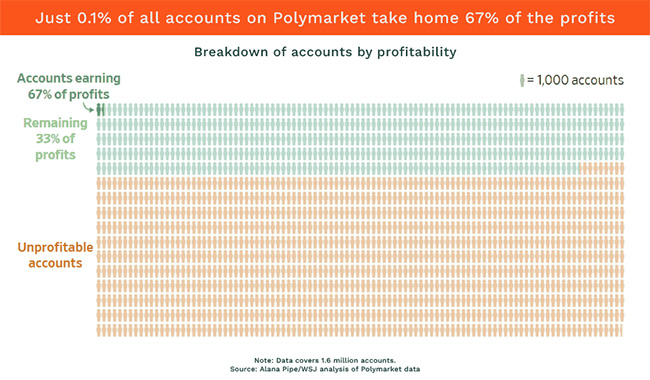
For most users, trading on prediction markets leads to losing money. A recent Wall Street Journal analysis revealed that professional traders are systematically decimating casual traders, with just 0.1% of accounts on Polymarket capturing 67% of all profits. Professionals are exploiting structural inefficiencies that have long disappeared from traditional financial markets, systematically relieving the average gambler of their cash. These strategies require immense scale and speed, placing them largely beyond the reach of the casual trader.
For the serious investor, the value is not in trying to out-trade insiders but in observing the resulting price as a sentiment indicator. When an event contract has sufficient volume, the price acts as a highly refined aggregator of public and private information. It provides a gauge of market sentiment, but that sentiment is bought at the expense of those who got run over by better-informed players.
Observation, not participation
Prediction markets are a remarkable tool for gauging what the world thinks is about to happen, and these prices provide a cold, capital-weighted look at where the insider or “smart money” is leaning. But if the stock market has taught us anything, it is that humans are categorically not good at predicting an uncertain future.
Therefore, these platforms are no substitute for a disciplined, long-term investment plan. Your edge comes from time and compounding, not from trying to gamble your way to retirement through bets on celebrity pregnancies, or which team will win the World Cup. Use the signal, but stay out of the casino.
ALSO READ:
- In cryptoland, you can bet on Taylor Swift – or The Rapture
- Confessions of an election oracle
- The memecoin casino where even the house is gambling
Top image: Rawpixel/Currency collage.
Sign up to Currency’s weekly newsletters to receive your own bulletin of weekday news and weekend treats. Register here.