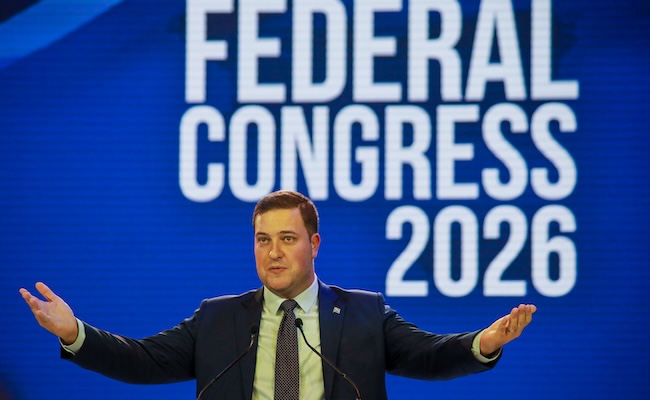

The DA’s election of a new federal leadership this weekend ushered in six leaders who swept seasoned veterans aside and, on average, are 22 years younger than the ANC’s so-called top seven. That’s not by mistake.
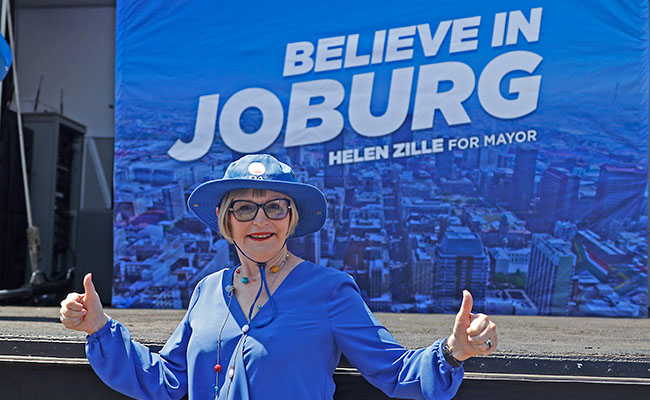
Helen Zille, at 75, helped mark the changing of the guard when she broke into a karaoke-worthy rendition of Brenda Fassie’s Vuli Ndlela during an interview with eNCA, just as a performer took to the stage at the opening of the DA’s federal congress at the Gallagher Convention Centre in Midrand.
“Gosh, here’s my song, here’s my song,” said Zille. A speaker of isiXhosa, Zille, still fresh from her swim in a Joburg pothole, closed her eyes and rocked in her chair as she sang to the wedding anthem that asks guests to clear a path for the groom and his bride. Fassie’s 1997 tune, which blends isiXhosa and isiZulu, served as a metaphor for the optimism and freedom that followed Nelson Mandela’s election as South Africa’s first democratic president; its lyrics were slightly tweaked when the ANC used it in Thabo Mbeki’s 1999 election campaign.
About 40km away, a very different mood had prevailed a day earlier. On Friday, at the Birchwood Hotel in Boksburg, the ANC’s national executive committee had convened a special meeting to manage the fracture in its decades-long alliance with the SACP – a split that threatens to divide an already declining electorate. The ANC failed to convince the SACP to stand down. And now, any member who contests elections under the SACP banner will be ejected from the party.
All this while an invigorated DA was talking openly about coalition-building and its belief that it can win the 2029 national elections.
“We spent years building a party that could be a strong opposition,” newly elected federal leader Geordin Hill-Lewis, 39, said in his victory speech. “Then we built a party that could govern. Now we must build the biggest party in South Africa.”
Hill-Lewis invoked Mbeki’s era of faster GDP growth as a benchmark for capable governance – and connected the DA back 67 years to the founding of the Progressive Party, despite its formation in 2000, when the then Democratic Party merged with other opposition organisations. “We are the heirs to a liberal tradition in South Africa,” he said. “It began in 1959 with those brave few – leaders like Helen Suzman and Zach de Beer – who broke away to stand for a vision of a non-racial, constitutional democracy when it was unfashionable and dangerous to do so.”
The trust deficit
The congress also acknowledged that many of the party’s previous tactics had failed and alienated black South Africans.
“Our task now is to become a political home for the millions of South Africans who like us and feel warm towards us but don’t quite yet feel they can lend us their votes,” Hill-Lewis said.
Political analyst Ralph Mathekga, a senior expert at Geopolitical Intelligence Services, says the appointment of Solly Msimanga, 45, as federal chair – defeating incumbent Ivan Meyer, 64 – was perhaps one of the most telling signs of all.
“Msimanga is someone who has stayed within the DA through trials and tribulations,” he says. “He’s had to deal with criticism about whether the DA takes him seriously, and he has matured within it. He now sits within the engine of the party’s operations.”
With South Africa’s political landscape having changed significantly under the government of national unity (GNU) and an ANC that has seen itself slide from a majority governing party to about 40% in the 2024 national elections and with local government elections coming up, the DA is well positioned to navigate that “fragmentation and possibly find new ground” under someone like Msimanga, Mathekga adds.
More positioned for opposition
Jonathan Moakes, co-founder of The South Africa Brief and a former DA chief executive, told Currency earlier this year that by contesting a second term as Cape Town mayor, Hill-Lewis will sit outside both parliament and the GNU; a parliamentary leader will act on the party’s behalf in government, a configuration that creates its own centre of gravity.
The precedent exists – Zille led the party as both mayor and later as Western Cape premier – but the stakes are different now that the DA is a governing partner rather than a pure opposition force.
“There is potential for Geordin to be a little more oppositional and dig in his heels a bit more on ideological issues,” Moakes said. Not being vested in the GNU’s day-to-day operation could allow him to hold the party’s red lines more firmly – making the relationship with the ANC a continuation of what former leader John Steenhuisen built, but “probably a bit more combative”.
Institutional pragmatism
Ashor Sarupen, 37, the deputy finance minister, steps into Zille’s role as chair of the federal council, and will need to learn from her and need all her support, says Mathekga. “Whatever people say about her, you can’t reduce her to some of those statements,” he adds of Zille. “She led the party through very difficult times and helped it navigate strategically.”
Piet Croucamp, an associate professor in political science at North-West University, told Newzroom Afrika that policy formulation in the DA is not driven by individuals but by institutions. “It has multiple centres of influence,” he said, adding that Sarupen – in his role at the finance ministry – already plays a key part in economic policy discussions.
The DA’s new top structure – Hill-Lewis, Msimanga, Sarupen, and deputy federal chairs Siviwe Gwarube, 36, Cilliers Brink, 38, and the reappointed Solly Malatsi, 40 – brings the party’s average executive age down by 18 years, following the departures of Zille, Meyer and deputy chairs JP Smith, 54, and Anton Bredell, 60.
“Younger leaders can frame issues in ways that resonate with younger South Africans,” Mathekga says. “But South Africa is quite a conservative society when it comes to leadership – historically, it has favoured older figures.” Within the DA, he argues, an open democratic process is producing younger leaders – unlike parties such as the EFF, which may have a young figurehead but operates through a dictatorial internal culture. “That openness to ideas is exciting.”
From liberalism to social democracy?
The characterisation of the DA as a “white party” is becoming a harder claim to make, Mathekga says. Croucamp agrees. “The argument that there is a glass ceiling for black leaders in the DA is increasingly difficult to sustain,” he said. “The party is no longer overwhelmingly white. It may not yet fully reflect South Africa’s demographics, but it has made meaningful progress.”
The leadership is openly acknowledging a trust deficit in black communities, Croucamp said. “In the past, the party often prioritised retaining its existing base rather than investing in grassroots support in black communities. That was a strategic mistake. Now there appears to be a shift towards building trust and relationships in those communities. That is a different approach.”
Hill-Lewis’s defence of social grants in his speech signals that the party understands it needs to respond to lived realities – not just govern well in technical terms, he added.
“This younger leadership understands the complexities,” Mathekga says. “They’re building networks and engaging with the idea of an equitable society, but they’re also critical of how policy has been implemented – particularly where it’s been distorted by patronage. There’s still a lot of room for new thinking in this country.”
Many people don’t vote because they don’t trust the government to deliver, which opens a gap for the DA.
“There are millions of South Africans – particularly among the poor – who are disengaged from the political system altogether,” Croucamp said. “Many don’t vote, not because they support another party, but because they don’t trust the system. If the DA wants to expand, it cannot simply promise better service delivery. It first has to build relationships and credibility in those communities. Without that trust, delivery promises won’t translate into votes.”
ALSO READ:
- 490,000 votes to win Joburg? Inside Sarupen’s grand plans
- Dear John … what comes next for the DA?
- Real Politics: Hill-Lewis might just be the reset the DA needs
Top image: Newly elected DA leader Geordin Hill-Lewis at the Gallagher Convention Centre on April 12. Picture: Gallo Images/Fani Mahuntsi.
Sign up to Currency’s weekly newsletters to receive your own bulletin of weekday news and weekend treats. Register here.