


There will be few people more pleased by the five-year jail sentence imposed on Julius Malema than another ungovernable South African: Elon Musk.
For the past week, Musk has launched a series of attacks on Malema, reposting the EFF leader signing Kill the Boer as an indication of how hostile the country is to white South Africans.
His crusade against Malema has been a long one. Last year, he called for “immediate sanctions” against Malema, arguing that he be designated an “international criminal”. Earlier, he described Malema as the “anti-Mandela”.
Outside the KuGompo City court this week, ahead of sentencing, Malema did his bit to recast himself as Mandela – the victim of a racist judge and a martyr of political prosecution (despite the fact that there’s not a jot of evidence for either).
Magistrate Twanet Olivier wasn’t intimidated though. She handed down a five-year jail sentence for firing a semi-automatic rifle in the air during his party’s fifth anniversary celebrations in 2018. Now, that does seem harsh in a country where fraudsters and murderers routinely escape jail, and it was no surprise that Malema’s advocate, Laurance Hodes, appealed that sentence immediately.
Musk might feel like the law is slowly wisening up to Malema. The most famous Bryanston High pupil had less luck, however, tilting against South Africa’s BEE laws – which he has pitched as the main obstacle to his satellite service Starlink opening in South Africa.
The problem is that the communications regulator Icasa has remained bullheadedly wedded to the notion that it will only grant a licence to a company that has sold 30% of its shares to a “historically disadvantaged” person.
‘Apartheid 2.0’
Musk fumed that Icasa wouldn’t license Starlink, “even though I was born there, because I am not black”. He then added: “We were offered many times the opportunity to bribe our way to a licence by pretending that a black guy runs Starlink SA, but I have refused to do so on principle.”
It’s a wild claim, and who knows if Musk really meant “bribe” in the sense of an ANC mayor asking for extra shekels behind a couch, or in the metaphorical sense of Cape Town property prices being “extortion”.
He doubled down, later speaking of South Africa’s “super racist” laws, accusing the government of implementing “apartheid 2.0”.
It provoked a confusing and somewhat misleading response from President Cyril Ramaphosa. Answering questions from a journalist about Musk’s criticism, Ramaphosa said BEE is a constitutional imperative that is “empowering, not racist” for a country that needs to change its economic complexion.
And, he said, there is already wiggle room: overseas firms that cannot sell shares to black investors, because of their foreign ownership restrictions, are “given an opportunity through the equity equivalence process, where they can do other things that are empowering”.
Ramaphosa said this could be through developing black suppliers, assisting with education, or via helping develop communities.
“Many American companies are complying with that,” he said. In fact, 600 are already, “including the blue-chip companies such as Google, Amazon, Microsoft”.
‘No special treatment’
Yet Ramaphosa’s response to Musk was disingenuous because, actually, all Starlink desperately wants to do is use this “equity equivalence” process in the same way that Google, Amazon and Microsoft already do; the problem is that Icasa hasn’t given it the green light to do this.
Currency has a number of confidential letters written by Ryan Goodnight, a director of Starlink’s holding company, SpaceX, to numerous South African officials over the past year ,which make exactly this point.
In one letter sent to trade, industry and competition minister Parks Tau last June, Goodnight says Starlink “has never sought an exemption from [black empowerment] laws, nor have we asked for any special treatment”.
“The only reason Starlink is not in South Africa today is because Icasa’s licence regulations stipulate that all licence holders must be 30% locally owned. As you are aware, Starlink is a global system, and we must retain sole ownership of all our subsidiaries,” he wrote.
Goodnight said that if Starlink were allowed by Icasa to use the “equity equivalence programmes” instead of being forced to sell a 30% stake, it would “help solve” the situation where millions of rural south Africans are locked out of the information economy.
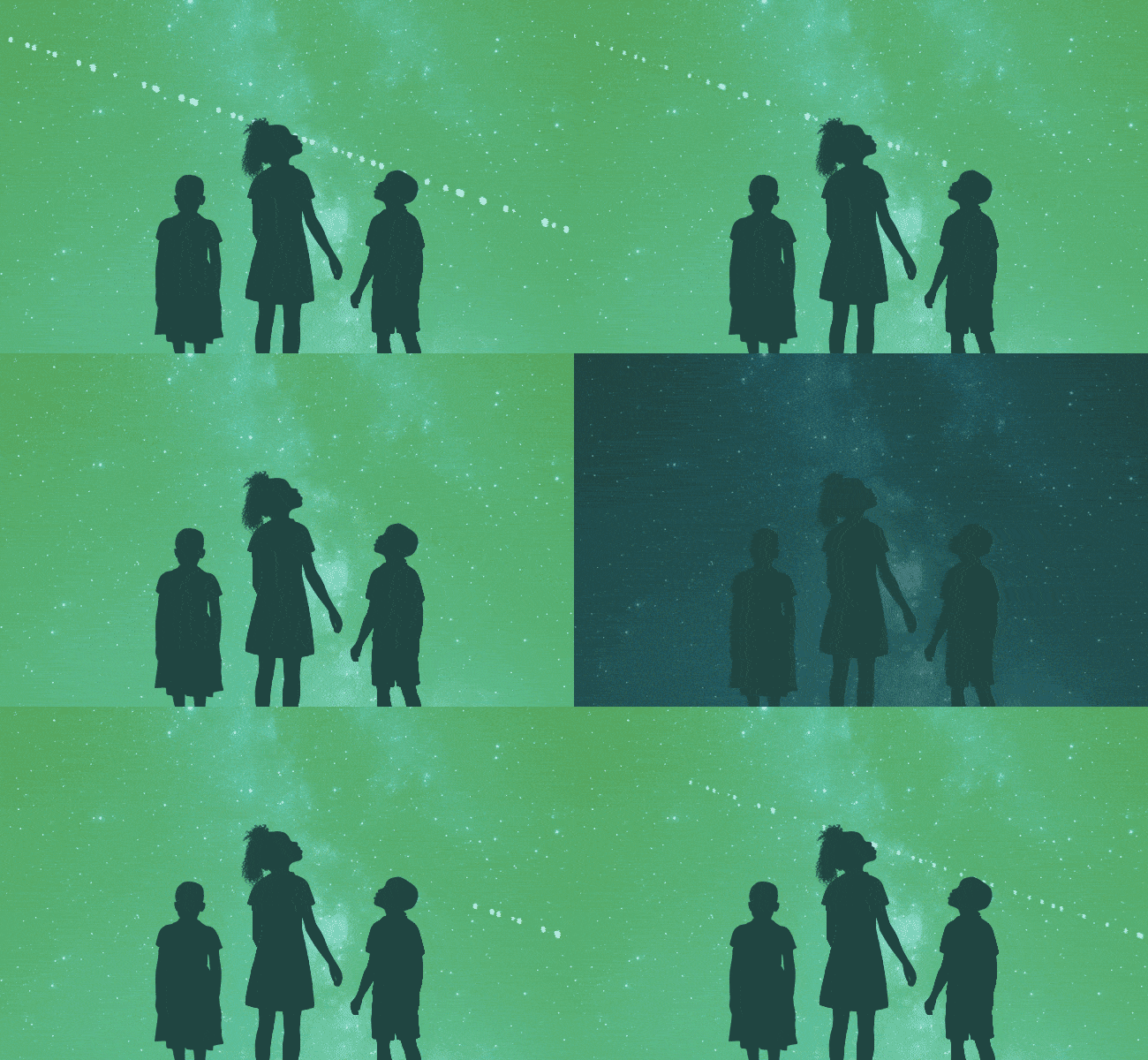
In particular, he said Starlink would provide “over 5,000 rural schools with fully-funded Starlink kits and services” and maintenance services, “impacting the lives of an estimated 2.4-million schoolchildren”.
In another letter to the department of communications last July, Goodnight cited World Bank research which demonstrated that for each 10% increase in broadband penetration, GDP growth in countries like South Africa rises by 1.21%.
“Giving millions of South Africans access to broadband would constitute one of the biggest empowerment programmes the South African government has undertaken,” he said.
So do you think, in light of this offer, that Icasa has done what it should have, which is prostrate itself at Starlink’s feet for the opportunity to help 2.4-million schoolchildren?
Well no, of course not. There is a sense that absent a swift call from an ANC politician, nothing would rouse Icasa from its glacial bureaucratic shiftlessness.
The problem is, Icasa has shown no inclination to anger the ANC – a party which has all but said Starlink should not be given the right to operate in this country.
Defining ‘empowerment’
After communications minister Solly Malatsi filed a policy proposal in December to allow “equity equivalence” for licensed companies such as Starlink, he was savaged by Khusela Diko, the high-profile ANC member who now chairs parliament’s communications committee.
Diko accused Malatsi of trying to “reverse the gains of democracy” through his efforts to soften the rules, describing his compromise as “an affront to the centuries-old fight for equity and redress by the black majority”.
She said his offer of connecting 5,000 schools “doesn’t move the needle an inch” and, this week, she said Musk must just “comply or move on”.
Elsewhere, she argued that Starlink is “not the sole or definitive solution to South Africa’s connectivity challenges, nor is it the only low earth orbit satellite provider seeking to operate” in this country. And this week, after Namibia declared that Starlink would have to sell 51% of its shares to black investors to operate in that country, Diko applauded it as “the land of the brave”.
This is perhaps not the most surprising policy position, it must be said, from someone like Diko, whose late husband scored a controversial R125m government tender for personal protective equipment during Covid.
Still, it underscores the philosophical divide between the ANC and others: for many in the party, it is only when you sell an equity stake to some individual (many an ANC-linked oligarch has got rich like this) that “true empowerment” takes place. Helping 2.4-million children, not so much.
If you’re looking for an explanation for why the ANC plunged to 40.2% in the last national poll, you’d do worse than to start here.
In this sense, the Starlink battle is more than just a battle of wills between an odious billionaire and a political party that can’t see further than its stomach; it’s a moment of truth for whether South Africa is willing to shrug off archaic ideology in favour of pragmatic growth.
ALSO READ:
- Starlink: Don’t debate Musk – debate rural connectivity
- Starlink and parliament’s theatre of the absurd
- Is Starlink set for blast-off with BEE policy shift?
Top image: Rawpixel/Currency collage.
Sign up to Currency’s weekly newsletters to receive your own bulletin of weekday news and weekend treats. Register here.







The hate by the ANC for anything US, Trump or Musk is probably because they have been called out very publicly on the BBBEE scam and Starlink does not / will not provide a snouting opportunity. It’s tragic that millions of kids in underserved rural schools are denied access to the internet because of the ANC’s spite. Roll on 2029!