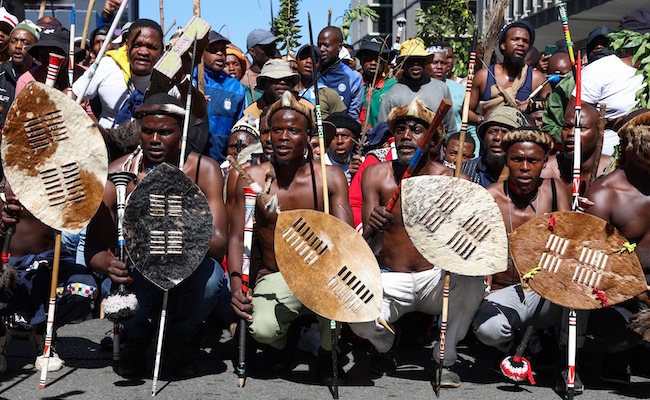

South Africa is seeing a rare and powerful sight: thousands of Zulu regiments marching through city centres in full traditional gear, carrying weapons that symbolise a warrior past.
At first glance, it looks like a show of force. The shields, the chants, the tight formations. But there is more going on beneath the surface. These are amabutho – a structured, disciplined force with deep roots in Zulu history, whose chain of command runs up through traditional leaders to King Misuzulu kaZwelithini.
That matters.
Unlike many political marches that break into chaos, the amabutho contingents have shown remarkable control amid protests in Johannesburg, Pretoria and Durban against undocumented immigration, high crime rates, and socio-economic challenges many locals blame on foreign nationals.
There was none of the looting on the scale of past xenophobic flare-ups, and the regiments themselves have largely avoided clashes with police – in some cases, officers have stood calmly alongside march leaders.
This discipline is not by accident. It is enforced.
Nkosikhona Ndabandaba, known as Phakelumthakathi, who leads many of these marches, has made it clear that violence will not be tolerated. In one widely shared video, he uses a sjambok on a supporter trying to attack foreign nationals, his message simple: the protest must stay peaceful. Inside the ranks, indunas from hostels and townships guide the movement, manage the crowd, and make sure instructions are followed.
The risks when people feel left behind
The role of King Misuzulu is central to all of this. The amabutho do not act in a vacuum. Their legitimacy comes from the Zulu royal house, and when they move in such large numbers, it signals approval from the top. That link to the king also helps explain why security forces have taken a softer approach. Authorities understand how amabutho operate. They know this is not a loose gathering but a structured system with leadership and rules.
So far, that structure has helped contain violence rather than fuel it.
But the situation is not without risk.
These marches are happening in a country under pressure. Unemployment, at 32.9%, has remained stubbornly high. Many people feel left behind. In townships and informal settlements, competition for work, space, and services is intense. Immigration has become a flashpoint in that struggle.
South Africa has laws that allow skilled people to enter the country. But in the informal economy, enforcement is weak. Documentation is often unclear. This creates frustration among citizens who feel the system is not working for them.
That frustration is now on the streets.
Civic movements and political groups are tapping into it. They call for mass deportations, demand tighter controls, and say they are putting “South Africans first”. Some of these demands are about law enforcement. But the methods used on the ground do not always follow the law.
This is where the danger grows.
It doesn’t take much to erupt into chaos
The amabutho have, for now, brought order to these protests. But they are not the only actors. Political parties and groups like Operation Dudula – the anti-migrant movement halted last November by a high court order over a violent campaign – are also present, and their approach is often more aggressive. In some cases, protests have shifted from marching to intimidation. Shops are forced to close. Migrants are targeted.
A traditional force that follows leadership and values discipline is now mixing with political and civic groups pushing a harder line. As these groups blend, the risk increases. A peaceful march can change quickly if control is lost, and once a small group sparks violence, even disciplined formations struggle to contain the chaos.
President Cyril Ramaphosa has tried to strike a balance. In his Freedom Day address in Bloemfontein on April 27, he acknowledged “legitimate concerns” about illegal migration while warning South Africans against letting those concerns “breed prejudice towards our fellow Africans”. That balance matters. It is also hard to maintain on the ground.
The deeper issue is the gap left by the state. For years, weak enforcement, poor service delivery, and slow systems have created frustration. In that gap, community movements have stepped in. They organise, they mobilise, they act. Sometimes within the law. Sometimes beyond it.
The amabutho marches sit right at the centre of this moment.
They show that large groups can organise without descending into chaos. That discipline and leadership can hold even in tense situations. But they also show how quickly things could shift.
The anger driving these protests is real. It comes from poverty, unemployment, and a sense that the system is failing ordinary people. But anger does not always find the right target. It is easier to confront a foreign shopkeeper than to challenge the systems that allow exploitation. It is easier to push out a street trader than to fix broken regulation.
That is how frustration becomes xenophobia.
Once people start deciding who belongs and who does not, outside the law, it becomes very hard to stop. Today it may be migrants. Tomorrow it could be anyone seen as an outsider.
The amabutho have shown restraint. Their link to King Misuzulu and their internal discipline have kept things calm. But the growing involvement of political groups is adding pressure that traditional structures alone cannot absorb.
The line between protest and violence is still visible. But it is getting thinner.
If the state does not step in with clear, consistent enforcement of the law, others will continue to fill the space. And not all of them will choose discipline over chaos.
For now, the amabutho are holding that line. But a line held by others is not a solution.
It is a warning.
Catch more of Zukile Majova’s viewpoints at Scrolla.Africa, a mobile-first news site covering breaking stories fast from communities across South Africa, where he is political editor, in English and isiZulu.
Listen to the latest episode of Sharp Sharp, a weekly podcast on South African politics, money, and power from Currency and Scrolla.Africa, where Zukile and Rob Rose unpack topics like this – on Spotify and Apple Podcasts now.
Top image: Gallo Images/Luba Lesolle.
Sign up to Currency’s weekly newsletters to receive your own bulletin of weekday news and weekend treats. Register here.