
White House officials are pressing China to use its influence with Iran to open the Strait of Hormuz just days before President Donald Trump and Chinese President Xi Jinping’s highly anticipated summit in Beijing.
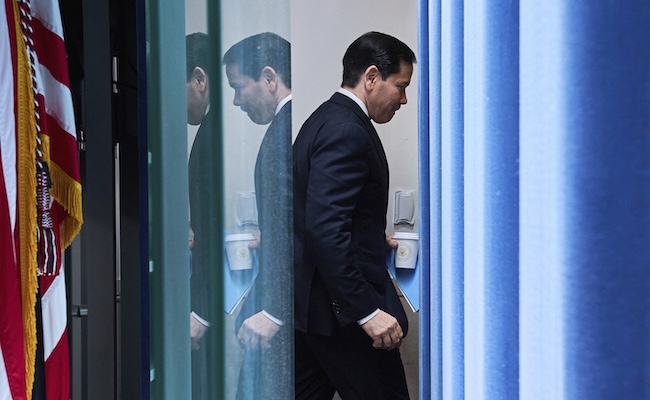
Secretary of state Marco Rubio called on Chinese officials to use Iranian foreign minister Abbas Araghchi’s visit to China to urge Tehran to release its chokehold on the critical waterway. Chinese foreign minister Wang Yi met with Araghchi on Wednesday, the official Xinhua news agency reported.
“I hope the Chinese tell him what he needs to be told,” Rubio said during a White House briefing Tuesday. “And that is that what you are doing in the strait is causing you to be globally isolated. You’re the bad guy in this.”
The secretary went on to argue that China has been hit harder than the US by Iran’s effective shuttering of the strait during the two-month-old war. Beijing’s export-driven economy depends on shipments going through the strait. China also imports about half of its crude oil and almost one-third of its liquefied natural gas from the Middle East, according to China’s General Administration of Customs.
“It is in China’s interest that Iran stop closing the strait,” Rubio said.
A diplomat familiar with the matter also told The Associated Press on Tuesday that the US has been engaging in serious efforts to persuade China to abstain from vetoing the most recent US-backed resolution at the UN Security Council aimed at opening up the strait and condemning Iran’s actions. The diplomat spoke on the condition of anonymity to discuss the deliberations.
China and Russia – Tehran’s two allies on the council – last month vetoed an earlier Hormuz resolution, saying it went too far and did not condemn the US and Israel for strikes that started the war.
Treasury secretary has also urged China to do more
Rubio’s push on China to get more involved came after treasury secretary Scott Bessent said Monday that Iran would be high on the agenda when Trump meets with Xi for the first visit by a US president to China since Trump visited in 2017.
The effective shuttering of the strait is having an enormous impact on Asia broadly, a factor that seems to have informed the Chinese government’s efforts to consult with Pakistan to help mediate a two-week ceasefire.
To be certain, Trump has said he believes China played a part in encouraging Iran to agree to a fragile ceasefire that was forged last month. Three diplomats who were familiar with China’s behind-the-scenes efforts also confirmed that Beijing, the biggest purchaser of Iranian oil, used its leverage to get the Iranians back to the negotiating table as talks wobbled.
But the Republican administration believes China can still do more to get involved in reopening the critical waterway.
“The threat of attacks from Iran has closed the strait – we are reopening it,” Bessent said in a Fox News interview. “So I would urge the Chinese to join us in supporting this international operation.”
Trump himself spoke in more measured tones about China’s involvement with Iran, telling reporters in the Oval Office earlier Tuesday that China hasn’t “challenged” him even as he continues to press Iran to give up its nuclear weapons programme and open the strait. China, however, has been critical of the US military action against its long-isolated economic partner in the Middle East.
“You know, in all fairness, he gets, like, 60% of his oil from Hormuz,” said Trump, slightly exaggerating Xi and China’s dependence on Middle East oil.
China has faced suspicions of assisting Tehran
China has long supported Iran’s ballistic missile programme and backed it with dual-use industrial components that can be used for missile production, according to the US government.
But Trump said last month that Xi had agreed to not provide weapons to Iran as reports circulated that Beijing had considered transferring arms.
Days after Trump said he received a letter of assurance from Xi, he claimed in an interview with CNBC that the US forces had intercepted a boat containing a “gift” from China bound for Iran. Trump did not offer further details.
The administration has also sought to step up economic pressure on China, Tehran’s biggest trade partner, for its ties to the Islamic Republic.
The treasury department announced on April 24 it was levying sanctions on a major China-based oil refinery and roughly 40 shipping companies and tankers involved in transporting Iranian oil. The sanctions cut off the companies from the US financial system and penalise anyone who does business with them.
Rubio says Taiwan will be on Trump-Xi agenda
Meanwhile, the Chinese have signalled they will look to press the US to dial back weapons sales to the self-ruled island of Taiwan that China views as its own breakaway province.
Rubio confirmed Taiwan would likely be part of the conversation between the leaders. “I think both countries understand that it is [in] neither one of our interests to see anything destabilising happen in that part of the world,” Rubio said. “We don’t need any destabilising events to occur with regards to Taiwan or anywhere in the Indo-Pacific. And I think that’s to the mutual benefit of both the United States and the Chinese.”
Trump in December announced a record-setting $11.1bn arms sale to Taiwan. Trump later suggested he would discuss the arms sales with Xi – a move that has alarmed officials in Taipei.
Last week, China’s foreign minister Wang, in a call with Rubio, urged the US to “make the right choices” on Taiwan in order to safeguard “stability” between the two nations, according to a statement by the Chinese foreign ministry.
Reporting by Aamer Madhani and Farnoush Amiri.
ALSO READ:
- What if Trump is (annoyingly) right?
- Truce under pressure as US fires on Iranian forces
- Iran fires on, seizes ships in Hormuz
Top image: US secretary of state Marco Rubio leaves the room after speaking to the media at the White House on May 5. Picture: AP Photo/Jacquelyn Martin.
Sign up to Currency’s weekly newsletters to receive your own bulletin of weekday news and weekend treats. Register here.