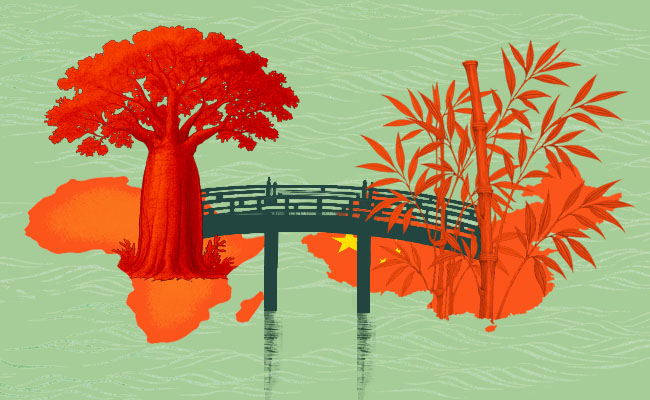

Is China’s new tariff-free access for African goods political theatre or consequential economics? The answer, irritatingly for anyone who enjoys a clean binary, is both – but probably much more the former than the latter.
The announcement is undoubtedly striking. From May 1, China removed tariffs on imports from 53 African countries with which it has diplomatic relations, leaving out only Eswatini, which still recognises Taiwan. The policy runs until April 2028 and extends a previous framework that applied to 33 least-developed countries.
Jervin Naidoo, political analyst at Oxford Economics Africa, describes this as making China “the first major economy to offer unilateral, continent-wide zero-tariff access to Africa”.
For Beijing, this is neatly timed. The US has become more erratic and protectionist on trade, Europe remains slow and rule-heavy, and Africa’s governments are looking for markets, investment and diplomatic room for manoeuvre. China’s gesture is therefore not trivial. It is a message: while the West lectures and imposes, China opens.
But the numbers complicate the celebration.
China-Africa trade reached a record $348bn in 2025, according to Chinese data cited by the Associated Press, but that figure was heavily skewed. China exported about $225bn to Africa while importing about $123bn, widening Africa’s deficit with China to roughly $102bn. That is not an incidental imbalance; it is the structure of the relationship. Africa sends China raw materials. China sends Africa manufactured goods.
The longer-term picture is no less stark. Africa-China goods trade has risen from about $11.7bn in 2000 to more than $250bn by 2022, according to the China-Africa Economic Bulletin. By 2024, SAIS-CARI, a research programme at Johns Hopkins University established in 2014 to analyse the economic, political and social dimensions of China-Africa relations, put Africa’s exports to China at $99bn, while imports from China were $179bn. The Democratic Republic of Congo, Angola, South Africa, Guinea and Zambia are the largest African exporters to China, mainly because of mineral and oil sales.
The same pattern is visible in the product mix. Naidoo’s Oxford Economics note says African exports to China remain dominated by raw materials, while imports from China are led by machinery, appliances and transport equipment. Its chart shows mineral fuels, ores and base metals accounting for the overwhelming share of China’s imports from Africa, rising over the past decade.
Naidoo’s argument is that the tariff removal could make African exports more competitive, especially agricultural exports such as coffee, cocoa, citrus and avocados, and could support higher foreign-exchange earnings. He points to the first-day example of a 24t shipment of South African apples entering China tariff-free, saving about $2,900 after the removal of a 10% duty. “By lowering barriers to entry,” Naidoo writes, the policy could encourage African producers “to expand output and diversify exports”.
That is the optimistic case. A tariff saving can matter in agriculture, where margins are often narrow and logistics costs are unforgiving. China’s consumer market is vast, and South Africa, Kenya, Ghana, Côte d’Ivoire and Morocco all have export sectors that could, at least in theory, benefit. The Associated Press reported that the policy may help cocoa from Côte d’Ivoire and Ghana, coffee and avocados from Kenya, and citrus and wine from South Africa, some of which previously faced duties of between 8% and 30%.
But Naidoo is also careful not to oversell it. The Oxford note warns that the impact is likely to be “uneven and constrained” because tariffs have not been the primary barrier to African exports. Limited industrial capacity, weak infrastructure, fragmented production systems, non-tariff barriers and logistics remain the bigger obstacles. The danger, Naidoo writes, is that the policy could reinforce existing trade imbalances, increasing export volumes without changing the structure of trade.
‘A bit overblown’
Donald MacKay, director at XA Global Trade Advisors, is blunter. In an interview conducted this week, he said the excitement about China’s opening is “a little bit overblown”.
His starting point is to divide South Africa’s exports to China into three buckets. The first, he says, is “minerals and other rocks” dug out of the ground, which account for more than 70% of South Africa’s exports to China. Most of those products already attract no duties or very low duties, so the new offer is unlikely to change much.
That matters because South Africa’s trade relationship with China is large, growing and unbalanced. The Institute for Security Studies Africa (ISS Africa) says total bilateral trade between the two countries rose from $1.34bn in 2000 to $34.18bn in 2023, but South Africa’s deficit with China had widened to $9.71bn by 2023. Since the Forum on China-Africa Co-operation was established in 2000, ISS Africa estimates the imbalance has produced an accumulated cash outflow of $114.83bn from South Africa to China.
Government figures show China remains South Africa’s largest trading partner, with bilateral trade rising from $34.2bn in 2024 to $36.4bn in 2025. But the rand-value breakdown is revealing. Wesgro data for 2023 put South African exports to China at R225.74bn, while imports from China were R404.49bn. South Africa’s largest export to China was iron ores and concentrates, worth R64.24bn, followed by chromium ores and ferro-alloys. Its largest import from China was telephone sets, worth R36.9bn, followed by electric accumulators and data-processing machines.
That is the whole relationship in one sentence: South Africa sells China ore; China sells South Africa devices.
MacKay’s second bucket is agriculture, and here he concedes there is a genuine opportunity. But he argues that tariffs are not the main blockage. The real issue is China’s sanitary and phytosanitary, or SPS, approval system. Before South African farmers can sell many products into China, Beijing has to approve the product, the pest-risk protocols and the systems designed to prevent plant or animal diseases entering China. That process, MacKay says, takes “really, really long” and can stretch to seven years. China also tends to process only one product in a category at a time.
In other words, abolishing the tariff does not help much if the product is still stuck outside the regulatory gate. As MacKay puts it, the big opportunity is agriculture, but most agricultural products are not blocked primarily because of tariffs.
His third bucket is manufactured goods, where he is most sceptical. MacKay says there is “pretty much nothing South Africa can manufacture that China can’t make better and cheaper”. That may be deliberately provocative, but the broad point is hard to dismiss. China is not merely a market; it is the world’s most formidable manufacturing competitor.
This is where the political economy becomes awkward. South Africa wants more access to China, but it is also trying to protect domestic industry from Chinese overcapacity. In March, South Africa imposed anti-dumping duties of 74.98% on structural steel imports from China and 20.32% on similar imports from Thailand. Reuters reported that imports make up about 36% of South Africa’s steel consumption, with China accounting for 73% of that.
So the tariff story cuts both ways. China is removing tariffs on African exports, while South Africa is imposing tariffs against Chinese imports in sectors where local producers are under pressure.
An asymmetric relationship
For China, the cost of the offer is limited. Its global goods exports reached $3.77-trillion in 2025 and imports were $2.58-trillion, producing a record surplus of almost $1.2-trillion. Against that, total China-Africa trade of $348bn is meaningful but hardly central – roughly 5.5% of China’s global goods trade. Africa buys about 6% of China’s exports and supplies under 5% of its imports.
For Africa, however, China is enormous. That asymmetry is the key. The offer is economically useful where exporters are already capable, certified and connected to logistics chains. It is politically valuable because it gives African governments an alternative story at a time when access to Western markets is uncertain. But it does not, by itself, industrialise anything.
Naidoo’s conclusion is measured: the policy could support diversification if African countries use it to promote value addition and build export capacity. Without that, it risks reinforcing the familiar pattern in which Africa exports raw materials and imports manufactured goods.
MacKay’s conclusion is harsher: this is not really a trade agreement in the World Trade Organisation sense, but a political instrument, “something closer to Agoa”, designed to score diplomatic points.
The fairest conclusion is that China has opened a door – but not necessarily the one Africa most needs. For South Africa, the immediate winners may be apples, citrus, wine, nuts and other export-ready agricultural products. The minerals trade will continue largely as before. Manufactured exports will remain the hardest sell. The real test is whether Pretoria can use this opening to accelerate product approvals, improve logistics, promote processing and bargain harder for investment that adds value locally.
Otherwise, the policy will do what Chinese diplomacy often does very well: cost Beijing little, earn it goodwill, irritate Washington, and leave African economies applauding a door that opens mostly onto the same old room.
ALSO READ:
- Claiming the ground beneath the elephants: Africa’s new geopolitical challenge
- Africa in 2026: Harsh trade realities, yet big growth still possible
- China’s African harvest: Trade wars are reshaping the fruit bowl
Top image: Rawpixel/Currency collage.
Sign up to Currency’s weekly newsletters to receive your own bulletin of weekday news and weekend treats. Register here.