
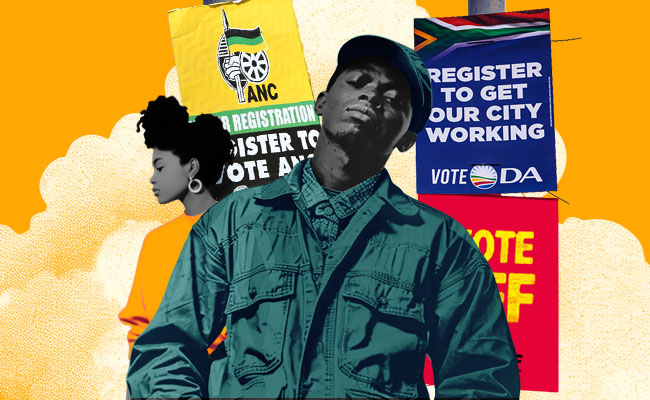

Look at any figures regarding young people in South Africa, and you might start to understand why they always complain about having a rough go of it. Youth unemployment sits at a staggering 45.8%, and the NEET rate – meaning those that are not in employment, education, or some form of training – is 38%. The average salary for matriculants entering the work force is barely over R6,000, and a troubling 40% of all credit defaulters in the country are under 35, despite this group holding only 17% of the country’s total credit.
So, it’s no real surprise that the voting levels amongst young people are critically low. While the ideals of democracy remain widely supported, there is a solid disconnect between democratic promises and tangible outcomes that is sorely obvious to young South Africans. According to data from the IEC, voter participation in the 20-29 age group has fallen from 49% in 2011 to only 35% in 2021.
“There’s this attitude of, ‘things are never going to change,’ no matter what party they vote for, so they’d rather not vote at all,” says Kea Maphila, 27, a master’s student at the University of the Witwatersrand. Decades of unfulfilled promises have taken their toll on young people who have not seen democracy work for them in their lifetime.
It’s also a basic loss of hope that things will change, concludes Neo Moliea, 24, also a master’s student at the University of the Witwatersrand. “Young people are disgruntled, disappointed, let down, poor, and unemployed,” he says. The lack of job opportunities for matriculant and graduates creates mass disillusionment for this voting demographic. “They feel like they are having doors shut in front of them.”
Disillusionment vs responsibility
Disillusionment is often the key word used to describe why young people are not voting – most often linked to service delivery failure and corruption. But, as political analyst Ralph Mathekga says, “not all political parties have failed at local government in South Africa.”
“When young people say they are disillusioned, I understand it, but I also ask myself, who else did they try? Are they just disillusioned with the ANC?”
Although she acknowledges the disillusionment problem, Maphila thinks that young people also “don’t understand the responsibility that comes with democracy.” She thinks education levels are a serious contributing factor to this: “there is a lot of ignorance around the issue of voting,” such as not understanding how to actually cast a vote or what sort of an impact it makes.
“People don’t want to vote because they don’t feel represented,” argues Cassandra Nuss, 24, a foreign policy researcher. “We don’t see any candidate or any party actually speaking to young people, though they love to talk about us,” she says. “We’re spoken about as statistics.”
Indeed, the current sitting parliament has a notably small youth demographic. Only 3% of MPs belong to the 20-29 age group, and only 8.5% of the national legislature is under 34.
Mathekga agrees that political parties in South Africa seem to not have a real grasp on what young people want to hear and seem to speak at them rather than with them.
He gives the EFF as an example: “it’s led by younger people who want to challenge the establishment…but when you listen to what they offer, you realise this party is conservative and orthodox. But their identity is such that they say they want to speak to younger people.”
He finds their identity puzzling in this regard. “You want to speak to younger people who live in the digital economy, who prefer to be in urban centres, [but] your main driving policy is to seize land? Do young people want to farm? The answer is no.”
Anyone but the ANC
That’s not to say there isn’t a small but passionate sector of the demographic that are choosing to actively engage in voting.
Moliea, who comes from the Emfuleni municipality, explains how it has been recorded as one of the worst performing municipalities in the country, and is currently running on a deficit. “I need to place my vote so that I can have a hand in influencing some sort of change,” he says.
Change seems to be the buzzword underpinning most young people’s motivation to vote. This rings particularly true for those in Johannesburg – for Okello Lester, 24, a law student, his motivation is the “utter state of hopelessness and degradation” that he has seen the city descend into.
But the reoccurring problem – and indeed, a demotivating factor for many young people – is the issue of who to actually vote in to make that change.
People seem surer of who they don’t want to vote for than who they do. The resounding sense is that young people are tired of the ANC – their enduring position in government is diametrically opposed to the youthful desire for change. But from there, there is little agreement.
“The older generation prefer the devil they know,” says Mathekga. While they are wary to change their votes, young people prefer to make a ‘control vote’ – they understand that the leading party cannot make a difference in their lives, so they vote for smaller parties that will take away that majority power. “But they are not asking, what will it do with the vote that I give it? Is it significant enough to do something?”
Many young people are opposed to ActionSA for their xenophobic rhetoric, but there is less vehement dislike for them than the ANC.
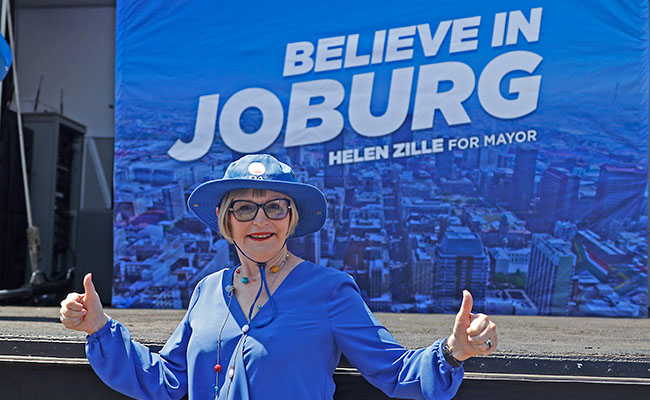
Lester “isn’t particularly excited about any existing parties,” but is swayed by Helen Zille’s experience as a candidate and the DA’s general service delivery track record. He also is keen on Rise Mzansi’s Joburg mayoral candidate, Lukhona Mguni.
Shannon Ludbrook, 23, is a member of the DA women’s network and strongly feels “they are the best option out of the bunch.”
But others that Currency canvassed are deeply opposed to the party, based on some of their foreign policy stances, and the mayoral candidature of Helen Zille. Some would vote for the EFF, while others consider it their ‘nightmare’ option. There are mentions of the MK, the GOOD party, the IFP and more – but few back any party solidly.
“I have been passively skimming through manifestos, and I still don’t know,” says Maphila. She thinks the upcoming municipal elections will be the most difficult election she will have taken part in.
Mathekga says many young people do not value manifestos these days. “The idea of the manifesto has come to nothing for them,” he argues, using the ANC as the main example. “It has not shaped the political action taken by political parties.”
Nuss says she dislikes most of the parties on offer but understands she has a responsibility to vote. “So, in the months in the lead up to voting, I have to think about what I can compromise on.”
If not the ballot box…
The problem, says Mathekga, is that “when democratic institutions fail to deliver, people are going to find alternatives. These include mass protests, social media campaigns, and occupy movements. South Africa has already seen this begin to creep into politics, with the likes of the anti-migrant movement, March and March, as a worrying example.
“Political parties remain the best way to organize concerns that people have and be able to channel them in a way that creates a harmonious society,” Mathekga argues.
But if parties keep breaking their promises, squabbling, stealing, and fighting, it’s no wonder that young people are losing faith in the entire electoral system.
Top image collage: Per-Anders Pettersson/Getty Images (DA voter registration poster); Lefty Shivambu/Gallo Images via Getty Images (ANC voter registration poster); Rawpixel; Currency.
Sign up to Currency’s weekly newsletters to receive your own bulletin of weekday news and weekend treats. Register here.








What a depressing bunch…. all that education and they don’t seem to have half a clue between them.