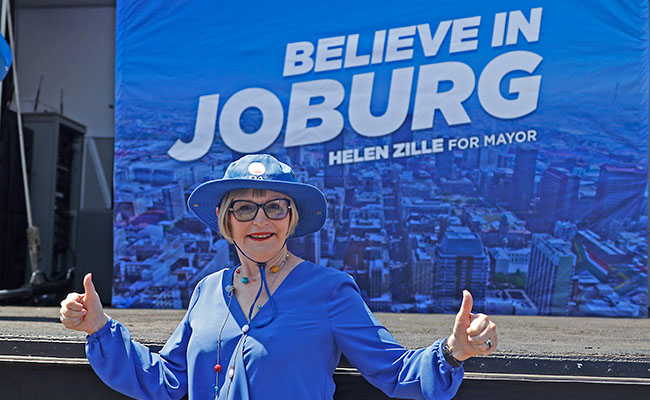

Helen Zille is running the strongest campaign in Joburg, but she is not yet winning the coalition war.
The DA can finish first in November 4’s municipal elections and still watch an ANC-led alliance elect the mayor. To win outright remains a tall order.
Zille must recover the 250,000-odd votes the DA lost after 2016, hold coloured voters against the Patriotic Alliance (PA), defeat ActionSA in the suburbs and achieve the breakthrough among black middle-class voters that the DA’s racial politics has repeatedly frustrated.
She wants to rescue Joburg from years of decline and return South Africa’s economic capital to a stable government. Yet even if the DA wins the most votes in less than four months from now, Zille could still find herself locked out of City Hall.
That is the paradox shaping Joburg’s municipal election. Winning the election and winning the mayor’s chain are no longer the same thing.
Coalition politics has changed everything.
Joburg is heading into what is likely to be another hung council. No single party appears capable of securing the 136 seats needed for an outright majority in the 270-seat council. Instead, the city’s next government will almost certainly be decided after election day, when political parties begin negotiating behind closed doors.
The DA enters the race with momentum but also with unfinished business.
In 2016, the party came within touching distance of taking Joburg outright after winning close to 480,000 votes. Five years later, that support had collapsed to about 240,000 proportional representation votes. Some voters stayed home. Many defected to Herman Mashaba’s ActionSA. Others drifted to smaller parties.
For Zille to achieve her ambition, the DA must recover much of that lost support.
That means persuading former DA voters that returning to the party offers the best chance of changing Joburg’s fortunes. It also means holding onto traditional supporters while expanding into communities where the party has historically struggled to gain traction.
There’s a new kingmaker in town
The DA’s biggest challenge is no longer defeating the ANC. It is rebuilding the broad coalition of voters that briefly made victory seem within reach almost a decade ago.
The political landscape, however, has changed dramatically since then.
The biggest new variable is Jacob Zuma’s MK Party.
MK did not exist during the 2021 local government elections. Yet in the 2024 provincial election, the party won more than 172,000 votes in Joburg.
Those votes came largely at the ANC’s expense.
At first glance, that appears to benefit the DA because it weakens the ANC’s ability to finish first. But the reality is more complicated.
Every new party that enters the council makes coalition negotiations more complex. MK may reduce the ANC’s vote share while simultaneously increasing the number of parties that could participate in an anti-DA coalition after the election.
That is why the municipal contest cannot be understood simply as a race between the DA and the ANC. It is becoming a contest between competing coalition blocs.
The by-election results since 2021 reinforce this picture.
The DA remains exceptionally strong in its traditional suburban heartlands. It continues to win overwhelming majorities in wards across the city’s northern suburbs, demonstrating that its core support remains loyal.
Where the party has found progress more difficult is outside those traditional strongholds.
The breakthrough in Evaton earlier this year, where the DA narrowly won a township ward from the ANC in the Emfuleni municipality, suggested that the party can attract black working- and middle-class voters who are frustrated by collapsing public services. But one victory does not signal a political realignment.
A rising threat from another corner
More telling is Joburg itself.
Despite holding its suburban base comfortably, the DA has not won a single Joburg by-election from another party since the 2021 municipal elections.
Another party has.
The PA has quietly become one of the biggest winners of the coalition era. It has taken wards from both the ANC and the DA, steadily increasing its bargaining power.
The PA may not emerge as one of Joburg’s largest parties. But in a fragmented council, even a handful of seats could determine who becomes mayor.
This is precisely why Zille’s task extends beyond campaigning.
She must also convince potential coalition partners that a DA-led administration would be worth supporting.
That may prove more difficult than winning votes.
Relations between the DA and ActionSA remain strained after years of unstable coalition governments in Joburg and Tshwane. Smaller parties have frequently accused the DA of adopting a dominant approach to coalition management, while the DA argues that many partners have prioritised positions over governance.
Those tensions have contributed to the revolving door of mayors that has characterised Joburg over the past five years.
The ANC has shown greater flexibility.
Though its alliances with the EFF, Al Jama-ah and other smaller parties have often been unstable, they have repeatedly succeeded in one objective: preventing the DA from governing South Africa’s biggest metros.
MK now introduces another possible partner into that equation.
National politics should not be confused with local politics. Parties that are fierce opponents in parliament have repeatedly found ways to work together in municipal councils when power is at stake.
For the DA, therefore, becoming the biggest party may only be the first hurdle.
The second is assembling a stable governing majority before its rivals do.
The DA needs voters to make their mark
That brings the focus back to turnout.
The DA’s clearest route to power is not necessarily persuading large numbers of ANC supporters to switch sides. It is motivating former DA supporters who stayed away in 2021 to return to the polls.
If those voters come back in significant numbers, the DA moves closer to governing.
If they stay home, coalition arithmetic begins to favour everyone else.
Joburg’s election is often described as a referendum on service delivery. It is certainly that. Residents are living with failing infrastructure, water shortages, electricity interruptions, deteriorating roads and declining public confidence in local government.
But politically, this election is about something even bigger.
It is a referendum on whether coalition politics can produce a stable government.
Zille is presenting herself as the experienced administrator who restored confidence in Cape Town and the Western Cape. Her campaign is built on competence rather than ideology.
Whether that message resonates beyond the DA’s traditional support base remains the defining question of the campaign.
One thing, however, already seems clear. Joburg is unlikely to produce a decisive winner.
The city will almost certainly produce a complicated negotiation.
The DA could finish first. The ANC could finish second. MK could reshape the balance of power. The PA and other smaller parties could become kingmakers.
When the votes have been counted, the battle for Joburg may only just be beginning.
That is why Zille can win the election and still lose City Hall.
ALSO READ:
- Zille, and Joburg’s battle for belief
- Zille at 39% for Jozi, ANC voters want Motsepe
- Real Politics: voters want service delivery, not ideology
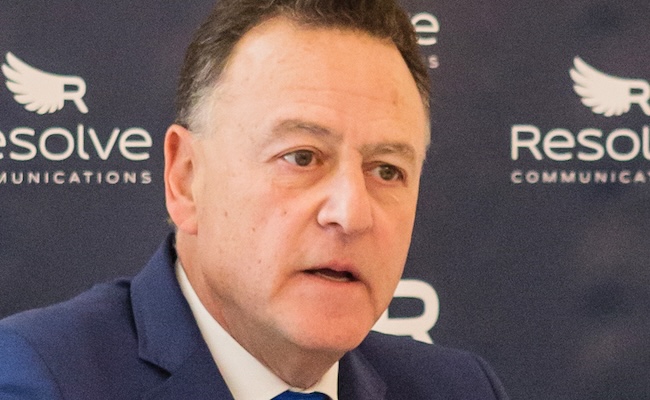
Top image: Helen Zille. Picture: Gallo Images/Sharon Seretlo.
Sign up to Currency’s weekly newsletters to receive your own bulletin of weekday news and weekend treats. Register here.