
Standard Bank’s grand experiment of becoming the first bank in Africa to handle payments directly in Chinese renminbi has paid off better than most people expected.
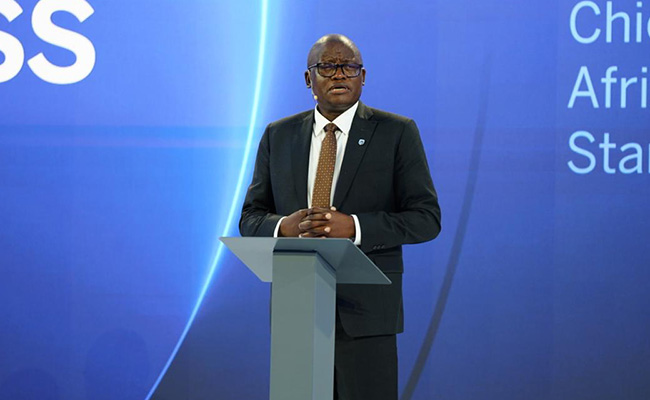
Speaking at the Africa Unlocked conference at the Norval Foundation yesterday, the bank’s CEO for Africa, Lungisa Fuzile, said that from nowhere, it cleared $500m in trades in the Chinese currency in just four months this year. “Annualise that, and you get the picture,” he said.
This suggests deep demand, after Standard became the first African bank to use China’s interbank payment system to settle transactions directly in yuan in November.
What this means practically is that until last year, a manufacturer in South Africa or Uganda buying goods from China would have first had to switch currencies from rands to dollars or euros, and then back to yuan to make the payment.
“This reduces trading risk involved in hopping from your own currency to the dollar, then to renminbi. And the transaction costs of doing that are high, so if you can cut out that red tape, it’s better for everyone,” Fuzile tells Currency.
In one sense, it’s an obvious step, given the surge in trade between Africa and China, which hit $348bn last year – 17.7% annual growth. China’s decision in May to reduce tariffs on 53 African countries to zero is likely to only accelerate this growth.
And while Standard Bank’s renminbi-settled transactions are still relatively small in the wider context, it is the precedent that has outsize importance.
With countries looking to find new trading partners in the aftermath of US President Donald Trump’s sabre-rattling over tariffs, and the prospect of the dollar’s value falling as an overindebted US prints more money, any shift away from the dollar is keenly watched.
Reducing friction
JPMorgan, the large US bank, last year warned that this trend is partly about a response to the “perceived safety and stability” of the dollar.
“Increased polarisation in the US could jeopardise its governance, which underpins its role as a global safe haven. Ongoing US tariff policy could also cause investors to lose confidence in American assets,” it said.
Equally, South Africa’s partners in Brics, Russia and China, have also ploughed a lot of political capital into trying to push alternative currencies, like the renminbi, in part for fear that sanctions could see them iced out of the financial system.
Last month, China’s central bank, the People’s Bank of China, released a new plan to insert the yuan into a greater proportion of the world’s financial architecture.
But Fuzile says his bank’s move isn’t part of a grand de-dollarisation strategy, but rather an economic decision to lubricate specific transactions for the bank’s customers.
“It’s about efficiency. And, look, the dollar is still the reserve currency, a position of dominance it got to not by political decree, but rather because of its economic utility. So this doesn’t just vanish,” he says.
Bill Blackie, CEO of business and commercial banking at Standard Bank, agrees, but says changing global trade patterns have diminished the dollar’s utility in the margin of the global financial architecture.
“This is what our customers want,” he tells Currency. “If you look across Africa, a high proportion of inputs are coming directly from China, and a high proportion of trade, including agricultural products, goes back to China.”
Certainly, reports of the dollar’s demise are exaggerated. Standard Bank’s move relates to a small amount of the overall trade it facilitates, and as much as the Chinese Communist Party would want the world’s trade to happen in yuan, this switch remains slow.
Foreign Policy magazine, in recent weeks, said that while China now settles 30% of its trade in yuan, up from zero in 2010, only 5% of global trade is settled directly using this currency.
There are two main reasons. First, Beijing’s restrictions “make it costly and impractical for foreign firms to source and hold the renminbi that they would need to pay Chinese suppliers”.
Outside China, yuan deposits amounted to just $234bn by early last year – less than 2% of the $15-trillion in dollars outside the US, the magazine said.
Second, renminbi settlement relies on an “inconveniently small network of clearing institutions and correspondent banks”. Standard Bank’s move will push this dial forward, but only incrementally.
Ultimately, says Blackie, this isn’t about the bigger picture, but rather about providing another option for the 1-million or so companies banked by the institution in 21 African countries (including South Africa).
“This is just about reducing friction. In the wider landscape of our total trading volumes, it’s small. But you have to start somewhere,” he says.
ALSO READ:
- Standard Bank’s next target is Tshabalala’s last big test
- Why Standard Bank is betting big on the Middle East
- Torching the dollar: the thinking behind Trump’s massive tariff gamble
Top image collage: Standard Bank’s Lungisa Fuzile. Picture: supplied.
Sign up to Currency’s weekly newsletters to receive your own bulletin of weekday news and weekend treats. Register here.