

The image of busloads of desperate foreigners clutching their belongings and leaving South Africa as the populist hounds bark their vitriol is a shameful one that speaks volumes about South Africa’s failure to deal with the illegal immigration crisis properly.
The failure does not belong to the department of home affairs, which has been working hard to restore border integrity and rid itself of the curse of corruption that has dogged it for decades. The government has a sensible policy of providing documentation to those who can legitimately visit the country and working to get illegal migrants regularised or returned to their home countries.
It is a policy that has been undermined by corruption and inefficiency, both of which the new home affairs administration is attempting to fix by sorting out the Border Management Authority. Home affairs is dealing with the technocratic dimensions of the immigration issue.
The true cause of the failure lies elsewhere, closer to the root cause of the problem: the failure of the regional hegemon to use its substantial weight to prevent state failure in Zimbabwe, Mozambique and Tanzania, and beyond. This is the cause of the floods of desperate people seeking refuge from collapsed economies and the absence of state services.
For two decades, South Africa has set aside its democratic and human rights principles and folded its arms while its neighbours have descended into autocracy and economic disaster. The chickens of that policy have come home to roost in the form of millions of economic and political refugees.
Ramaphosa’s political love-fest in Zim
There can be no greater illustration of this malaise than President Cyril Ramaphosa’s recent chummy visit to the farm of Zimbabwe’s wannabe dictator, Emmerson Mnangagwa, where he was seen hanging out with an elite that has turned that country’s economy into a hollow shell while a gormless elite gorges at the high table.
There was the architect of South Africa’s democratic constitution in a political love-fest with a man who was in the midst of amending his constitution to ensure his perpetual rule even as crackdowns on opposition figures and meetings were under way.
Ramaphosa had nothing to say about this development. What was important was that he and Mnangagwa were making couchfuls of money from their agricultural endeavours.
Ramaphosa’s pusillanimous silence extends to one of the most egregious instances of election rigging ever recorded. In Tanzania, the leader of the opposition, Tundu Lissu, was arraigned on treason charges six months before the election and held in prison, and his party was banned from participating. When youth protested, they were mowed down in their hundreds, according to an official inquiry that somehow failed to identify the perpetrators despite vast video evidence of state violence. The opposition believes the number of dead runs into the thousands. While cameras showed deserted polling stations as a nationwide boycott took effect, President Samia Hassan declared herself the winner with 98% of the vote, a statistic so absurd that nobody could take it seriously.
Well, almost nobody. A month after this disgraceful election, Ramaphosa assumed the chairmanship of the Southern African Development Community (Sadc).
One of his first actions was to issue a Sadc communiqué that was silent on human rights abuses, the rigged election, the treason trial and the thousands who died. Instead, it congratulated Hassan on her election victory. Lissu remains on trial as the treason farce drags out, an African prisoner of conscience. But South Africa, whose leaders suffered detention and imprisonment in political trials, is totally silent.
More of the same
Further afield in Uganda, another rigged election, leaving hundreds killed or arbitrarily arrested, got under way in January. A leading opposition figure, Kizza Besigye, was suffering the same fate as Lissu, and was on trial for treason. Another leading opposition figure, Robert Kyagulanyi Ssentamu, popularly known as Bobi Wine, campaigned on, suffering banned meetings, harassment and attacks on his supporters by security forces. Not content with claiming victory in yet another rigged election, the state hounded Wine and his wife, who was subjected to assault, until he had no choice but to leave the country, fearing for his life.
Perhaps it was the chummy relationship between Ramaphosa and that country’s dictator, Yoweri Museveni, that caused South Africa to be totally silent on this outright assault on democracy. After all, it was from Museveni that Ramaphosa acquired a herd of sought-after Ankole cattle.
In that country, the president’s wayward son and defence force chief Muhoozi Kainerugaba has just closed down leading Ugandan media outlets and proclaimed that all news coverage must be government-approved.
According to Reporters Without Borders: “Lightning has struck Uganda’s media landscape. Just hours after the country’s chief of defence forces, general Muhoozi Kainerugaba, posted on X that the president had ‘approved [his] plan to close both NTV and Monitor’, soldiers were deployed overnight to Nation Media Group’s headquarters and to the Kampala studios of the group’s television stations NTV Uganda and Spark TV. Troops took up positions outside the premises of the country’s leading media group and one of the largest in East Africa, blocked access to the buildings and cut off electricity.”
In Muhoozi’s words: “From now on, ALL bad stories about Uganda have to be cleared by my office! In Uganda, I DO NOT believe in a free press! The press should be guided by cadres of the revolution.”
A more egregious public assault on democracy is hard to imagine. But to South Africa, this occurrence is not worthy of comment or intervention.
Further north, in Sudan, South Africa is playing a weird and questionable role. Even as the government’s lawyers were taking Israel to the Hague over Gaza (the only global conflict deemed worthy of righteous indignation by Pretoria), Ramaphosa entertained Sudan’s Rapid Support Forces commander Mohamed Hamdan Dagalo Musa in Pretoria in January 2024. Apparently that organisation’s role in genocide in Sudan was not worthy of Ramaphosa’s attention.
Silence is a deliberate choice
Pretoria has been sitting on its hands, refusing to take up its regional leadership role in the face of rising autocracy and economic disaster. While the elites in Zimbabwe, Mozambique and Tanzania – all part of a chummy organisation called the Former Liberation Movements of Southern Africa – are trashing democracy and impoverishing their citizens, South Africa is happy to pretend that nothing is happening.
What the state fails to understand – or chooses not to – is that the regional instability being caused by Ramaphosa’s chums is directly related to South Africa’s illegal immigration crisis.
Rather than face starvation in the Zimbabwean countryside or the brutal repression meted out by “liberation movements” in Mozambique, Tanzania, Sudan and Uganda, people choose to seek a better life elsewhere. And South Africa is their destination of choice.
Just as the agenda in these regional movements is not growth or jobs, but power and its access to privilege, South Africa, too, has fallen into the same trap domestically. The desperation of migrants and the anger of South Africans is because there is insufficient economic growth and that, in turn, reflects government’s priorities and its unwillingness to make hard choices. And contrary to those who believe a big man model of benevolent dictatorship is the way forward, the results show that this model is neither benevolent nor productive – and that the worse the democracy, the worse the growth and development outcome.
It is axiomatic that the only way to stop the tide of illegal immigration is by becoming serious about growth and about South Africa’s regional role, speaking out against violent states and supporting democrats who want to bring accountability and people-centred governance to these countries. Sending people home by the busload is not going to change anything save worsening misery.
Silence is not a sin of omission. It represents a deliberate choice to reward elites that are destroying their countries and seeking enrichment. South Africa has become an enabler of autocracy in Southern Africa through its quiet tolerance of repression.
Ray Hartley and Greg Mills are with the Platform for African Democrats.
ALSO READ:
- Africa’s next Idi Amin rises as Uganda sinks
- Ramaphosa’s imploding presidency imperils the country
- Myth-busting: why foreigners aren’t taking local jobs
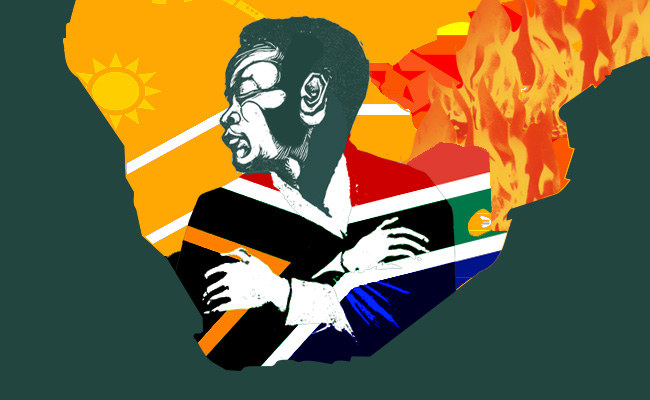
Top image collage: Wikimedia commons/WwJLaik; Rawpixel; Currency.
Sign up to Currency’s weekly newsletters to receive your own bulletin of weekday news and weekend treats. Register here.