

Look a little closer and you may notice how our top three grocery retail groups – Shoprite, Pick n Pay and Woolworths – are a little ambivalent about the gung-ho growth of their on-demand grocery delivery. They seem simultaneously boastful and embarrassed. Each one loudly proclaims their financial success, but search for formal details about this rapidly growing industry, and you will have little joy.
In Shoprite’s case, Sixty60 “continues to disrupt the South African retail market, growing sales by 47.7% and expanding its reach in general merchandise, selected Shoprite stores and in Petshop Science and Medirite Plus”, said CEO Pieter Engelbrecht in the 2025 annual report. Sales from the platform were R11.9bn, up 34.6% in the 26 weeks to December 28. Better still, says Shoprite, Sixty60 is now contributing to group profits.
Over at Pick n Pay, CEO Sean Summers is also evidently proud of asap!, though more reticent about disclosing absolute figures. In financial 2026, Pick n Pay’s online turnover growth was 32.7%, and the second straight year the online business was profitable.
At Woolworths, where Dash recorded an impressive 41.6% surge in sales in financial 2025, growth in the first half of 2026 was more muted at 23%. It has been making a profit since 2024.
Yet there is an inescapable image problem – a situation that the recent anti-immigration March and March protests have made worse.
Motorbike gang
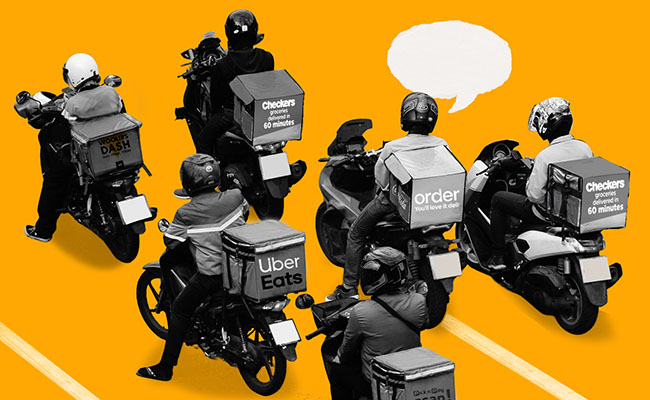
While on-demand delivery has proved hugely popular, almost every South African road user has a grim and often dangerous story to tell about their experience with a delivery motorbike. Not for nothing are they described as the country’s largest motorbike gang.
Then there’s the riders’ employment status. Drivers are described as “independent owner operators” and are contracted to render a delivery service. Essentially, they are contracted on a per-delivery basis and can use their own motorbikes or hire them. That means, as labour attorney and DA MP Michael Bagraim explained to a BusinessTech journalist, “they get no benefits whatsoever and have no protection of our labour law”.
Kwanele Ngogela, head of research at shareholder activist Just Share, tells Currency the independent contractor model isn’t incidental to how Checkers, Pick n Pay, Woolworths and others operate these services; “it’s fundamental to the business model”.
“What’s happening isn’t simply outsourcing, it’s a redesign of the employment relationship. Through platform technology and intermediary companies, retailers can exercise a high degree of operational control while distancing themselves from many of the legal responsibilities that ordinarily accompany an employment relationship,” he says.
That’s not to say that there is anything especially South African about this; as Muneer Ahmed, chief investment officer at Aeon Investment Management tells Currency, millions of people across the world work in the gig economy in precisely the same precarious conditions.
Gateway for urban work
But there’s an additional dimension in South Africa. Unlike a formal job, there are minimal requirements; employees need only have a valid driver’s license, access to a motorbike, a smartphone and the ability to use the delivery platform. This makes it one of the most accessible entry points into urban work for both South Africans and migrants, with an estimated 70% of drivers believed to be migrants.
According to the Checkers Sixty60 application website, applicants are asked to specify their identity document type; they need to select if they have a South African identity document, a work permit or asylum visa, and whether or not they have a motorbike or car.
At the Shoprite 2024 AGM, chair Wendy Lucas-Bull told Just Share that only 23% of the 6,000 drivers were South African, attributing the low figure to the high-risk element of the job.
“In the first 10 weeks of training 80% of South Africans drop out and by the end of the training only 8% of the South Africans are left,” she told shareholders. She said the group is doing a lot to attract more South African drivers, but according to exit interviews “South Africans don’t view the job as one they want to do, it is well paying but high risk”.
It was one of the very few times corporate South Africa spoke openly on the social dimensions of the service. And perhaps the last.
Hardly surprising, given the heated response to Lucas-Bull’s comments. The claim the work was well paid was not backed by any figures, though the Shoprite chair dismissed media reports of gross pay being between just R3,000 and R7,000 a month – before drivers deduct their own costs. (Woolworths’ figures indicate the average driver nets around R9,000-R10,000 a month.)
It’s not too difficult to find stories of Checkers Sixty60 drivers delivering takeaways in the evening through the UberEats platform, using Sixty60 branded motorbikes. They cite low pay as a reason for working multiple jobs that span well over 12 hours, where the standard working hours in South Africa cannot go over nine hours in one day, across a five-day period, according to the Basic Conditions of Employment Act.
The March and March angle
In the past two years, Shoprite has managed to bump up the South African component to 30% (of currently about 11,000 riders). But it’s a far cry from anything that would placate the parties behind the March and March campaign.
On-demand delivery drivers were a particular target of organiser Jacinta Ngobese-Zuma, ahead of the June 30 “deadline” for undocumented migrants to leave South Africa. And anecdotal reports since suggest that large numbers of foreign drivers did indeed leave the country, with an apparent resultant slew of job openings.
In some quarters, calls for business to be held accountable for the number of foreign nationals they employ are growing more strident. One of the most outspoken is ActionSA leader Herman Mashaba.
“One day we are going to review the applications of people who come into South Africa to drive scooters because no immigration laws allow such skills to qualify to be in this country,” he tells Currency. Mashaba says he’s grateful and proud of the role that March and March and others are playing in reserving jobs for South Africans.
So it’s understandable why companies are so reticent to talk about anything other than turnover and profit. Asked about issues around the March and March protests, Shoprite’s response was a rather terse: “We will not be commenting.” Woolworths was a wordier reference to the sensitivity of the issue and the need for confidentiality to protect its drivers. Pick n Pay’s was a pithy statement saying it will continue to monitor the environment.
Yet Ngogela tells Currency he suspects the reluctance to comment reflects more than just reputational sensitivity. “Once companies publicly acknowledge responsibility for drivers’ working conditions or safety, they move closer to acknowledging the degree of control they exercise over those workers. That inevitably feeds into the broader question of whether these workers are genuinely independent contractors or employees in substance.”
ALSO READ:
- The death dash
- 31 minutes, R18.9bn: Sixty60 is making Shoprite’s numbers sing
- Spare me your ‘lived experience’
Top image collage: Pexels/Markus Winkler; Rawpixel; Currency.
Sign up to Currency’s weekly newsletters to receive your own bulletin of weekday news and weekend treats. Register here.