
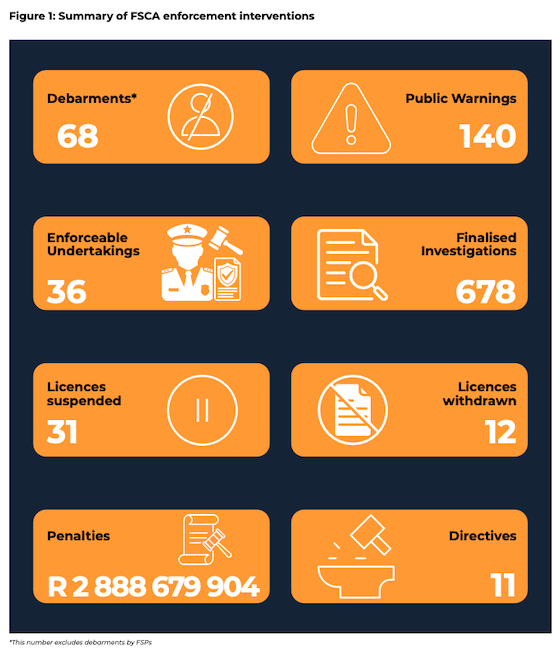
The latest annual report from South Africa’s financial regulator, the Financial Sector Conduct Authority (FSCA), shows a spectacular increase in administrative penalties – to R2.89bn in the year to March, from just R119.8m the previous year – with the organisation warning that increasingly sophisticated criminal networks are moving beyond simple online scams and infiltrating apparently legitimate, licensed financial institutions.
The huge R2.9bn penalty haul is slightly misleading because it was dominated by a handful of cases, led by Banxso, where deepfake advertising allegedly channelled customers into a licensed financial-services business that the FSCA said misappropriated their money.
But FSCA deputy commissioner Katherine Gibson said the Branxso case is illustrative of shifts from a world of individual criminals operating in isolation to “complex and mature crime networks supported by machine intellect, which brings speed, scale and accuracy in crime”.
In its report, the authority said it imposed penalties on 76 people and entities across 62 cases and finalised a record 678 investigations, up from 633 during the previous period. At the presentation of the report, Gerhard van Deventer, the FSCA’s divisional executive of enforcement, cautioned that the increase was not evenly spread across the regulator’s caseload.
Financial Advisory and Intermediary Services Act penalties were dominated by two major cases, Banxso and Medbond, while the market-abuse total was driven largely by a single separate matter.
The most significant was Banxso, the online trading company that became the regulator’s main example of what can happen when the distinction between a licensed financial institution and an online scam begins to collapse.
“The biggest issue of concern here is that this was a licensed entity in South Africa. They applied, they looked good, they qualified, and they were given a licence,” Van Deventer said.
“In my view, they were infiltrated,” he said, before becoming linked to deepfake advertising that routed potential investors to Banxso representatives.
Deepfakes
The FSCA began investigating Banxso in 2024 following information about online advertisements associated with an investment offering known as Immediate Matrix.
The advertisements used manipulated images and identities of prominent people to lend credibility to promises of unusually high investment returns. People who responded were directed to Banxso representatives and encouraged to trade contracts for difference, or CFDs – highly geared derivatives through which investors bet on movements in the prices of shares, currencies or other assets.
The FSCA said its investigation found that Banxso had directly or indirectly participated in, or materially benefited from, the deceptive advertising. Customers were given misleading information about potential returns and encouraged to trade CFDs, complex instruments that the FSCA regards as unsuitable for most retail investors.
More seriously, the authority said client funds were not placed with legitimate liquidity providers or authorised over-the-counter derivatives providers. Instead, the money was controlled internally, mixed between accounts, made difficult to trace and used for personal and business expenses.
The FSCA provisionally withdrew Banxso’s licence in October 2024 and withdrew it finally in July 2025. The Western Cape High Court subsequently placed the company into provisional liquidation in August 2025 and final liquidation in March this year. The court found Banxso had no employees or business premises, could no longer trade legally, and was “factually and commercially hopelessly insolvent”. It said the FSCA’s bank-account analysis provided compelling evidence that the business had not operated as represented to customers.
Investors before the court had claims exceeding R70m, while a related company, Flamingo Clearing House, claimed another R67.2m. Banxso had about R70m in its bank accounts, according to the judgment.
The FSCA imposed penalties exceeding R2bn on Banxso and several of its key people. The central R2bn order was imposed jointly and severally on Banxso and directors Harel Adam Sekler and Warwick David Sneider, with additional penalties imposed on the company and other individuals. The regulator also withdrew the licence and imposed debarments of up to 30 years.
Banxso and its key people initially challenged the withdrawal of the company’s licence, but the financial services tribunal dismissed those applications in December. Five individuals subsequently applied for reconsideration of their penalties and debarments, and those proceedings remain pending.
The investigation was also referred to the Hawks for consideration of possible criminal proceedings.
But the eventual recovery by Banxso customers remains uncertain. Van Deventer said the FSCA had asked the Financial Intelligence Centre to freeze bank accounts containing about R100m, and had helped the Asset Forfeiture Unit obtain a preservation order. The preserved money was ultimately transferred to Banxso’s liquidators.
However, the liquidation falls outside the FSCA’s direct responsibility.
“We don’t actually get involved in the liquidation process,” Van Deventer said. The difference between penalties imposed and money actually recovered is an important qualification to the FSCA’s record penalty figure. Administrative penalties become civil debts owed to the regulator, which can register them as high court judgments and use ordinary collection mechanisms.
But Van Deventer acknowledged that while some penalties were paid in full and others in instalments, some were eventually written off because the money could not be recovered. The FSCA’s integrated report is expected to provide details of collections, impairments and write-offs.
Captured, infiltrated, repurposed
The Banxso case presents the regulator with an uncomfortable consumer-protection problem.
The FSCA routinely advises members of the public to check whether a business is licensed before investing. Yet Banxso was licensed, meaning that the very test consumers were encouraged to apply would initially have reassured them.
Gibson said the FSCA is not a general regulator of every scam in South Africa. Its primary responsibility is the conduct of financial institutions. That makes the integrity of licensed firms – and the ability to detect changes in their ownership, management, customer-acquisition methods and movement of client funds – central to its mandate.
The implication is that licensing can no longer be regarded as a once-off regulatory gateway. Firms that appeared legitimate when applying may later be captured, infiltrated or repurposed by more sophisticated networks.
ALSO READ:
- Swindled: why no-one ever sees con artists coming
- PODCAST: Regulating the rise of AI in financial services
- Kretzschmar ‘coping’ in Sun City, as FSCA wraps up probe
Sign up to Currency’s weekly newsletters to receive your own bulletin of weekday news and weekend treats. Register here.