
As offshore oil potential, green hydrogen and foreign investment surge, Namibia is radically redefining its balance of power relative to economic giant South Africa.
The Namibia-South Africa Binational Commission held in Pretoria in July, saw both countries sign a raft of agreements. From air services and labour to economic partnerships, all were designed to boost trade and investment ties.
Experts remain cautiously optimistic.
Lydia Nghaamwa, a Namibian trade and energy law specialist, says: “Namibia is no longer the junior partner in this relationship. Its ports, its critical minerals and the Orange Basin have made it increasingly central to South Africa’s industrial and energy planning, and this commission reflects that shift.”
Geopolitical importance and legal commitment are, however, two different things, she says.
“The real measure of success will be whether governments convert political commitments into predictable and binding legal frameworks that provide certainty for investors, enable meaningful private sector participation, and ensure that the economic benefits of regional co-operation are felt not only in boardrooms and capitals, but also by ordinary citizens, including those living in the most remote communities,” Nghaamwa says.
Changing relations
Professor André du Pisani, from the department of political science at the University of Namibia, says bilateral relations between Namibia and South Africa, while undergoing change, must be historicised.
“Not only was Namibia under South African neocolonial control for 75 years, but the country shares a border/frontier of 855km with its bigger and more powerful southern neighbour,” he says.
The longstanding dispute over the Orange River boundary between the countries remains unresolved; a final border agreement between the two states has been outstanding since Namibia’s independence in March 1990.
Recently, this matter was elevated to the respective presidents for further negotiations and a final decision to be ratified by the parliaments of both countries.
“Borders are more than geographic logic, they are cultural and social constructs, central, in this case, to Namibia’s economic and political fortunes. The //Gariep [Orange River] is a lifeline for water, diamond mining, agriculture and tourism,” Du Pisani says.
South Africa is Namibia’s largest trading partner, with 29% of total exports going to that country, followed by China with 24%, the academic says. In tourism, South Africa remains one of Namibia’s most important feeder markets.
But relations between the two countries are changing as they navigate complex transitions towards cleaner energy, technological advancement and enhanced supply-chain economics in critical minerals and potential carbon exploration in Namibia.
“These developments will bring more states and multinational corporations into the equation and will impact, over time, investment regimes, technological transfer and local human and productive capacity. Superpowers such as the US and China will deepen their engagement with Namibia,” Du Pisani says.
He says Russia as a great power, largely for symbolic reasons that hark back to the more recent liberation struggle, will also attempt to benefit from recent carbon discoveries and from a decision by the Namibian government to go nuclear.
“Currently, uranium exports make for 31.1% of total Namibian exports – all to China,” he says.
The rivalry of strong states for access to and control of both countries’ mineral endowment is likely to impact the political economy of the Southern African Development Community as much as it may recalibrate some aspects of bilateral relations between Namibia and South Africa, Du Pisani says.
Going big on oil
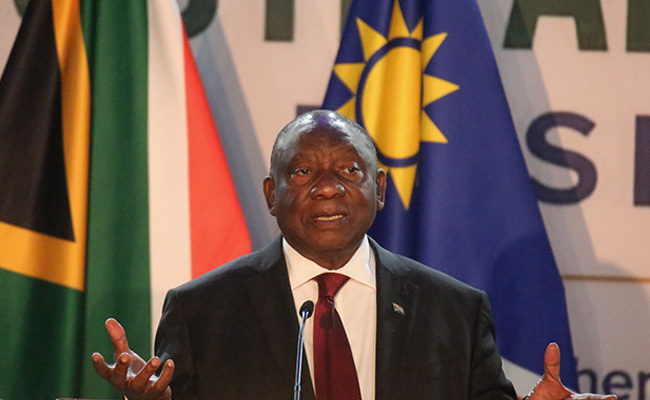
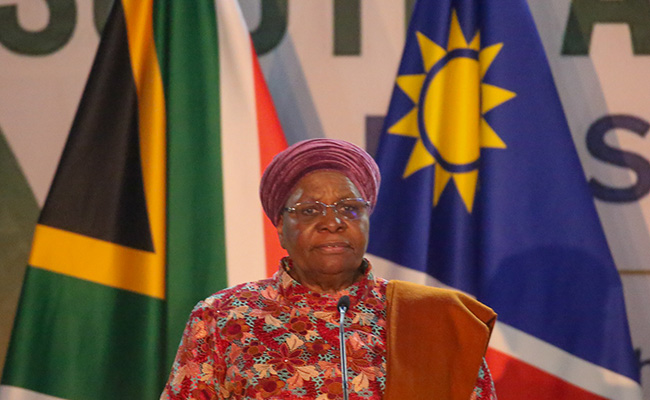
At the binational commission, Namibian president Netumbo Nandi-Ndaitwah and South African president Cyril Ramaphosa downplayed recent oil and gas discoveries in both countries, instead shifting focus to other strategic priorities in their opening remarks, including renewable energy and green hydrogen.
But it is oil discoveries in Namibia that have been making headlines recently.
The country is holding its breath as it awaits TotalEnergies’ final investment decision on its landmark Venus offshore oil project, expected shortly.
This decision could launch the country’s first commercial oil venture and bring it closer to first oil by the end of the decade, pending final negotiations and regulatory approvals. The level of investment from key players will reveal just how far this oil dream can go.
National Petroleum Corporation of Namibia spokesperson Paulo Coelho says: “One of the strongest signals of investor confidence is the behaviour of the international oil companies themselves. TotalEnergies and Galp recently reorganised their Namibian portfolios, with TotalEnergies acquiring operatorship and a 40% interest in the Mopane licence, while Galp gained exposure to the more advanced Venus project.”
He says TotalEnergies also agreed to fund half of Galp’s investment requirements for Mopane through exploration, appraisal and development.
“Companies do not assume operatorship or make funding commitments of this scale without extensive technical, financial and commercial assessment,” Coelho says.
He says the second major signal is the progress on Venus. TotalEnergies has stated that the discovery is fully appraised, front-end engineering and design is complete, and competitive engineering and construction bids have been received.
“The company is working towards a final investment decision in the second half of 2026, with potential first oil targeted for 2030 and planned production of approximately 150,000 barrels per day,” Coelho confirms.
Third, exploration success is followed by appraisal drilling and production testing.
He says the Mopane partners plan additional exploration and appraisal wells in 2026 and 2027 to define the first development. Elsewhere in the Orange Basin, the Capricornus discovery recorded 38 metres of net oil pay and flowed at more than 11,000 barrels per day during testing. These activities aim to determine recoverable volumes, reservoir performance and the most commercially viable development concepts, he says.
Coelho says the government is also preparing for the next phase through the National Upstream Petroleum Local Content Policy, regulatory reforms, skills development and a greater focus on Namibian participation in the supply chain.
“This does not guarantee production, but it shows Namibia is preparing institutionally and economically for the possibility of field development.”
“The next decisive milestone is the final investment decision. Once that is reached, the discussion will shift from potential to committed construction, contracting, and production.”
Investment excellence
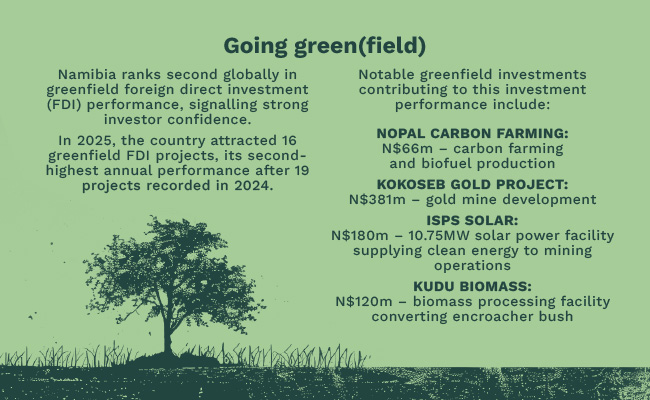
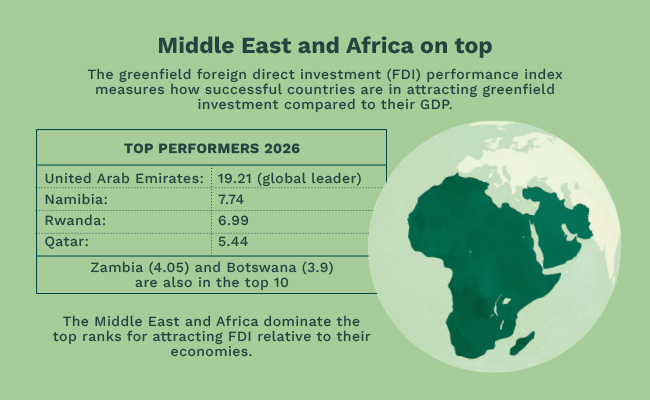
Adding more momentum, Namibia has been ranked second globally and first in Africa on the 2026 intelligence greenfield foreign direct investment performance index, which measures countries’ success in attracting greenfield investment relative to the size of their economy. Of the 98 nations assessed, it trailed only the United Arab Emirates.
Relative to GDP, the country outperformed larger economies such as Rwanda, Qatar, Zambia, and Botswana – all of which also featured among the global top 10.
The ranking underscores the Middle East and Africa as “leading global regions for countries that outperformed in their attraction of foreign direct investment relative to the size of their economies last year”.
Given the commitments made at the fourth Namibia-South Africa Binational Commission on development in Namibia, investors may well agree that Ramaphosa’s opening joke that he could “smell money” whenever he was in a room full of businesspeople set a fitting tone for what is unfolding in Namibia.
ALSO READ:
- Energy trader GreenCo woos Sanlam with $10m stake
- How South Africa can win in the new world order
- ‘Malignment’: the direction of South Africa’s foreign relations
Top image: Cyril Ramaphosa at the Namibia-South Africa Binational Commission. Picture: NIPDB.
Sign up to Currency’s weekly newsletters to receive your own bulletin of weekday news and weekend treats. Register here.