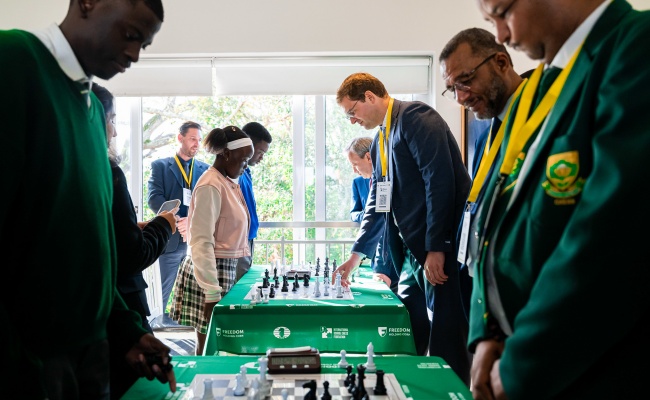

The African Continental Stage of the FIDE ISCF World Schools Team Championship was held in Stellenbosch recently.
The International Schools Chess Federation (ISCF) was established in 2024 to promote and grow school and youth chess globally. The ISCF works closely with FIDE, the world governing federation for chess, and operates as an affiliated member federation like its global network of national federations. The ISCF was the brainchild of Timur Turlov, founder and CEO of Freedom Holding Corp, who is also the inaugural president of the ISCF.
Freedom Holding is a Kazakhstan-based multinational financial conglomerate with extensive interests in financial markets across Central Asia and Eastern Europe; it has also begun expanding into the US and Western Europe. Freedom serves as the marquee sponsor and partner for the ISCF and, through its various initiatives, invests about $15m annually in youth and school chess.
Speaking on the sidelines of the tournament in Stellenbosch recently, Turlov noted that Freedom already has some commercial presence in South Africa, and he is impressed by the sophistication of the South African market. Freedom will consider expanding its offerings there, he said.
Obviously, operating multiple emerging and frontier markets in Central Asia and Eastern Europe has given Turlov and Freedom plenty of experience in dealing with regulators, and he noted in his comments to the media that the South African regulatory framework is quite advanced. He added that regulation is a two-way street between industry and the regulator with the aim of achieving goals for society’s mutual benefit. He said his experience in other markets shows that outright bans and heavy restrictions are not particularly successful in the long term, as they often result in people seeking offshore solutions. These are timely comments as South Africa prepares for the upcoming Financial Action Task Force audit and review alongside the proposed cryptocurrency regulations out for comment.
One of Freedom’s subsidiary businesses recently purchased one of the longest-standing dedicated chess websites, ChessBase. Turlov noted that he sees significant growth under Freedom’s ownership, through investments in improving the underlying IT infrastructure and growing chess beyond its traditional user base by offering a better user experience and a mobile-first strategy. Turlov also sees scope for ChessBase to
help many national chess federations modernise their operating systems and infrastructure so that they can better serve their current membership and grow in their respective national markets. He believes a purpose-built operating platform built by people with a deep chess background can be part of ChessBase’s growth under Freedom’s ownership.
As part of the competition’s media session, FIDE president Arkady Dvorkovich addressed initiatives under way at the elite and professional levels of chess to grow the game. The tournament in Africa is part of a strategic initiative to invest more in African chess more broadly, which he said is a must, given that 70% of the world’s population under the age of 30 lives on the continent. So, both as a growth market and for the long-term sustainability of chess, Africa needs a dedicated strategy.
He acknowledged that the strategy would need to be localised, but said technological advancements are making it easier to bring the game to previously underserved African markets. Dvorkovich also highlighted advances in streaming technology and said this will be a key pillar for growing the audience for chess, along with faster and time-limited chess, to make games shorter and more exciting for viewers. The explosion of T20 cricket as a format over the past few years shows that even a game as old and traditional as cricket can reinvent itself and generate a new way of playing that resonates with a younger audience. Chess also has a long and deep heritage, as noted by Dvorkovich, and FIDE must balance this heritage and tradition with innovation in both the game and in how it thinks about growing chess with new audiences and new markets.
Both Turlov and Dvorkovich stressed that, in the world of AI, chess is more important than ever for students, as the lessons on strategy and multilevel thinking are highly beneficial for using AI tools, which will develop over the coming years. Turlov, a lifelong chess player, said lessons he has learnt through playing chess regularly translate into his business life, showing again how school sports and the lessons children learn from sport, whether chess, cricket or rugby, can translate into other aspects of work and business life.
One of the most exciting developments for the future of chess in Africa was the news that FIDE is discussing bringing the Chess Olympiad to the continent. FIDE is in preliminary talks with several partners about hosting the event. Given the success of the event in Stellenbosch, Wesgro and the City of Cape Town should push hard to bring the event to Cape Town and South Africa.
Cape Town has a strong reputation for hosting large-scale events, and this would be another feather in its cap. However, discussions are still in the preliminary stages, so it’s
Sign up to Currency’s weekly newsletters to receive your own bulletin of weekday news and weekend treats. Register here.