
It seems almost fated. Nearly 10 years after Brexit, the UK loses its sixth prime minister prematurely, following Keir Starmer’s resignation this week. It is as though there is a link between the two.
Before Brexit, the UK’s post-World War II prime ministers served for an average of five years, from Clement Attlee to David Cameron. After Brexit, the average more than halved to just over two years, from Theresa May to Starmer. Not a single post-Brexit prime minister has completed his or her intended political term, particularly Liz Truss, whose 45 days were outlasted by a lettuce. They are all lettuces now.
Cameron resigned after calling for the referendum and losing it, May was chewed up by the withdrawal negotiations, Boris Johnson got Brexit done and then himself undone, Truss converted sovereignty into a gilt-market stress test, Rishi Sunak was the adult in a collapsing nursery, and Starmer, the great administrator of earnestness, has now administered himself right out of Downing Street.
Those are the headlines, but the nuances are important. Starmer was not brought down by Brexit in the way May was. He was brought down by the Britain Brexit left behind: poorer than it needed to be, angrier than it admitted, suspicious of managerial politics, and still unable to say plainly what it wanted from Europe. Brexit was not the immediate cause of his fall. Arguably, it was the decade-long condition in which his kind of politics became almost impossible.
A political booby trap
This requires some perspective, since Britain was not a gleaming economic machine humming along nicely until Nigel Farage turned up with a pint and that grin. Britain’s economic problems, such as they are, predated Brexit by years. And, it must be said, Britain’s problems are the kind of problems a country like South Africa would love to have. Brits are gloomy about their political condition (aren’t we all?), but on the whole, the standard of living is excellent and visiting the UK is a joy. Life goes on.
The sad truth is that the 2008 financial crisis crunched the UK’s productivity growth. The obligatory austerity that followed narrowed the state’s room for manoeuvre. Housing, as everywhere, has become a machine for enriching incumbents and excluding the young; infrastructure is tired, and its planning is absurd (hello, High-Speed Two); regional inequality is entrenched; and the British state, once admired for its dry competence, increasingly resembles a grand old hotel where the lifts no longer work, and nobody can find the manager.
Is this Brexit’s fault? Personally, I vacillate. Too much Brexit commentary IMHO, resembles a kind of theology disguised as economics. Remainers say Brexit caused the sickness, while Leavers say Brexit was never implemented properly. But Brexit didn’t invent Britain’s productivity problem. Nor did it create the North-South divide, the National Health Service backlog, the decay of local government, the failure to build, or the curious national conviction that a country can have Scandinavian public services, American taxes, and Italian administrative energy.
But I suppose Brexit did make many of them harder to solve. It turned the country’s largest economic relationship into a permanent political booby trap.
The sod-off vote
Great rivers of ink have been spilled over this question, and so I step into this fraught terrain with caution. Despite the sheer quantity of words expended on the subject, I have one tentative insight to proffer. I am an interested outsider, nothing more, which perhaps gives me this perspective: the UK’s problem is not Brexit as such, but the nature of how trade blocs work.
Weren’t expecting that, were you?
Judging by the media coverage, British understanding of Brexit is a bit myopic – the EU becomes simply the foil. It is natural that Brits should be obsessed by both (and write about it, endlessly and sometimes brilliantly, as only the British can), converting national stasis into prose style. But zoom the camera out a bit, and the picture changes.
To my mind, Brexit itself is actually quite simple. British people, by and large, voted to leave not so much because of economic philosophy, but because they wanted to show their backsides to those poncy, righteous, interfering mandarins of Brussels. It was a kinda sod-offy vote. It wasn’t a careful, clear-sighted weighing of the options because, if it had been, the results could have been predicted.
By leaving the single market and customs union, trade will get harder. Regaining legal autonomy will mean losing regulatory influence. “Taking back control” will mean discovering that many of the things you most want to control are controlled by geography, markets, supply chains, demography and your nearest 27 neighbours.
This “sod-off” attitude was not just a British phenomenon. The Irish voted against the Treaty of Lisbon in 2008 before reversing their position a year later. France and the Netherlands had voted against the proposed European Constitutional Treaty in 2005. Denmark rejected Maastricht in 1992 before accepting it after opt-outs. In other words, Britain is not unique in having a public allergic reaction to supranational Europe. What is unique is that Britain let its allergy lead it all the way out of the building.
Political promises that outrun economic capacity
Even the consequences of Brexit are kinda simple. The people who say that it has been a financial disaster are the same people who said it would be a financial disaster prior to Brexit. This does not make them totally wrong, but it does complicate the emotional satisfaction of saying “I told you so,” especially if you say it every Tuesday.
Actually, Brexit has not been a disastrous calamity in the cartoon sense. Britain has not become a cold-water Atlantis. On some ordinary growth comparisons, it has not performed any worse than any other large European economy. Germany, for example, has had its own grim period of stagnation, and Germany did not vote to leave the EU, take back control, restore parliamentary sovereignty, or send Brussels a rude note written on the side of a bus.
Germany is the central industrial power of Europe, the great beneficiary of the single market, the anchor of the eurozone, and at the centre of the European manufacturing web. And yet it, too, has been struggling with weak economic growth, declining productivity growth, ageing, high energy costs, overdependence on old industrial strengths, China’s rise up the value chain and, would you believe, late trains. I am not making this up.
So the honest comparison is not Britain-ruined-by-Brexit versus Germany-triumphant-in-Europe. The real comparison is two mature European economies, both struggling with productivity, both living off models that worked better in the 1990s and early 2000s, both finding that political promises outrun economic capacity. Britain’s problem is that it chose to add Brexit to the list. Germany’s problem is that even inside the bloc, even at the centre of it, the old industrial advantage is no longer enough.
Losing an advantage
The truth is that Brexit has not been the boost Leavers hoped for nor the calamity Remainers feared. Author Tom McTague’s formulation is still probably the fairest: Brexit “neither crushed us, nor set us free”. (Here’s the paywalled article: “Ten Years On Our Politicians Still Can’t Be Honest About Brexit”.)
But it did do damage. The Office for Budget Responsibility still estimates that Brexit will reduce Britain’s long-run productivity by about 4% relative to remaining in the EU, largely because trade intensity is expected to be lower. Other estimates are harsher. Some economists put the GDP loss by the middle of this decade at 6%-8% against the counterfactual of staying in. Counterfactuals – don’t you just love them?
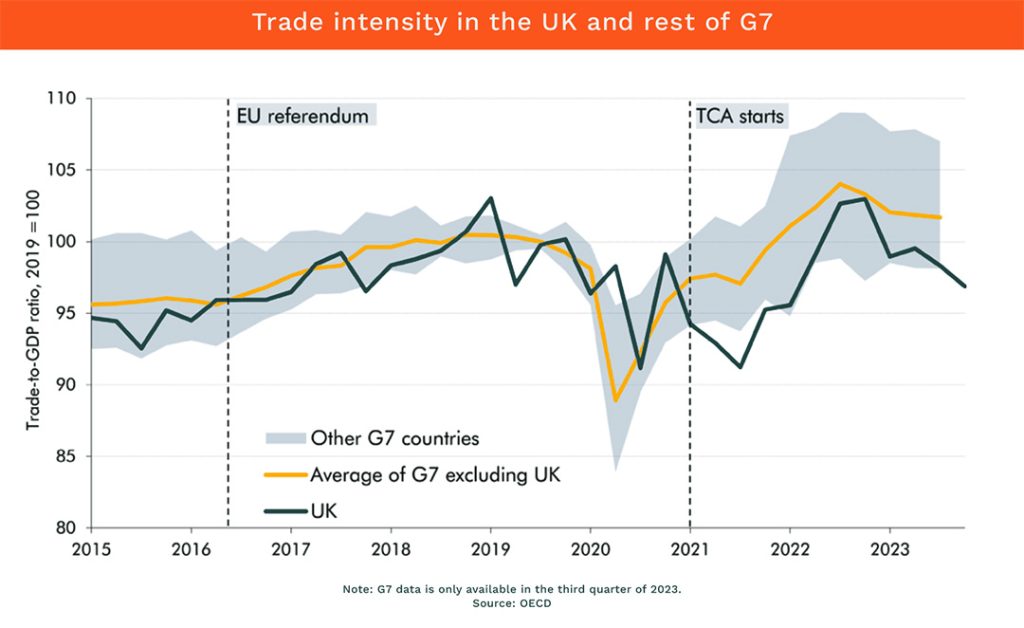
So what is the issue here? Simply put, it is this: increasing trade is a natural boost to the economic fortunes of all parties; we all know this. But it does not boost all parties equally over time. If an economic bloc has large players and small players, larger players often benefit more initially because they have the existing industrial heft, capital depth, distribution systems, brands, institutions and managerial capacity to exploit the larger market quickly.
But as time goes on, the smaller players catch up, and in some cases, they catch up very quickly. People and capital move within the bloc, skills are shared, supply chains lengthen and deepen, infrastructure improves, standards converge, and investors stop treating the periphery as exotic and start treating it as an extension of the market.
The advantages of the larger players do not disappear, but they become less decisive, since the small players also get new roads, factories, logistics networks, universities, bankable law, German orders, French tourists, Dutch machinery, Irish tax lessons and, most importantly, the confidence that comes from being plugged into something larger than themselves.
This pattern of major-power dominance/smaller-power catch-up is also a visible manifestation of the North American Free Trade Agreement. It’s even slightly visible in the Southern African Development Community.
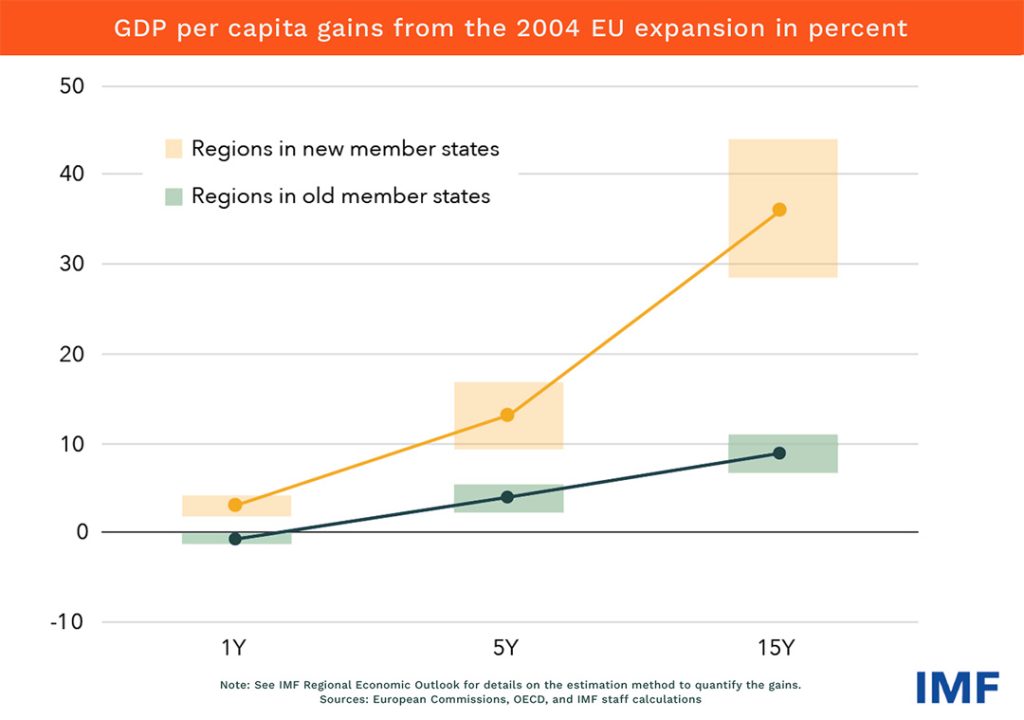
Look at the countries that joined the EU in the great enlargement of 2004. The 10 new member states had GDP per head of about 59% of the EU average when they entered. By 2022, that had risen to 81%. That is pretty amazing. The International Monetary Fund has estimated that EU membership increased per-capita incomes in the new member states by more than 30% after 15 years, compared with where they would otherwise have been. That is not Brussels fairy dust. That is the boring miracle of deep integration and the slow conversion of political aspiration into economic machinery.
Winners and losers
But here comes the awkward question: if the smaller and poorer countries benefited, did some of that benefit come at the expense of Britain, Germany and France?
The answer has to be yes, at least partly. Doesn’t it? Some production that might once have taken place in Western Europe moved East. Some factories, components, back-office functions and supply-chain stages shifted to lower-cost, increasingly competent economies. Some workers in the old core faced competition they did not previously have. Some communities experienced integration less as uplift than as exposure.
So yes, there were comparative losers. There always are. The sin of the European project, and of globalisation more broadly, was not that it created no gains – it created enormous gains. The sin was that its evangelists often talk as though the gains themselves answered the distributional question. They do not.
Historian and former newspaper editor Max Hastings, in his grand and furious Remoaner manner, says the British are cursed by an “exaggerated sense of self-importance”.
I would phrase it slightly differently: Britain is cursed by an exaggerated belief in its own optionality. It thought it could leave a bloc and retain the privileges of bloc membership, recover sovereignty and preserve influence. It imagined rejecting free movement and enjoying frictionless access. A farmer quoted by Hastings apparently explained his own Brexit vote as “Heart over head, old boy.” There is an entire national tragedy in that shrug.
Britain voted to take back control and discovered that “control” had been misdescribed. Control was presented as if it meant freedom from interference. In a modern economy, control often means influence over the systems in which you are unavoidably enmeshed. Outside the EU, Britain regained some formal legal powers, but lost influence over the standards, markets and political decisions of its immediate economic neighbourhood.
A problematic narrative
As for Starmer, personally cautious and constrained, he just wasn’t able to build a story big and bold enough to explain the pain he was imposing or the constraints he had inherited. Starmer could not say Britain needed a closer relationship with Europe without sounding, to some voters, like he was trying to reverse the sacred referendum. He could not say Brexit had made Britain poorer without sounding, to others, like he was sneering at the people who voted for it. He could not fund public services properly without admitting that growth was too weak, taxes too constrained and the fiscal inheritance too mean. He could not use Brexit as an explanation without sounding like a Remoaner, and he could not ignore it without sounding like a fool. Andy Burnham is going to discover exactly the same thing; maybe he will negotiate it better, maybe he won’t.
The problem is that trade blocs are not only about tariffs. They are machines for organising relative national futures. The EU has been, for poorer members, a convergence machine. It has allowed smaller and weaker economies to catch up by giving them access to a vast market and imposing, sometimes maddeningly, the disciplines required to function in that market. For richer members, it has been a scale machine: a way to project influence through collective weight.
Trade blocs are also annoying. They standardise, interfere, negotiate, regulate, harmonise and irritate. They generate a class of fluent institutional insiders who speak in acronyms and look as though they own several scarves. They create democratic distance. They produce rules nobody remembers voting for.
But done right, they do generate prosperity, scale and bargaining power. The mature political question is not whether this is emotionally satisfying. It’s whether the benefits are worth the irritation.
This is the purgatory McTague captures so well: UK politicians still cannot be honest about Europe because honesty requires admitting trade-offs. Remainers cannot quite admit that sovereignty matters. Leavers cannot quite admit that market access matters. Labour cannot quite admit it wants a closer relationship. Conservatives cannot quite admit that their great liberation has been economically thin gruel. Reform cannot admit that shouting “control” is not the same as exercising it.
And so the prime ministers keep falling.
This story first appeared on Tim Cohen’s blog, Loose Canon.
ALSO READ:
- What Trump’s trade rivals might use as payback
- Business strategy: the three things that don’t change
- The incredible pointlessness of EU elections
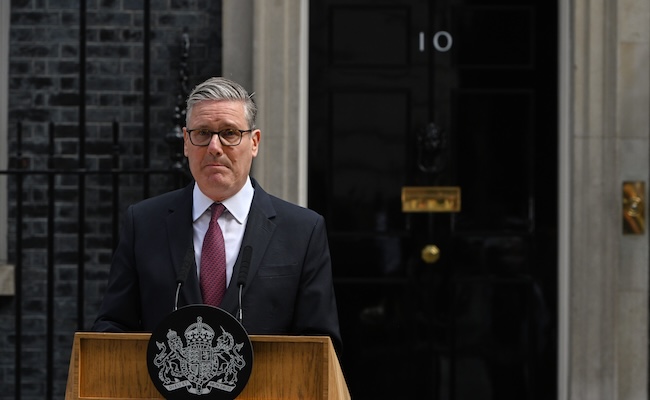
Top image: Britain’s Prime Minister Keir Starmer speaks to the media outside 10 Downing Street to announce his resignation on June 22. Picture: AP Photo/Thomas Krych.
Sign up to Currency’s weekly newsletters to receive your own bulletin of weekday news and weekend treats. Register here.