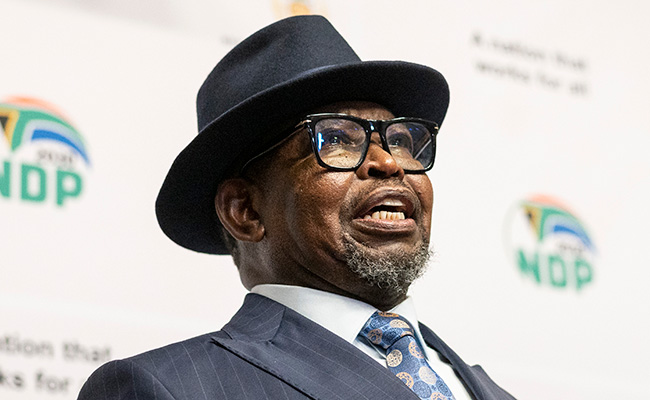

Finance minister Enoch Godongwana is delivering his best budget since taking office in August 2021, with a number of tailwinds that have allowed him and his team at the National Treasury to scrap a proposed R20bn in additional taxes that was to be raised this year and even give relief to taxpayers, small businesses and savers.
Here, in his own words, is how Godongwana framed his fifth budget:
“Five years ago, the outlook was stark. State capture had hollowed out critical institutions and weakened state-owned entities. South Africa had been downgraded to junk status by the last of the three major credit rating agencies in 2020. The devastation of the coronavirus pandemic coupled with the Russia-Ukraine conflict had dealt a blow to global growth. And in 2023, the Financial Action Task Force had placed South Africa on its greylist. The warning lights were flashing. Public finances were under severe strain and growth had stalled.”
That has changed.
Here are the numbers that matter from this year’s budget:
Personal income tax and medical credits
For the first time in two years, personal income tax brackets and rebates will be fully adjusted for inflation – in line with the 3.4% forecast for 2026/27. Medical tax credits increase from R364 to R376 per month for the first two members and from R246 to R254 per month for additional members. Lower- and middle-income taxpayers stand to benefit most from the bracket adjustments.
VAT threshold and tax-free savings
To assist small businesses and encourage savings, the compulsory VAT registration threshold rises from R1m to R2.3m from April, and the annual tax-free investment limit increases from R36,000 to R46,000. These changes form part of a broader set of threshold adjustments pegged to inflation.
Fuel levies
The general fuel levy increases by less than inflation to R4.10 per litre for petrol and R3.93 per litre for diesel from April. The Road Accident Fund levy rises 7c a litre to R2.25 per litre. Taxes currently account for roughly a third of the pump price.
Carbon tax
The carbon tax increased from R236 to R308 per tonne of CO₂ equivalent from January. The carbon fuel levy rises to 19c per litre for petrol and 23c per litre for diesel from April, as required under the Carbon Tax Act (2019). The cost recovery quantum for the liquid fuels sector also increases, from 0.99c per litre to 1.29c per litre.
Alcohol and tobacco excise duties
Excise duties on alcohol and tobacco – including vaping products – increase by 3.4%, in line with the inflation forecast. Effective April 1 each year, excise adjustments will take effect from the 2027 budget. Stakeholder consultation on a review of the alcohol excise regime will continue during 2026.
Global minimum tax
The government will implement updated global minimum tax rules in 2026/27 to target profit shifting by multinationals that exploit low or zero tax rates in other jurisdictions. Tax revenues of R2bn are estimated from this reform in 2026/27, down from an earlier estimate of R8bn following revised Organisation for Economic Co-operation and Development rules and updated company data.
Online gambling tax
Treasury published a draft paper in November 2025 proposing a 20% tax on gross revenue from online gambling, in addition to existing provincial taxes. The public comment period closed on February 27 2026; a revised proposal is expected to be released for further public comment later this year.
Diamond export levy
With the global diamond industry under pressure, a 5% levy applies to unpolished diamonds released for export to encourage domestic sales to local cutters and polishers. Producers that meet local sales requirements are exempt – 40% for large producers, 15% for medium ones. Treasury proposes lowering the threshold between the two tiers from R3bn to R2bn, and giving large producers the option to either sell 15% locally and offer the balance to the Diamond Exchange and Export Centre (DEEC), or sell 40% locally and bypass the DEEC obligation. Stakeholder consultation will continue after budget day.
Social grants
The old-age, disability and care dependency grants will increase from R2,315 to R2,400 a month from April, and the war veterans grant will increase from R2,335 to R2,420. The foster care grant rises from R1,250 to R1,295, and the child support and grant-in-aid grants from R560 to R580. The social relief of distress grant – currently R370 per month – has been extended until March 31 2027 at an additional cost of R36.4bn. South Africa has 26.5-million social grant beneficiaries.
Household consumption
Household consumption growth is expected to reach 3.1% in 2025 before moderating to 1.8% in 2026 as the temporary boost from the two-pot retirement system unwinds. From 2026 to 2028, consumption is forecast to average 2%, supported by rising wages, lower inflation, gradual interest rate easing, a stable power supply and improved consumer confidence.
Municipal waste
Unauthorised, irregular, and fruitless and wasteful expenditure in municipalities reached R236.3bn in 2023/24 – R81.6bn unauthorised, R137bn irregular and R17.7bn fruitless and wasteful. Despite two decades of reform interventions, Treasury has now invoked section 216(2) of the constitution against persistently non-compliant municipalities, enabling it to halt national transfers to municipalities that are in consistent breach of the Municipal Finance Management Act.
Eskom municipal debt
Municipalities owe Eskom R85.2bn. Of 71 participants in the Municipal Debt Relief Programme, only 15 have consistently met the conditions. To remedy the situation, the Treasury will use the Distribution Agency Agreements under which Eskom takes over electricity distribution from defaulting municipalities. Those that refuse will be removed from the programme and become liable for the entirety of their debts.
Passenger rail
Metrorail has been allocated R23.1bn to upgrade signalling and telecoms, with a target to grow passenger trips from 116-million this year to 450-million by 2028/29.
US research funding cuts
R410m has been reprioritised from the department of health to the South African Medical Research Council to offset grants withdrawn by the US, as part of a co-funding arrangement to sustain key HIV/Aids research programmes.
Early retirement programme
A total 7,687 applications were approved in the first phase at a cost of R3.7bn, with estimated net savings of R5.5bn – R2.6bn in 2026/27, R1.4bn in 2027/28 and R1.5bn in 2028/29. The programme is intended to rejuvenate the public service and help restructure departments.
ALSO READ:
- 10 things to know about the budget
- South Africa’s debt finally peaks, and growth is the target
- Treasury lifts TFSA limit to R46,000
Top image: Rawpixel/Currency collage.
Sign up to Currency’s weekly newsletters to receive your own bulletin of weekday news and weekend treats. Register here.