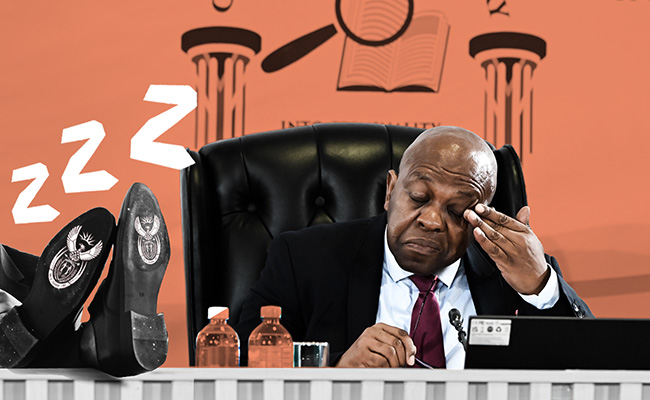


Patrick Dlamini, the suspended head of the Public Investment Corporation (PIC), has accused an anonymous group of whistleblowers of concocting a complaint against him that was “patently designed to cause instability to the PIC”.
Dlamini lodged papers for an urgent hearing in the high court in Pretoria, due to take place on Tuesday, in which he takes aim at the PIC’s board for suspending him based on “nothing more than speculation and the say-so of an unidentified and unidentifiable [group]”.
His 55-page affidavit is notable, not least for the fact that this is his first public attack on the 26-page whistleblower complaint that led to his “precautionary suspension” on July 13 and proved to be a catalyst for a much wider boardroom implosion at Africa’s largest fund manager.
Subsequently, the entire PIC board quit, with the directors at war over how to respond to the whistleblowers.
It also laid bare political tensions between finance minister Enoch Godongwana, who supported Dlamini, and deputy finance minister David Masondo who, until his resignation last week, chaired the board that suspended the CEO.
This leadership crisis at the PIC, which manages R3.8-trillion on behalf of 1.7-million civil servants, has now rippled deeper. There is no board, five of the top six positions are filled by acting executives, and there are no permanent appointees heading up the listed investments, fixed income, and unlisted investments portfolios.
While a new interim board is set to be appointed on Thursday, according to News24, Dlamini’s court action against the PIC comes at an inconvenient time, with nobody apparently mandated to oppose the application.
If the action is uncontested, the court could deem his suspension to be invalid, and he will return to the PIC in quick time.
In his affidavit, Dlamini says the suspension sparked a series of “serious and far-reaching consequences, which underscore the gravity of the situation”.
“There has been significant and measurable detriment to public confidence in the PIC, which has been the subject of sustained and damaging negative media attention,” he says. “The reputational harm to the PIC, an institution entrusted with the management of over R3.8-trillion in public retirement savings, is incalculable.”
This underscores Godongwana’s sentiments in a statement over the weekend.
Godongwana said Masondo’s resignation was “necessary given the governance challenges”, adding that any instability at the PIC “poses systemic risk to the economy”.
Dlamini, meanwhile, is arguing that the PIC’s whistleblower policy has been abused to sideline him at a critical time.
While he says this policy is aimed at protecting people who make “responsible disclosure of unlawful criminal or irregular conduct”, this particular group of whistleblowers is acting “in bad faith”.
Dlamini says the “concerned individuals” who make up the whistleblowers are not PIC employees, and have insisted on anonymity. Given this, he says the board failed by not subjecting the complaint to “heightened scrutiny before acting upon it”.
In their original 26-page complaint in June, the whistleblowers claimed Dlamini “centralised power”, “acted outside his legal authority”, failed to disclose conflicts of interest around Lanseria Airport, in which the PIC has a stake, and “subverted the board”.
Dlamini rejects this. He says “there is no evidence” provided for their claims, adding that he declared all his conflicts of interest upfront when he joined the PIC, and acted strictly in according with the authority he had been given.
“While I readily accept the need to protect public confidence in entities such as the PIC where credible allegations of impropriety are raised, the board’s response must be proportionate, lawful and measured,” he says. “[But here], the board has treated unverified allegations from anonymous sources as though they were established facts.”
Bad faith
Dlamini claims there was an ulterior motive for this complaint: to sideline him on behalf of a company called Acapulco, which had a messy fallout with the institution over a deal dating back more than 10 years.
The backstory here is that in 2013, the PIC lent R333.2m to Acapulco to buy 25% of Lanseria, but when Acapulco defaulted on the repayments, the PIC took over the shares. Nonetheless, arbitrators ruled last year that the PIC should pay R411m to Acapulco for its “sweat equity”.
Dlamini, however, reopened this case. Suspecting that the PIC had overpaid based on an inflated value for the Lanseria Airport, he hired PwC to investigate. And the forensic auditors confirmed his suspicion: the PIC had indeed vastly overpaid.
The Lanseria valuation on which that R411m payment hinged was an “obvious outlier”, PwC said, and was only allowed to stand because of “missteps” at the PIC.
“The outcome reflects a series of decisions and actions in which contractual and governance mechanisms were not consistently applied,” it said.
Last week, Dlamini told Currency that he commissioned the report because he had a “duty to ensure there was proper due diligence” in the PIC’s payment. “We needed to know whether we dropped the ball.”
Now, in his affidavit, Dlamini says the whistleblower complaint bears a “striking and material resemblance” to Acapulco’s claims. This, he says, implies the whistleblowers were linked to Acapulco, and were motivated by “Acapulco’s dissatisfaction with the scrutiny to which the transaction has been subjected”.
The whistleblowers, for their part, have maintained that there is documented evidence for every one of their claims. They say this is their bid to protect the PIC from an “unaccountable” executive, and those with illicit designs on the PIC’s billions.
Last Friday, in a letter to parliament, the whistleblowers asked the standing committee on finance to intervene in this case since – after Masondo and the board quit – there is now no-one to oppose Dlamini’s court action.
“[His] suspension falls by default and the investigation falls with it. An institution entrusted with R3.8-trillion in public retirement savings is returned to the control of an executive whose conduct stands unexamined,” they say.
They say his court claim is “materially deficient”, and he provides little proof for his claims – particularly that this is an urgent case.
In a separate letter to the DA’s representative on that committee, Mark Burke, the whistleblowers have asked that Ashor Sarupen, the deputy finance minister drawn from the DA’s ranks, be appointed as the new PIC chair.
“The DA has been a stabilising force within the government of national unity,” they say. “The PIC cannot be permitted to become an instrument, a prize, a piggy bank or a casualty of political contest.”
There is one thing on which both Dlamini and the whistleblowers seem to agree: this leadership crisis has evoked the spectre of the darkest era in the PIC’s history, about a decade ago, which ultimately led to a commission of inquiry under judge Lex Mpati.
Mpati’s commission made 308 recommendations which have largely all been implemented – except for the one critical recommendation: that a politician must not chair the institution.
In his court papers, Dlamini says he was appointed precisely to restore the PIC to its “revered status” as one of Africa’s top fund managers, given his track record of turning around state-owned entities, like the Development Bank of Southern Africa.
“The findings and conclusions of the Mpati commission are the very failings against which I have strived to guard in my tenure as the CEO of the PIC,” he says.
ALSO READ:
- PODCAST: ‘Sharp Sharp’ – PIC cleared for crash-landing
- PIC crisis deepens as four more directors quit
- Inside the PIC’s meltdown
Top image collage: Rawpixel; Currency.
Sign up to Currency’s weekly newsletters to receive your own bulletin of weekday news and weekend treats. Register here.