

South African hedge funds are undergoing a quiet identity shift: from flashy, high-octane products associated with speculative punting to portfolio tools increasingly used by retirees and income investors trying to avoid violent market swings, massively boosting assets under management.
That is the picture painted by Wade Witbooi, managing director of Amplify Investment Partners, who says the client conversation has become less about “super returns” and more about portfolio construction, drawdown management and stability.
“The narrative has changed,” Witbooi says in an interview with Currency. “Previously, when people thought and talked about hedge funds, that was about wild and high total returns … the Wolf of Wall Street type of stories. But now the context has changed. It’s about how it can benefit my client – per product, per age group.”
In particular demand is increasingly coming from post-retirement investors. “We found a lot of clients in post-retirement or in living annuities … use hedge funds as a lowly correlated asset to add to a portfolio to smooth out their investment return,” he says, adding that while some hedge funds are return-maximisation vehicles, “I think most of them are risk-mitigation vehicles”.
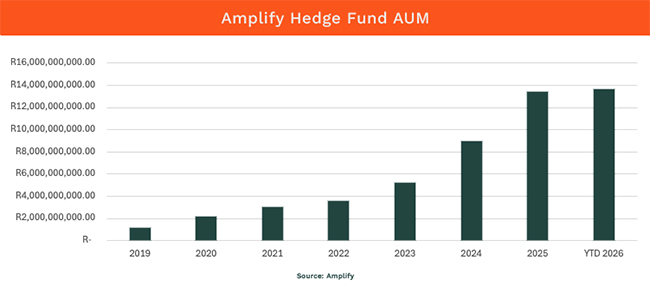
This is reflected in Amplify’s hedge fund assets under management, which have just exploded over the past five years, partly due to performance and partly to the group’s fund-of-funds philosophy.
‘Mitigating market volatility’
That shift fits a broader South African trend. The Association for Savings and Investment South Africa (Asisa) says hedge funds attracted net inflows of R13.3bn in 2024, more than double 2023’s R6.24bn, with retail investors contributing most of the inflows. Asisa also explicitly links demand to hedge funds’ role in “mitigating market volatility” and says retail hedge funds alone drew R11.84bn in net inflows.
Novare’s latest hedge fund survey put local industry assets at R152.7bn in 2024, up R45.8bn year on year. Retail hedge funds now make up just over half of funds by number (78 of 152), helped by investment platforms and discretionary fund managers, as well as a shift towards daily-priced products. But qualified-investor hedge funds still hold a slim majority of assets – R79bn versus R72.1bn for retail – underlining the fast growth in the mass market.
It also fits a global pattern. Reuters reported in January that Bank of America’s allocator survey found 51% of fund investors plan to increase hedge fund allocations in 2026, with investors consolidating around large multi-strategy managers after stronger performance; the report cited hedge fund industry assets at roughly $5-trillion by the third quarter of 2025.
Goldman Sachs, citing its own allocator survey, said more than 90% of allocators reported that hedge fund portfolios met or exceeded expectations in 2025, with demand strongest for strategies seen as less correlated with traditional assets.
A broader toolkit
For Amplify, the pitch is not that it is itself a hedge fund, but an asset-management platform with hedge funds as one part of a broader toolkit. Witbooi describes Amplify as a Sanlam-owned business inside the group’s multi-manager structure, with roots in Blue Ink Investments, a fund-of-hedge-funds business that was acquired and integrated over time.
He says the company’s DNA was built around manager discovery – finding skilled, often lesser-known boutiques and backing them first with internal capital before opening products to outside investors. “The view was always to put our own money first,” he says.
That manager-selection approach, he says, grew from a belief that some hedge fund skills – especially risk management and handling complexity – can translate effectively into long-only portfolios.
Witbooi says Amplify now has 10 retail hedge funds and had “just booked over R80bn” in gross assets under management at the end of last year, with hedge fund growth “beyond our expectations”. He estimates hedge fund assets at Amplify have risen from about R7bn two years ago to roughly R13.5bn.
He also points to regulation as both a brake and a legitimiser. In retirement fund portfolios subject to regulation 28, he says, hedge fund exposure is constrained, which limits how fast allocations can scale. But outside that framework – especially in post-retirement portfolios – hedge funds are increasingly being used as part of mainstream allocations rather than as a speculative side bet. “By count, there is much more representation across portfolios,” he says.
The result is a category that looks less like its own mythology and more like mainstream portfolio plumbing – still alternative in structure, perhaps, but increasingly conventional in purpose. For a market once sold on excitement, that may be the biggest shift of all.
ALSO READ:
- Alternatives: The next frontier for resilient portfolios
- Hedge funds shine, but myths linger
- Keeping his shorts: Hedge fund OG Jean Pierre Verster
Top image: Rawpixel/Currency collage.
Sign up to Currency’s weekly newsletters to receive your own bulletin of weekday news and weekend treats. Register here.