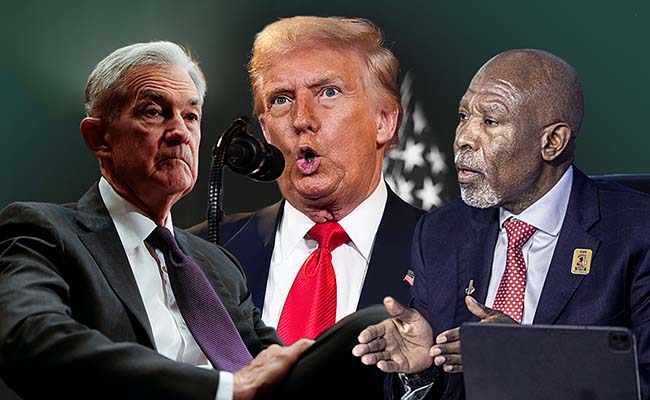


Lesetja Kganyago, governor of the South African Reserve Bank (SARB), has joined top central bankers in defending Federal Reserve chair Jerome Powell against threats of criminal prosecution, as US President Donald Trump steps up his campaign to force the Fed to do his bidding.
Trump on Tuesday escalated his attacks on Powell for not cutting interest rates faster, a move that would likely bolster the president’s popularity, which had sunk to 36% according to a poll last month from Gallup. This comes as the 72-year-old faces the prospect of criminal charges over the cost of a revamp to the central bank’s headquarters, which Powell described as nothing but a “pretext” to curb the Fed’s independence.
These developments have worldwide ramifications, as the Fed’s decisions anchor global borrowing costs, since the US dollar is the predominant currency for trade deals and a global reserve currency. Other populist leaders may also feel emboldened to push their own central banks to do what suits them politically, rather than do what is best for their country’s economy.
Now, 13 chiefs of central banks across the world have drawn a line in the sand, issuing an implicit sharp rebuke of Trump’s actions. This includes Kganyago, European Central Bank president Christine Lagarde and the Bank of England’s Andrew Bailey.
Powell has “served with integrity, focused on his mandate and an unwavering commitment to the public interest”, they said in a statement. “The independence of central banks is a cornerstone of price, financial and economic stability in the interest of the citizens that we serve. It is therefore critical to preserve that independence, with full respect for the rule of law and democratic accountability.”
‘Standing firm in the face of threats’
But with relations between the US and many other countries fraught, with consistent threats from the White House for new punitive tariffs, this central bank statement sparked unease.
New Zealand’s central bank chief Anna Breman was rebuked by the country’s foreign affairs minister for getting involved in “US domestic politics” and told to stay in her “lane” of local monetary policy.
The threat of criminal charges stems from Powell’s June testimony to Congress about the cost of a massive renovation of Fed buildings, which had expanded from its budget of $1.9bn to $2.5bn. Trump had claimed that there was a slew of lavish features such as VIP elevators and marble finishings – but Powell had embarrassed him by publicly correcting his calculations on camera.
On Sunday, in an extraordinary departure after years of deflecting Trump’s public attacks, Powell released a video statement in which he said that “public service sometimes requires standing firm in the face of threats”.
Powell revealed that he had been served with subpoenas by the justice department, suggesting it may be preparing to indict him for lying to congress – similar to the politically-motivated charges it brought against former Federal Bureau of Investigation head James Comey, which a judge promptly dismissed in November.
On Tuesday, when asked about the Fed renovations, Trump said Powell was “billions of dollars over budget, so, he either is incompetent, or he is crooked. I don’t know what he is, but he certainly doesn’t do a very good job,” according to the Wall Street Journal.
This has been interpreted by critics as a way of heaping further pressure on Powell to leave earlier than May, when his term expires, while sending a message to Powell’s successor – expected to be appointed within weeks – to be more pliant towards the White House.
‘Economies pay the price’
While the SARB declined to comment further on the statement, Kganyago has repeatedly argued for central bank independence – a key tenet of global monetary policy since the 1970s that ensures decisions are taken without regard to the political consequences for an incumbent administration.
Last year, he warned that central banks and other institutions are facing a crackdown from right-wing populists, and could not afford to be complacent. “In any democracy, where there’s contestation about the role of institutions, central banks must understand there will be contestations about their role,” he said.
In 2024, he said political pressures can “get in the way of good outcomes”, while adding that independence doesn’t mean that a central bank can “do whatever it pleases”, since it is held accountable for delivering on a mandate set by the government.
“Where central banks are captives of the political process, they tend to be willing to fund whatever government wants, or to adjust monetary policy to suit election timetables. Ultimately, these come at a huge cost to the economy, paid with an inflation tax, which is levied disproportionately on the poor.”
Kganyago said central banks that insist on financial stability can irk politicians, for whom interest rate cuts are far more politically palatable. He said ordinary people “do not want the currency crashing; they do not want prices in the shops spiralling; and they do not want to worry if their money in the bank is safe”.
Pushback
Economists in the US have warned that a politicised Fed that caves in to Trump’s demands will erode its credibility as an inflation fighter and likely lead investors to demand higher rates before investing in US government bonds.
One such critic is Jamie Dimon, the CEO of banking group JPMorgan, who warned that meddling with the Fed will “raise inflation expectations and probably increase rates over time”.
Trump dismissed Dimon, a veteran with 44 years of banking experience, as simply “wrong”.
Prosecutors are also coming under pressure from Trump to prioritise the Fed case. The Wall Street Journal reported that Trump blasted them as “weak”, urging faster action on his priorities – including the inquiry tied to Powell and the cost of renovating Fed buildings.
Yet his campaign may backfire. Resistance in the US Senate has grown, according to Barron’s, with some senators saying they will block Fed nominations until the legal case involving Powell is settled.
Turkey offers a cautionary tale as to what happens when markets start to believe that politicians can bend a central bank to their will. President Recep Tayyip Erdoğan, from July 2019, fired a series of governors for not cutting rates fast enough – based on his unorthodox view that lower rates will curb price increases – sparking a slump in confidence, a slide in the lira to record lows, and a brutal inflation cycle.
With reporting from the Associated Press
ALSO READ:
- Trump-Powell tensions flare as DOJ targets Fed
- The SARB’s Trump headache
- With a US recession around the corner, where are the adults?
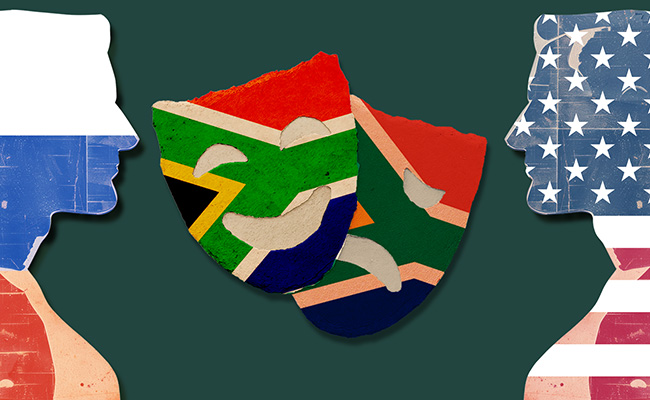
Top image: Fed chair Jerome Powell (Kent Nishimura/Getty Images); US President Donald Trump (Andrew Harnik/Getty Images) and SARB governor Lesetja Kganyago (er-Anders Pettersson/Getty Images).
.
Sign up to Currency’s weekly newsletters to receive your own bulletin of weekday news and weekend treats. Register here.