
It is sobering to reflect on why so many trade unions are flirting with irrelevance.
On this score, the antics of the country’s largest labour federation, Cosatu, which picketed outside the Constitutional Court this week against a challenge to National Health Insurance (NHI), are deeply illuminating.
On Tuesday, the first of 15 legal challenges to NHI kicked off, this time with the Board of Healthcare Funders (BHF), which represents 40 medical aids, arguing that this landmark healthcare policy was passed without any meaningful public participation.
“We kept saying the emperor has no clothes, everyone can see the emperor has no clothes, yet [parliament] goes ahead and enacts legislation that says the emperor does indeed have clothes,” the BHF’s counsel, Bruce Leech SC, argued in court.
This case centred around procedure, with Leech arguing that parliament ignored the three main public concerns outlined in the 340,000 submissions before rubber-stamping the bill. Yet the implied criticism of NHI – that it is far from the panacea for poor quality healthcare that the government sold it as – was never far away.
As Leech argued, there are huge information gaps around this policy which have yet to be closed.
‘Integral questions’
“First, how much is this going to cost – can we afford it, in other words? Second, what am I going to be getting in return? And third, how will this work, especially since your track record suggests a lack of trustworthiness,” he argued.
Those are not nice-to-knows, Leech said; those are “integral questions”, since the public will have to pay for NHI through new taxes.
The Constitutional Court must now decide if the public participation process was so flawed that the whole process must begin from scratch.
The stakes are high, as this legislation will effectively eradicate private medical aids, creating a single state-run NHI fund to which all doctors will have to contract and from which all medical services will then be doled out.
Intuitively, you’d think this would be bad news for the country’s workforce.
Not only will NHI dilute any medical benefits they get from their employer, but it will also slash their take-home pay, as new income taxes are implemented to pay for the policy. (Cost estimates vary from north of R400bn to R1.3-trillion per year.)
And yet, quixotically, there was Cosatu this week, picketing outside the Constitutional Court in defence of NHI.
A lurch away from equality
Zanele Sabela, Cosatu’s spokesperson, said NHI is the only way to put an end to “the two unequal systems currently in place, which are remnants of apartheid – one for people with money and another for the poor and working class”.
Despite the lack of detail, Sabela rejected the BHF’s argument, saying the public consultation process had been “incredibly extensive”.
Now, how can this be good for Cosatu’s members, you wonder?
“The simple answer is that it isn’t – I don’t understand how any union could be in favour of the policy,” says Theuns Du Buisson, a researcher at Solidarity, another trade union which, in contrast to Cosatu, has gone to court to demand NHI be scrapped.
“The trade unions I’ve spoken to, which do support NHI, argue that it’s a step towards equality, but it really isn’t,” Du Buisson says. “Our research shows it’ll require a minimum of an extra 14% payroll tax on everyone, while those people who get medical aid from their employers will be drastically worse off.”
Du Buisson says 90% of the doctors and therapists who make up Solidarity’s members have said they will either close their practices, retire early, or leave the country if NHI is imposed. In other words, NHI will create a squeeze on the supply side of South Africa’s medical professionals, while throttling private medical aids.
And yet, there is one potential answer to why Cosatu is supporting the government’s political ambitions, which also helps explain why the country’s largest labour group has lost a good chunk of its membership in recent years.
In a word: politics. Cosatu may be weaker than it was two decades ago, but it still remains an alliance partner to the ANC, which has made NHI a signature policy. The union, then, seems to be acting out of political necessity in shielding NHI.
Growing disconnect
Now it is true that trade unions played a pivotal role in thwarting apartheid, which explains why they were so powerful when the country entered democracy. But that was ages ago. Today, there are 3.1-million union members, which means they have shed nearly a quarter of their membership since their peak.
Cosatu, the largest, which boasted nearly 2.2-million members in 2012, has dribbled down to 1.8-million.
Zwelinzima Vavi, Cosatu’s former general secretary, told the Sunday World this week that much of this decline is due to unions’ own goals.
“Organisers became overwhelmed, and the movement lost its effectiveness,” he said. “When leaders no longer experience what workers go through – the daily struggle, the transport, the long hours – that disconnect grows.”
There are many factors in this decline. Besides a growing disconnect from members, an economy that grew at less than 1% a year for a decade didn’t help. But their frequent inability to think in any commercial way hasn’t aided their progress either.
‘Wilful blindness’
Mbhazima Shilowa, the former premier of Gauteng, wrote this week of the “wilful blindness” of trade unions, pointing out how, as much as they railed against corruption, they also looked the other way when their own members were nabbed.
“It is no wonder the general public views trade unions as self-serving, with some of their members having their hands in the cookie jar,” he wrote for News24.
Now you can understand that, in the case of NHI, some unions have bought the ANC rhetoric wholesale without delving deeper into the impact on salaries or benefits. But this intellectual laziness also buttressed their political aims.
This NHI case illustrates precisely the Achilles heel of the fastest-shrinking unions: in shifting their emphasis from protecting workers to protecting their own political alliances, they’ll only hasten their slide into irrelevance.
ALSO READ:
- NHI is a fantasy fix for a broken system
- The contradictions driving the ANC’s NHI lie
- The NHI is dead (say economists); long live the NHI (says the ANC)
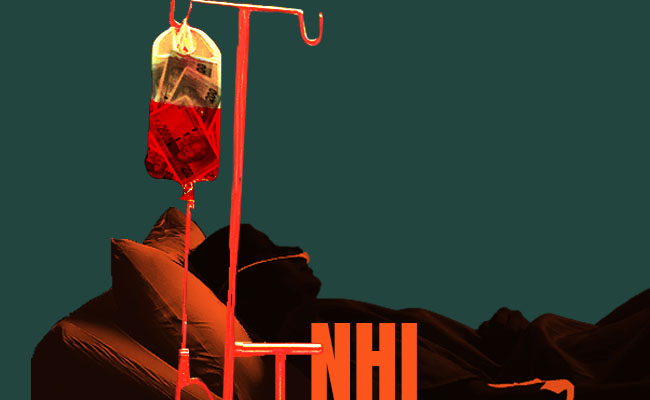
Top image: Rawpixel/Currency collage.
Sign up to Currency’s weekly newsletters to receive your own bulletin of weekday news and weekend treats. Register here.