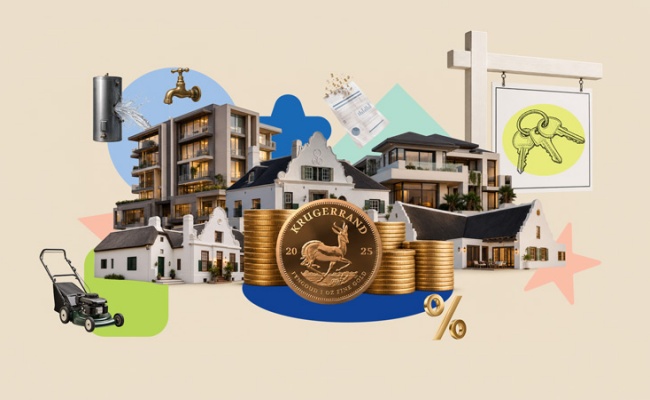

Property has long occupied a sacred place in the South African money conversation. Buy bricks. Hold for the long term. Watch the value climb. Retire comfortably. That, at least, is the story many of us were told.
And to be fair, property has earned its reputation. It is visible, useful and emotionally satisfying. You can live in it, improve it, rent it out, leave it to your children, or stand in the driveway admiring the boundary wall you spent far too much money repairing. It feels solid because it is solid.
But here is the less comfortable question: if you had taken the same amount of money and put it into gold instead, what would the result look like today?
That is the question behind The Scoin Shop’s Gold vs Property Calculator. This online tool invites South Africans to compare a property purchase against the historical value of Krugerrands over the same period. It does not pretend to settle the debate forever. Markets are not that tidy. What it does do is place two familiar South African wealth assets side by side and ask a useful question: are we sometimes too quick to assume that property is the obvious winner?
For many South Africans, property is the default long-term wealth asset. It is what parents recommend, banks understand and dinner-table conversations approve of. Gold, by contrast, is often treated as the mysterious cousin at the family lunch: respected, slightly misunderstood and usually discussed seriously only when things get uncomfortable.
Yet gold has been a store of value for centuries, and in South Africa, the Krugerrand gives that story a distinctly local accent. The calculator allows users to enter a property purchase price and date, then compare that against what the same capital could have become had it been used to buy Krugerrands instead. It also allows users to factor in the costs property owners know all too well: rates, levies, insurance and maintenance.
This is where the conversation becomes more interesting.
Property returns are often discussed in terms of what a home was bought for and what it might sell for today. Bought for R800,000. Worth R2.2m now. Sounds marvellous. But the gross number is only part of the story. Over the years, the owner may also have paid rates, levies, special levies, insurance, repairs, security upgrades, repainting and compliance costs.
These are not theoretical expenses. They are the price of ownership.
Gold has costs too, particularly where safe storage and insurance are concerned. But it does not require tenants, transfer attorneys, body corporate meetings, geyser replacements or urgent calls about a leaking roof. It is not subject to zoning disputes. It does not need to be repainted before a sale.
That does not make gold “better” in every case. It makes it different. And different is exactly the point.
One of the calculator’s more useful contributions is that it encourages people to think beyond the old either/or argument. Property and gold are not natural enemies. They serve different roles. Property can provide shelter, lifestyle utility and rental income. Gold is generally held as a store of value, a hedge against uncertainty and a way to keep some wealth outside the property cycle.
The trouble comes when too much wealth sits in one place.
Many South Africans are heavily exposed to property, often without thinking of it that way. A primary residence, a holiday flat, a buy-to-let unit and perhaps a family property inherited along the way can create the impression of stability. But concentration risk is still concentration risk, even when it comes with a tiled roof and a municipal account.
Property is also not as liquid as people like to imagine. Selling a home can take months. The process involves agents, paperwork, compliance certificates, negotiation, delays and transaction costs. Gold, by comparison, can often be sold far faster and, importantly, in smaller portions. You cannot sell one bedroom, half a garage or 12% of the patio. You can, however, sell a portion of a gold holding.
Liquidity matters most when life refuses to follow the spreadsheet.
The calculator is careful about its limits. It excludes rental income, bond interest, transfer duty, tax, selling commission, renovations, location-specific performance and future returns. That is important. A well-chosen property in the right area, bought at the right time and managed well, can be an excellent asset. A poorly chosen one can be a very expensive lesson.
Gold has its own variables too: purchase premiums, selling spreads, storage choices and price volatility. Past performance is not a promise. No serious financial conversation should pretend otherwise.
But the broader point remains valuable. For decades, South Africans have been encouraged to see property as the grown-up asset and gold as the crisis asset. The calculator challenges that hierarchy. It asks users to look at the numbers, not the folklore.
That is especially relevant in a country where currency weakness, rising municipal costs, infrastructure strain and policy uncertainty can all affect household wealth in ways that are not always visible at first glance. A property may rise in value on paper while its carrying costs quietly eat into the real return. Gold, meanwhile, may sit silently in the background, doing what it has done for generations: preserving value without asking for a plumbing certificate.
Rael Demby, CEO of The South African Gold Coin Exchange and The Scoin Shop, says the purpose of the calculator is not to discourage property ownership but to broaden the wealth conversation.
“South Africans understand property because it is familiar,” says Demby. “But familiarity should not stop us from comparing alternatives. Gold has played an important role in preserving wealth across generations, and this tool gives people a simple way to see how the same capital may have performed over time.”
That word “may” matters. This is not advice. It is not a prediction. It is not an instruction to sell the house, buy Krugerrands and move into a tasteful tent.
It is an invitation to think more clearly.
The most sensible wealth decisions are rarely built on slogans. “Property always goes up” is a slogan. “Gold is the ultimate safe haven” can be one too. Real life sits somewhere in between, with costs, timing, tax, liquidity, behaviour and risk all playing their part.
Property may still deserve its place in the wealth conversation. But it no longer deserves to be the only grown-up in the room.
Sometimes the safest assumption is the one worth questioning.
Sign up to Currency’s weekly newsletters to receive your own bulletin of weekday news and weekend treats. Register here.