
Many of us have a teacher we remember with extraordinary fondness and respect – a person who changes your whole life. I was lucky enough to have two. The first was my matric form master, Terence Ashton, who left me with a love of the English language and literature. The second was my matric history teacher, Naomi van Etten.
For me – an odd, gangly, unpopular, academically useless student – they were bright lights in an otherwise very dark high school career at Pretoria Boys High School in the late 1970s. The school was just brutal; it was quite normal to be caned by three different masters on a single day. The broad philosophy was that the school (and I think many white boys’ schools at the time) was about discipline and toughness in preparation, I always thought, to be fodder in the inevitable racial conflagration that was about to descend. I was just not that; I was happily ill-disciplined, a habit I have proudly managed to maintain into old age, but sadly also a bit of a wimp. Fitting in was tough.
And yet, there were exceptions. There would be chaos in most classes, but in Van Etten’s class, the students were broadly engrossed. She loved her subject so much, it rubbed off. But it was more than just that: she made us teach it to each other. We were all volunteered to teach a topic in AN Boyce’s tome of a history textbook, and I still remember presenting a somewhat panicked exposition of Napoleon’s coronation to an unforgiving audience.
But she was different for another reason too. The formal South African history of the time was focused on Afrikaners: how brave they were, how fabulously they fought, how shockingly they were treated by the English, how great the Great Trek was, how betrayed Piet Retief was by the duplicitous Dingane, how Afrikaner women walked barefoot over the Drakensberg, or at least threatened to, etc, etc, etc. And this was obviously because the dominant political force at the time was the National Party, and that’s what they were interested in, almost to the exclusion of everything else.
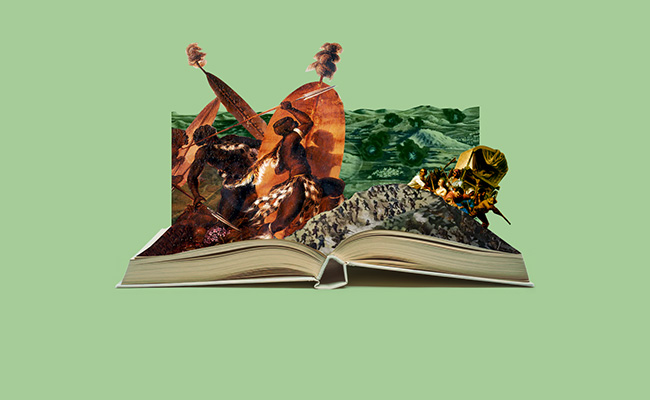
But Van Etten’s view was that you couldn’t understand South African history without including the Mfecane, which was totally absent; I mean absolutely not taught at all. So, without sanction, without the lure of boosting your marks in the end-of-year exams, she spent a few weeks reading to us from Donald R Morris’s wonderful account of it, The Washing of the Spears, and discussing conflicts and movements within the indigenous population of South Africa. It was an incredibly insightful and brave decision for a teacher to take at that time.
And it helps that the story of Shaka and the Zulu nation is riveting, in the way that history can seem to spring up in front of your eyes. But it wasn’t just an astonishing story, it was also consequential.
One for the books
Fast-forward to the current day, and the history curriculum for pupils in grades 4 to 12 has been gazetted by basic education minister Siviwe Gwarube. And you won’t believe this, but it reflects almost exactly the political philosophy of the political rulers of the current day – including the fact that it’s 30 years late. Plus ça change.
The department of basic education (DBE) declares that this is a “new African-centred curriculum for 21st-century South Africa”. The DBE says that before 1994, school history put “the experiences and achievements of white people, mainly males” (you don’t say!) at its centre. The new curriculum, by contrast, expands the timeline backwards through archaeology, linguistics and oral history.
It gives African languages, oral traditions, praise poetry, folklore, memory and landscape a much more prominent place as sources. As far as content is concerned, the outline shifts hard towards African and precolonial histories, race and racism, segregation, gender, liberation struggles, heritage and the politics of historical representation.
Honestly, I’m on board with lots of this. I particularly like the pedagogical imperative, because it makes the historical method far more explicit: every topic is organised around key questions, source evaluation, procedural concepts and argument.
But it’s all rather reminiscent of an ANC political seminar. Obviously the drafters are aware that everybody is going to be making this accusation, so they are careful to mitigate this. The Boer War, for example, is not discarded entirely – it is just kinda demoted. It is now called the South African War and looks beyond the Boers and the Brits, and stresses black participation, black suffering in camps, and the postwar exclusion of blacks from the settlement. And in grade 12, it returns within a broader topic on imperialism, industrialisation, Afrikaner and African nationalisms, and the road to Union.
Overcorrecting
Fair enough. But you know how you can tell that this is a nationalist rather than an intellectual approach to history? First, a comparative analysis of post-independent African history is just not there. What could be more interesting and relevant to modern students?
And second, there is lots on African intellectual contributions – for example, ubuntu as a humanist philosophy. It is all very clearly designed to make you proud “as an African”. Fine, legitimate correction.
But corrections can overcorrect. To me, the curriculum doesn’t give learners a clear encounter with Locke, Rousseau, Smith, Marx, liberalism, nationalism, conservatism and the Enlightenment as historical forces. European ideas are certainly present, but only as actors within colonialism, racism or revolution, not in a systematic, intellectual-history way. And yet we live in a world where Chinese businesses (and everyone else) use a system of accounts invented by a Franciscan friar in Tuscany in 1494.
Distinguished professor of education at Stellenbosch University Jonathan Jansen has described the proposed new history curriculum as “anti-intellectual and soul deadening”. I wouldn’t go that far. But Naomi van Etten’s history class this is not.
ALSO READ:
- Matric: The exit point for top South African students
- Say no to ‘political economic empowerment’!
- We’ve got the spirit, how about you?
Top image: Rawpixel/Wikimedia Commons/Charles Bell/Bacon’s South Africa War Prints/Currency collage.
Sign up to Currency’s weekly newsletters to receive your own bulletin of weekday news and weekend treats. Register here.