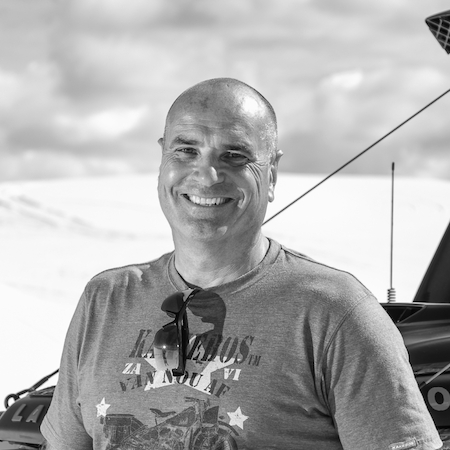
In ‘Overlanding Through the Boardroom’, Johan de Villiers turns bush lessons into business ones. In this edited excerpt from the book’s fifth chapter, he explores how a high-stakes mountaineering expedition on South America’s deadliest peak taught him the psychology of team selection – and how understanding what drives the people in front of you is the difference between sealing the deal and walking away empty-handed.
In the mountaineering world, summiting the Seven Summits – the highest mountain on each of the seven continents – is a dream for many. The list includes Everest in Nepal, Aconcagua in Argentina, Denali in Alaska, Kilimanjaro in Tanzania, Elbrus in Russia, Vinson in Antarctica and Carstensz Pyramid in Indonesia.
My mountaineering journey began in 2004 with Kilimanjaro. In 2010, Kim and I trekked to Everest Base Camp, crossing the Khumbu Icefall – and that was when the mountaineering bug bit us properly. We became determined to conquer all seven.
Climbing is not cheap. Over a decade later, the cost of expeditions has soared by nearly 300%. Some of those summits remain indefinitely postponed for now. But in 2012, we set our sights on Aconcagua – the highest mountain in the Americas, the highest outside Asia, and the highest peak in both the western and southern hemispheres. Its Spanish nickname is el asesino – the assassin – and for good reason: it kills more climbers per year than Everest.
The weak link
We chose the 360-degree full-route summit – longer, more expensive and more demanding than the standard southern approach, but offering a more immersive experience for those fit enough. After a four-hour shuttle from Mendoza to the entrance of Aconcagua National Park, we met our climbing team: two guides, Kim, a Singaporean ultra-distance desert runner who had completed the Gobi March – 250km through the Mongolian desert carrying everything you need to survive – and a rather boisterous American in his 60s who announced, without much prompting, that this was his third attempt at the mountain. Let’s call him Chuck.
Two red flags surfaced almost immediately. At base camp, a mandatory health check determines whether you’re fit enough to proceed. Anyone who fails has their permit cancelled and goes home. Chuck’s oxygen saturation levels were in the acceptable range, but only just. He was given the green light – but the concern lingered. We had one weather window. One shot at the summit. If we didn’t make it in that attempt, it meant wasted time, wasted money and three weeks of our lives gone. Chuck was already looking like a liability.
Every day, we ventured out for acclimatisation climbs, following the cardinal mountaineering strategy of climbing high and sleeping low. The weather was worsening, and with each passing day, Chuck was struggling more visibly. Then, monitoring weather data via a satellite dish at base camp, we spotted a potential window: a clear 18-hour stretch three days out, followed by a week of severe weather. If we didn’t take that window, the expedition would be scrapped entirely.
The problem: the third day was scheduled for another acclimatisation climb, not the summit. We weren’t fully acclimatised. And Chuck was the weakest link. If he couldn’t keep pace on summit day, we’d all have to turn back.
Difficult decisions had to be made. When Chuck stepped out to visit the food tent, we cornered our guides. After some discussion – and with the Singaporean runner’s agreement – they agreed to pull Chuck from the team and move the summit attempt forward by two days.
We began the perilous 10-hour ascent to Camp Colera at 5,970m, a desolate landscape of ice and snow, bone-chilling cold cutting right through us. We turned in at 7pm, hoping for five hours of sleep before the midnight clatter of tent zippers and the glow of headlamps would signal our final push.
At about 6am, the guides stopped us. The Singaporean runner was now falling behind. At our current pace, it would take too long for all five of us to reach the summit and get back before nightfall.
Kim and I exchanged glances.
“We are not turning back,” Kim said. “We are going for the summit, with or without you.”
After a heated exchange, the guides reached a consensus. One would escort the Singaporean back down. The other would press on with Kim and me. Six hours later, our South African flag flew from the summit. We made it back just as the weather moved in.
When we arrived at base camp, we were greeted by a Georgian professional mountaineering team – all 14 of them. They’d been camped there for a week. They’d misjudged the weather, missed the window and were heading home. Kim and I were the sole conquerors of the summit that week.
Two lessons from the mountain
This experience reinforced two principles that extend far beyond the mountains.
The first is that team selection is everything. In mountaineering, if you do not trust the person on the other end of the rope with your life, you should not be climbing with them. A weak link doesn’t just slow you down – it can force you to compromise the entire objective or, worse, endanger everyone on the rope.
The same principle applies in business. The decision of whom you partner with – whether employees, clients, suppliers or service providers – carries equal weight. A poor choice creates a weak link, and when that weak link fails, it can force your entire organisation to abandon its larger goals. Ethical considerations compound this. Always put ethical conduct at the forefront. If a partner’s ethical standards conflict with yours, that is reason enough to end the relationship, regardless of the short-term cost.
The second lesson is adaptability. Sticking to a flawed plan is a recipe for disaster. When conditions change, the ability to pivot – and the courage to do so – is what separates those who summit from those who go home empty-handed.
The psychology of sales
Navigating team dynamics on a mountain mirrors something I have observed throughout my career in sales: both require a deep understanding of human motivation, and both reward those who can read the room and adapt their approach accordingly.
At its core, the psychology of sales is about understanding what drives people to invest in something – a product, a service or an idea. Every handshake, every pitch and every successful deal springs from that understanding. And whether you realise it or not, you are playing the role of salesperson constantly. Persuading your partner about a holiday destination, negotiating with a contractor, discussing costs with an architect – in every case, you are selling an idea or a willingness to meet halfway. Understanding the person in front of you – and what drives them – determines the outcome.
The four personality types
After considerable experience in the field, I have come to identify four distinct personality types. The goal is to identify who you are dealing with within the first 30 to 60 seconds of meeting someone. That quick assessment can be the difference between closing the deal and losing it.
The first divide is between those who tell you what they want and those who ask questions.
The Director is composed, decisive and results-oriented. They walk into a car dealership and say, “I want a black 911 Turbo S.” If you have one at the right price, the deal is done in minutes. If you don’t, think twice before suggesting an alternative – a Director asked for something specific, and redirecting them risks losing the sale altogether. In a B2B setting, Directors occupy traditional leadership roles: team leads, managers and C-suite executives. Pitch to them on a single page. Get to the point. They respond well to a pressure close – creating urgency around scarcity or timing. Their blind spots are impatience and a lack of empathy that can make clients feel like line items rather than relationships.
The Emotive is impossible to miss. Hands and eyes in constant motion, emotions swinging visibly between highs and lows, launching into a colourful account of their morning before you have asked a single question. The Emotive is the most persuadable of the four types. Appeal to their senses – put them in the car, let them feel the G-force, hear the turbo, smell the nappa leather – and the sale closes itself. In B2B environments, Emotives gravitate to sales and marketing. Mirror their energy. Entertain them. Like Directors, they have short sales cycles and make quick decisions. Their weakness is emotional volatility, which can cloud judgment and create friction in team environments.
The Scientist arrives with a brochure and a list of questions. They want projected resale values, fuel consumption broken down by urban and highway driving, carbon emissions data and insurance estimates – and they will challenge any inconsistency between what you say and what the brochure says. Never rush a Scientist. Never use a hard close. Provide specification sheets, case studies and reference sites. Expect a sales cycle measured in weeks. In B2B settings, Scientists fill technical, financial and administrative roles – engineers, accountants and purchasing managers. Their weakness: slow decision-making under pressure and a reserved nature that can impede team cohesion.
The Amiable is, I will be candid, my least favourite to deal with in a sales environment. They ask questions like a Scientist but without seeking data-driven answers. They agree with every pitch, nod enthusiastically, and appear close to committing – before finding a reason to leave and “think it over”. In a business context, an Amiable will often award the purchase order to whichever salesperson last spoke to them, simply to avoid upsetting anyone. Identify them quickly, treat them courteously, use a pressure close to force a decision, and redirect your energy elsewhere before they consume your resources without producing a result. Their strengths – empathy, collaboration, networking – make them genuinely valuable in human resources and support roles, but they are miscast in high-pressure sales or negotiation positions.
The six persuasion buttons
Understanding personality type is the broad view. The six persuasion buttons are the precision instrument beneath it. Every individual is driven, to varying degrees, by one or more of the following: power, achievement, recognition, association, safety and order.
Visual cues are among the most reliable indicators. The person who places their BMW M5 key on the boardroom table is likely driven by power and achievement – respond to the signal, and respond explicitly. The MBA certificate framed prominently on the office wall signals a need for recognition – comment on it. You will be five steps ahead of every competitor who walked past it without a word. The gold Rolex is not a timekeeping device. It is a statement. Notice it.
Finance directors, accountants, and auditors respond to safety and order. Weave words like “compliance”, “fiduciary duty”, “corporate governance” and “risk management” into your pitch. Demonstrate that every box has been ticked before you ask for the order. Engineers and technicians are driven primarily by recognition and association – a public email praising a late-night effort costs nothing and achieves more than an overtime cheque. Sales representatives, on the other hand, want the commission. Different professionals, different buttons.
Selling to organisations
Pitching to a boardroom is a fundamentally different exercise from selling to an individual. You will not have time to identify each person’s personality type, let alone target their individual persuasion buttons. Instead, your focus must shift to the collective needs of the organisation, addressed through three primary drivers: image, performance, and finance.
Image means understanding how your product or service enhances the company’s public identity and stakeholder perception. Performance means demonstrating, with tangible evidence, how your offering increases productivity, removes bottlenecks or improves outcomes. Finance means making the long-term financial case – not just the upfront cost, but the savings, revenue uplift and return on investment.
Consider three very different examples. For Intel, performance is paramount – establish your competitive edge before discussing price, and don’t leave the room until you have. For Investec, an investment bank with a high-net-worth client base, the primary buttons are image and finance in close balance – position your offering as premium and contemporary, and reinforce the return-on-investment narrative. For BP, which famously spent $211m redesigning its logo into a green sunflower, the answer is unequivocally image – pitch the eco-friendly credentials of your product, propose donating end-of-life equipment to a school or charity of their choice, and arrange media coverage of the donation. Only once image is addressed does the financial conversation become relevant.
Negotiating with a tribe
I want to close with a story that maps tribal negotiation directly onto corporate selling.
In 1998, stranded in the Zambian wilderness after missing a border crossing, Kim and I found ourselves followed by an unknown vehicle through the pitch-black African savanna. A hand-painted sign reading “CAMPING” appeared in our headlights. We turned off the road and followed a rough track for 2km through dense bush until it opened into a clearing. A figure emerged from the shadows – a Maasai warrior, well over six feet tall, spear raised in greeting, face marked with intricate scarification.
“Do you want security for the night?” he asked.
When you are stranded in the wilderness, and a Maasai warrior holding a spear asks if you need protection, there is only one answer.
“How much?” I asked.
“Two dollars,” he said.
At six the following morning, I unzipped our tent. He was standing in the same spot. He had not moved in 11 hours. He gave his word, and he kept it.
The parallels to corporate selling are deliberate. Whether negotiating for your safety in the African bush or standing outside a boardroom door, the principles are identical. Identify the real needs of the other party – not the surface ones, but the ones that drive their decisions.
Engage the key decision-makers, not just the most visible face in the room; every organisation, like every tribe, has its elders whose opinions carry weight. And respect cultural differences – every company has its own values, rituals and ways of doing things. Ignoring them is the fastest way to lose trust before the pitch has even begun.
Whether on the slopes of Aconcagua or in a glass-walled boardroom, what you are ultimately selling is the same thing: yourself, your judgment and the trust that comes with it.
‘Overlanding Through the Boardroom: Using Adventure Principles for Success in Business’ is published by Rockhopper Books.
Johan de Villiers is the leader of First Technology Western Cape, an award-winning IT provider in South Africa.
ALSO READ:
- Chapter 4: Lessons from black swans
- Chapter 3: The Dunning-Kruger effect
- Chapter 2: The Swiss cheese effect
- Chapter 1: The mindset factor
Top image: Rawpixel/Currency collage.
Sign up to Currency’s weekly newsletters to receive your own bulletin of weekday news and weekend treats. Register here.