

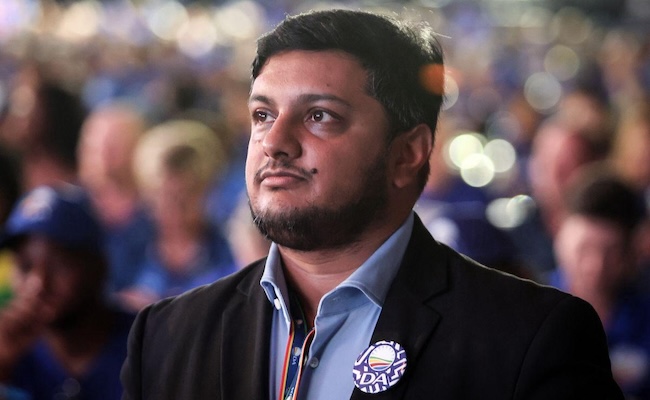

Ashor Sarupen has succeeded Helen Zille as the DA’s federal council chair – arguably the most powerful position in the party. He will be the strategist behind the DA’s 2029 national election ambitions – and the fight for Joburg this year is central to the plan. He spoke to Currency.
What exactly is your role as federal chair?
Effectively, on a plain reading of the constitution of the DA, the entire engine room – everything that moves in the party – reports to me. So my role is broad and sweeping. The way I see it is that the leader of the party will set tone, vision and direction with the new federal executive, and my job is to turn these things into strategy and execution.
Is this an especially acute time now ahead of 2029?
We have to lay the groundwork in the 2026 local government elections for success in 2029. With the ANC collapsing we’ve got to make the right kinds of breakthroughs to become the largest party in the country, without sacrificing our values. And that’s the second part of my role. The Progressive Reform Party, in 1975 when it was merged with the PFP [Progressive Federal Party], created the position of chair of the federal council. People who held that position were Gordon Waddell, Harry Schwarz, Alex Boraine, Douglas Gibson, James Selfe and Helen Zille. Each of those were core liberal ideologues who kept the party ideologically centred, and now as we try to make our big breakthrough with probably the youngest leadership cohort in the country, someone’s got to be the hardened ideologue.
Do you have to be a hardened ideologue? Is that maybe one of the reasons the DA hasn’t grown as much as it could have?
Look, the constraints on the DA’s growth have nothing to do with ideology, but whenever we’ve fallen back it’s because we’ve betrayed who we are to our voters. You don’t have to be a liberal ideologue to vote for the DA but what you do get when you vote for the DA is the things beyond delivery that people vote for: language, culture, religion etc. The crux of the DA’s offer is that those things are best defended and protected when we defend and protect each others’ rights and responsibilities and language and culture and religion – not when we do it just for people who look like us and talk like us. And the moment we betray that is when we run into trouble. So internally, when we approach things, we must always be principled. I don’t think it wins votes but the opposite loses votes.
It’s about building up a ground war of hundreds of thousands of activists who knock on doors every day and speak to voters. That’s where the breakthrough will come, and that’s been my project for the past five years as deputy campaign manager and then campaign manager and deputy chair of the federal council. It’s to build up the DA on the ground to make sure we’re genuinely embedded in the communities we try to represent, and the ones we’re trying to make breakthroughs into as well.
Do you think that’s working?
Well if you look at the DA’s losses in 2021 to ActionSA in Gauteng, as an example, and then the sudden resurgence in 2024, most of those [votes] came from the south of Gauteng, in the townships of Emfuleni and Midvaal. What we did was find 230,000 additional votes to augment the losses from ActionSA and Rise Mzansi by winning over ANC voters. So, yes, it does work.
If you look at by-elections where we’ve tested the methodology, in the Eastern Cape in Govan Mbeki, a 100% rural black ward, we got 25%. In Tshwane, in a ward in Soshanguve, we went from 6% to 12%.
Politics can’t be an abstract thing – social media and AI – that’s not it. Why was the ANC formidable once upon a time? Because it ran a massive ground machine and even if it made mistakes, three weeks before the elections it would have tens of thousands of people speaking to communities and it is that physical interaction that moves voters.
What other plans do you have?
The lawfare project will continue: we’ll continue litigation against expropriation without compensation; we’ll continue to take on the NHI [National Health Insurance] in court. The critical projects that have made the DA what it is. Everything Helen [Zille] did well, I will continue. Obviously I have my own style …
Does it impede your work in Treasury? It’s a huge job in and of itself?
Thankfully I’m based in Gauteng, the National Treasury’s based in Gauteng and the DA has a federal office in Bruma. I live 10 minutes away from the DA office and an hour away from Treasury. There’ll be a very tight separation of party and state, and I’ve warned the DA they’ll have to shuttle me because I’m not going to use any government resources to do party work.
When do you sleep?!
James Selfe used to say: ‘What are you doing between two and four in the morning?’. We’ll figure it out. Successful political parties have their leadership in government; it’s not unusual. I think it’s doable.
Is this what you always wanted?
No, I never planned a political career. I was a student at Wits, I studied a BSc, but I got involved in DA politics and it was all quite by accident.
For outsiders, one of the issues with the DA seemed to be a likeability problem. Do you think that’s changing?
There’s a presumption that the DA’s problem is likability. I don’t think that’s true. South Africa’s had a history of apartheid and the ANC positioned itself as the liberation movement, and if you read Anthea Jeffery’s book, The People’s War, any alternative to that was discredited in the 80s. So there’s a deep culturally-embedded view of politics in communities, and that’s generationally embedded. So you’ve got to move beyond that to change it. It’s sociological. You could give the DA a fresh coat of paint, you could bring a nice likeable person in as leader – it won’t necessarily make any difference to the result. You have to change hearts and minds one individual voter at a time.
Do you think you really can unseat the ANC?
All proportional representation systems lead to fragmentation; that’s a fact of politics. What the DA has got to do is make sure we can get ourselves bigger than anyone else so we can lead the government. We’ve got to grow the DA to be the largest party.
And in Joburg? How many votes do you actually need to win there?
If we got 490,000 voters, we’d get 51% of Joburg – based on the turnout trends since 2019, which have been dropping.
Is that all?
It is achievable. In the last national election, turnout in Joburg was 63% of the national ballot and 61% of the provincial ballot. In 2021, turnout was 42.7%. Bear in mind that in 2021 the ANC only got 313,000 votes on the ward ballots. The DA got 247,000 and ActionSA got 128,000. So based on those turnout trends, only 922,000 people voted in Joburg in 2021.
Does that make people think: ‘Oh that’s not much, I don’t have to go and vote,’ or does it galvanise them?
This is the thing: we keep trying to explain to voters in Joburg that if you don’t vote, you cost us three times. Because you cast a ward ballot, you cast a proportional ballot, and then the IEC [Electoral Commission of South Africa] adds those two together to determine the overall proportionality of the council. But I think if DA voters understand that if they just pitch up and stand in the queue, in Gauteng everything is to play for.
*This article has been corrected to reflect that the DA needs 490,000 voters to win. We regret the error.
ALSO READ:
- The DA just got much younger. The ANC should worry
- Dear John … what comes next for the DA?
- The economic fix: Sarupen’s roadmap to faster growth
Top image: supplied.
Sign up to Currency’s weekly newsletters to receive your own bulletin of weekday news and weekend treats. Register here.





Its infuriating to think it would only take 490,000 votes to give the DA a majority and turn this city around. I can’t believe people enjoy living with broken traffic lights and streetlights, giant potholes and water that may or may not come out of the taps. Do they really think this is normal? Why do people just accept it as such? Its unbelievable!
A reform that needs to happen is around multi-ward candidacy. In 2021, Al-Jamah had one candidate standing in 114 different wards. The votes amassed in each ward in which he stood contributed to the party’s total votes and therefore total seats, and resulted in the party getting a crucial 3 seats – and ultimately, 2 mayors. To add insult to injury, the candidate who stood in 114 wards then left JHB for Parliament.