
Election after election, voters have drifted from the ANC. But they are not moving in large numbers to the DA. Instead, many have found a home in other parties or have stopped voting altogether.
The reality is that disillusionment with the ANC does not automatically translate into support for the DA.
Even as support for the former governing party plunged more than 17 percentage points to a lowly 40.18% in the 2024 elections, the share of the then official opposition party rose to 21.81% from 20.77% in 2019. That’s about 3.1-million votes for the DA – not exactly a leap when considering that, in just six months, former president Jacob Zuma’s MK Party attracted about 4.58-million votes on the national and regional ballot, 14.58% of all valid ballots cast.
The DA’s central problem is not visibility. It is not even competence. It is trust.
The party often assumes that poor governance, corruption and economic stagnation under the ANC will push voters towards it. But this ignores a key reality. Many former ANC voters are not rejecting the party’s policies. They are rejecting its failure to deliver on them.
If the ANC were to fight corruption decisively and grow the economy, many of its lost voters could return. That means the DA is not simply competing against a weakened ANC. It is competing against the ANC’s original promise.
This is where the DA’s challenge becomes deeper. It has changed the face of its leadership, but not its ideological posture on the issues that matter most to black voters.
Closing the trust gap
Newly elected DA leader Geordin Hill-Lewis represents a new generation. At 39, he is young and energetic, and he leads a more diverse team than the party has had before. In a country where representation carries weight, that matters.
But a new face does not equal a new political offering.
Hill-Lewis has made it clear that he stands in continuity with past leaders such as Tony Leon, Helen Zille, Mmusi Maimane and John Steenhuisen. His message is rooted in the DA’s long-standing themes: clean governance, opposition to corruption, protection of property rights, and resistance to current empowerment policies.
For many voters, this signals consistency. But not change.
The DA’s stance on BEE remains a sticking point. The party argues for an approach based on need rather than race. Many voters see this as a rejection of efforts to address historical inequality.
This is where the trust deficit becomes critical.
Hill-Lewis himself has acknowledged the gap. Black South Africans make up about 80% of the population, yet many do not believe the DA is fully committed to their advancement. Closing this gap is now his stated priority.
But closing a trust deficit requires more than messaging. It requires a shift in how policies are framed and understood.
The importance of visibility
There are also practical challenges. Hill-Lewis is still largely unknown in many black communities. The DA often points to his track record as mayor of Cape Town. But governance success in one metro does not automatically translate into national appeal.
Outside the Western Cape, the DA’s achievements feel distant. Service delivery in Cape Town may be strong, but it has not created an emotional connection with voters elsewhere.
Leadership style also matters.
Hill-Lewis is measured, calm and policy focused. These are strengths in government.
But South African politics often rewards leaders who can connect emotionally and command attention. In communities where he is not well known, his low-key style may not cut through.
Politics is not only about what you do. It is about how you are seen.
There is another layer to this challenge. About 11.49-million registered voters did not vote in the 2024 elections. That is a massive pool of potential support, and winning those people over will require more than presenting the DA as a better administrator. It will require a vision that speaks to their lived realities.
One of the biggest gaps in the current debate is youth unemployment. About 600,000 graduates are without jobs. This is not just an economic issue. It is a social and political crisis.
So far, the DA has not placed this at the centre of its national message. For a party trying to grow among young and black voters, that is a missed opportunity.
Breaking the ceiling
Hill-Lewis has outlined a clear plan. He wants to prove the DA governs well, build deeper connections with non-supporters, play a strong role in coalition politics and promote optimism about South Africa.
These are sensible goals. But they do not yet amount to a new political compact.
The DA’s growth has been stuck at about 20% for years. Breaking through this ceiling will require difficult choices. The party must expand its appeal without losing its core base.
That balancing act is not easy. On one hand, it must reassure traditional voters. On the other hand, it must convince black voters that it understands and prioritises their concerns.
The new leadership team is more diverse than the previous one. That is a step forward. But representation alone cannot change deeply held perceptions.
Ultimately, the DA’s problem is not that voters do not see it. It is that many do not feel it.
Hill-Lewis has time to change this. But time alone will not be enough. If the DA wants to become a true national alternative, it must do more than refresh its image. It must rethink how its ideas land with the majority of South Africans.
Until then, millions may continue to leave the ANC. But they may keep looking elsewhere for a political home.
Catch more of Zukile Majova’s viewpoints at Scrolla.Africa, a mobile-first news site covering breaking stories fast from communities across South Africa, where he is political editor, in English and isiZulu.
ALSO READ:
- The DA just got much younger. The ANC should worry
- 490,000 voters to win Joburg? Inside Sarupen’s grand plans
- Real Politics: Hill-Lewis might just be the reset the DA needs
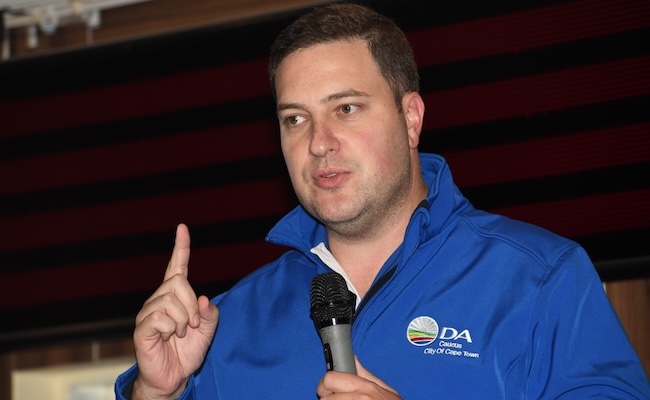
Top image: DA leader Geordin Hill-Lewis. Picture: Gallo Images/Frennie Shivambu.
Sign up to Currency’s weekly newsletters to receive your own bulletin of weekday news and weekend treats. Register here.