
One of the most dangerous things that can happen to an investor is making money for the wrong reason.
A bad decision that loses money may teach caution. A bad decision that makes money teaches precisely the wrong lesson: it rewards the behaviour, strengthens the story, and encourages a larger bet next time.
The market has handed you a profit. You assume it has also handed you praise. It has not.
The self-belief ratchet
When a decision goes well, the explanation is obvious. I saw something others missed; I was early; I held my nerve; I am, it turns out, a prescient and perspicacious genius.
When it goes badly, the explanation is equally clear. An unforeseeable twist of fate intervened, one that would have caught anyone. My thesis was sound; the timing was unfortunate, or the market behaved absurdly.
Success is internalised, while failure is externalised. Over time, self-belief ratchets upwards.
I was right. Therefore my reasoning was good, therefore I possess unusual insight, therefore the next position deserves to be larger.
The first lucky decision is rarely the one that causes serious damage. Trouble comes later, after luck has become identity, and identity has inflated position size. This may help explain why catastrophic corporate decisions so often come from hitherto successful chief executives: previous success has earned them confidence and freedom from challenge, making the next enormous bet feel justified.
Luck leads to hubris. Hubris increases the stakes. Eventually reality collects its debt.
The supposed Sports Illustrated cover jinx captures something similar. Sports stars often perform badly after landing on the cover because it tends to follow an exceptional run; the next performance is more likely to resemble their usual level than another career peak.
The cover did not cause the slump. It merely planted a flag near the top.
Why investing is such a bad teacher
In games dominated by skill, learning is easier. Where substantial luck is involved, it becomes much harder. Chess is a comparatively obliging teacher: the rules are stable, play is repeated, feedback is immediate, and mistakes can often be traced to particular moves.
Investing offers almost none of these comforts. Feedback is delayed, giving memory time to tidy up the original uncertainty. It depends on the horizon: an investment can look brilliant after six months and foolish after five years, or the reverse. The same decision cannot be repeated under identical conditions, and markets contain too many interacting causes for one clean explanation.
A stock may rise because your thesis was right, or because interest rates fell, the sector rerated, a competitor failed, sentiment caught fire, or simply because the whole market was going up. Usually, it is some mixture.
Veteran investing strategist and author Michael Mauboussin offers a simple test for how much skill an activity contains: can you lose on purpose?
A chess player can deliberately make bad moves; a 100m runner can deliberately run slowly. But you could buy a stock you considered a complete dud in an attempt to lose money and accidentally make a handsome profit. Investing involves skill, but luck remains stubbornly entangled with it.
Kenneth French, an influential American finance professor, once ran the numbers on a fund manager who genuinely beat the market by five percentage points a year after costs, with equity-like volatility. It would still take 64 years before we could be conventionally confident that the record reflected skill rather than luck.
Three investment careers spent waiting to discover whether the genius was genuine.
When the scoreboard lies
Investors judge decisions by outcomes because outcomes are visible. Profit feels like proof; loss feels like refutation. Yet a sound decision can lose money, while a foolish one can make it. The market is under no obligation to teach you the correct lesson.
Nor does a favourable outcome mean the risk was never there. If half your portfolio sits in one stock and it doubles, the concentration was still dangerous. The risk did not bite this time; that does not make it imaginary, or make taking it automatically wise.
Yet success rewrites the story. Concentration becomes conviction, leverage becomes efficiency, and failure to diversify becomes focus. Five technology stocks rising together may feel like five demonstrations of skill; in reality, you may simply have made the same bet five times.
Mistaking luck for skill changes what you do next. Confidence rises, position sizes increase, diversification feels unnecessary, and challenge becomes irritating because the evidence appears to be on your side.
Until it isn’t.
Create better feedback
If the market will not provide clean feedback, create some of your own.
Before making a significant decision, record what you believe, why the market may be wrong, what would undermine your thesis, the risks you are accepting, and the position size that the uncertainty justifies. Later, review the decision against what you wrote, rather than against the cleaner version your memory has since produced.
Do not ask only whether it made money. Ask whether the reasoning held up, the risks were identified, the position was sensibly sized, and if you would make the same decision again for the same reasons.
This will not remove luck, but it makes hindsight less able to rewrite the record. A single result tells you almost nothing; a documented pattern of well-calibrated decisions begins to tell you something.
Skill is not one spectacular outcome. It is a repeatable process that remains coherent across many decisions, including those the market happens to punish.
The uncomfortable solution
Investing requires confidence, but confidence should be earned slowly and spent carefully. The market will sometimes reward your mistakes and punish your discipline, so neither profit nor loss should deliver an unquestioned verdict.
When a decision goes well, resist promoting yourself from fortunate participant to market visionary; when it goes badly, do not automatically blame the weather. Luck becomes dangerous when it is mistaken for brilliance, because apparent brilliance licenses a larger bet.
The point is not to deny yourself credit, but to make sure it is deserved.
This article is part of an ongoing Currency series on how behavioural finance can help investors make better decisions.
If you’d like the full framework behind these ideas, including tools to align investing strategies with your financial personality, Greg B Davies’ CPD-accredited course, The Art of Behavioural Investing, created with 42Courses and Oxford Risk, walks you through the approach step by step.
ALSO READ:
- Don’t let fear of failure stop you in your tracks
- The difference between being an investor and a buyer
- Don’t dive at every penalty: the investing case for doing less
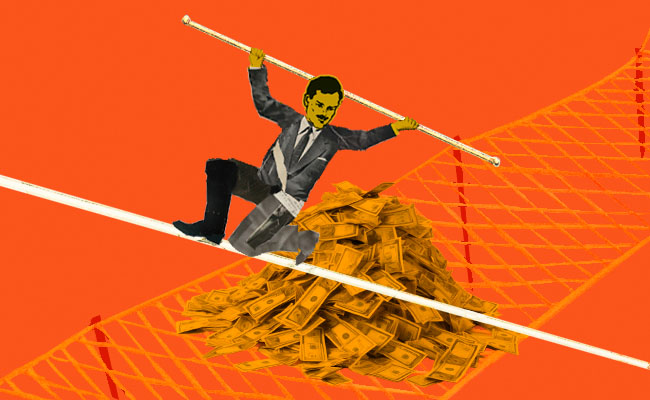
Top image collage: Rawpixel; Currency.
Sign up to Currency’s weekly newsletters to receive your own bulletin of weekday news and weekend treats. Register here.