
Alphamin has a tiny fraction of JSE owners, but the tin miner is about to post a record quarter’s earnings – about $158m – thanks to this year’s jump in tin prices, and is set to propose a fat dividend come the release of its year-end numbers. Currency spoke to CEO Eoin O’Driscoll.
Tin prices spiked from about $30,000 a tonne in January to almost $60,000, and are now at about $48,000. Is there a big speculative element to the increase or is there a genuine supply deficit that’s helping?
We think it’s a confluence of factors. There’s a certain element of dollar weakness. There’s definitely a constraint in supply. Myanmar has fallen off quite substantially over the past five years; it came from nowhere to about 15% of the world’s supply and it was all alluvial, artisanal mining. The thinking is that has been depleted and there’s been no industrial-scale exploration development [since]. The other big one is Indonesia: it was producing 80,000 tonnes three years ago and closer to 50,000 last year, and it’s also struggling to keep up with its production levels.
So on the supply side we feel very comfortable that we’re heading for a structural deficit, and on the demand side it’s starting to pick up as well with AI infrastructure demand etc. There’s a very real correlation between semi-conductor demand and tin prices; it tracks almost perfectly.
But there have also been some positions put in the market and we’ve seen that in short-term spikes in the past, when they unwind the price comes crashing down again. But it’s less likely to be as severe this time. We think north of $40,000 a tonne is pretty sustainable at this stage.
As for your own supply, it seems pretty constant at about 5,000 tonnes a quarter?
For the next six, seven years that’s where we see ourselves. Beyond that we need to have exploration success and extend the life of the mine. Normally if they’re worried about DRC [Democratic Republic of Congo] supply, they’re worried about us, and every time the tin price spikes we get calls asking if we’re evacuating, but we’re not.
Yes, I hear there have been quite a few skirmishes around Bisie, where your mine is located. Is it still quite a fraught region?
Very clearly the region has had 70 years of semi-permanent conflict. Around the mine it’s very settled and we haven’t had any security incidents in a long time. [But] in the past 18 months, [rebel group] M23 has been the big story and they are a different level of armed group to what we’ve seen in the past. There are skirmishes between the DRC and the army, but about 150km east of us.
It seems in your production update that the extra drilling you’ve done at your Mpama North mine hasn’t yielded much to get excited about? If we’re talking about how to extend your life of mine …
The drilling so far has been underwhelming. We originally did our drilling at Mpama North from 2015 to 2017 and then concentrated on development of the mine, and in 2020 we were in survival mode. We then restarted exploration, and in 2021/22 had a lot of success in extending Mpama North and finding the Mpama South deposit. The original intention was to bed down Mpama South and then hit exploration hard again; last year was somewhat interrupted by the evacuation in March.
It’s very early days, we’re going to keep looking around the extensions in Mpama North and South, but the initial holes weren’t the quick easy wins we’d hoped for.
Does it really matter for the time being? If you’re producing 20,000 tonnes a year and tin prices remain here, then you’re just an understandable, consistent little investment for the next seven years?
It’s very much our intention to mine there for 40, 50 years to come. It’s an extremely highly prospective area, [and] it’s completely unexplored. So your worst-case scenario is a pretty nice little case, but absolutely not what we see happening.
Does that mean you have to have a nuanced approach to your dividend? Will you need to keep cash back?
That’s very unlikely. Exploration isn’t really a massive needle-mover in terms of cost. We’ll probably spend $10m-$20m a year in the next couple of years on exploration. If we could spend $100m and guarantee more reserves we’d do it, but we’re constrained by how many drill rigs we can sensibly have drilling. The topography’s very difficult, you’ve got to clear roads, it’s quite a narrow, steeply-dipping orebody, so you have to be quite precise in how you drill to make sure you hit it.
So that would suggest your dividend is pretty secure?
It’s up to the board, but I’d be surprised if it’s not a substantial dividend.
How big is your South African investor base, given that you’re also listed on the Toronto Stock Exchange (TSX)?
We have about 15-million shares out of 1.3-billion on our listing, so about 1%.
That’s tiny! Why do you keep a JSE listing at all?
We originally did the listing in 2017 when we were developing Mpama North, and there appeared to be a lot of interest in South Africa at that time. It just didn’t really take off and we raised a lot less money than we’d hoped. But delisting is a headache, frankly, and I think where we’re at now is that we accept that we have the listing and we’d rather like to give it a bit more life. The shares are transferable between the TSX and the JSE, and with the rand strength maybe it’s a good time to look at [a stock] with a high-dividend dollar yield.
You are coming up against the same sort of indifference or unease that a lot of junior miners and exploration companies experience from the local investor community. Does it mean you have to go on costly roadshows? Is it worth it?
I think it didn’t gain traction in the early days because it was preproduction, which carries its own risk. The address is always tough, though we’ve developed a track record since then. And tin wasn’t a particularly well-known metal back then; it was trading at between $15,000 and $20,000 a tonne. So I think the story has changed and we’ll give it a chance, but if there’s no traction then clearly we’ll have to concentrate on where the shareholders are.
Which would be a pity … How about fuel costs? You said in your update that they’ve added about $2,000 to all-in sustainable costs. If oil stays at about $100 a barrel, what sort of cost increases will you have to swallow?
We’re seeing about 25%, maybe a 30%, in orders we’ve placed in the past six weeks. So if it stays around here that’s what we’d be looking at. But ultimately it’s not really a needle-mover. Our ebitda [earnings before interest, tax, depreciation and amortisation] margin is $30,000 a tonne, so it’s not the end of the world. Really the critical thing for us is supply, and so far supply has been fine. I think it’s been a headache for our fuel supplier, who’s running around everywhere he can trying to find supply, but he seems to be finding it so we’re happy enough.
What’s it like mining in the DRC? There must be loads of things you have to plan for that others would take for granted in a different jurisdiction?
Very much so. Critical spares and long lead items are something we have to think extremely carefully about. In a real emergency we’ll fly something in, but from Joburg to Kampala is relatively straightforward in terms of roads etc, but Kampala to the mine, which is 1,000km, is 30 days on a truck when everything goes smoothly, and in the wet season it can be north of 60.
We’ve had a few logistical headaches over the years, and anything and everything that can go wrong we think has, and we’ve always weathered it. So we’ve never actually stopped the mine. When staff go up there they say it’s a logistics operation with a mine attached, rather than the other way around.
This is the full version of an interview that first appeared in the Financial Mail. Currency and Financial Mail are part of the Financial Mail Group.
ALSO READ:
- Choke points and power plays in the age of critical minerals
- Shuka: A junior miner with a very grown-up asset
- Africa has turned the screw on its gold miners. Just ask Gold Fields
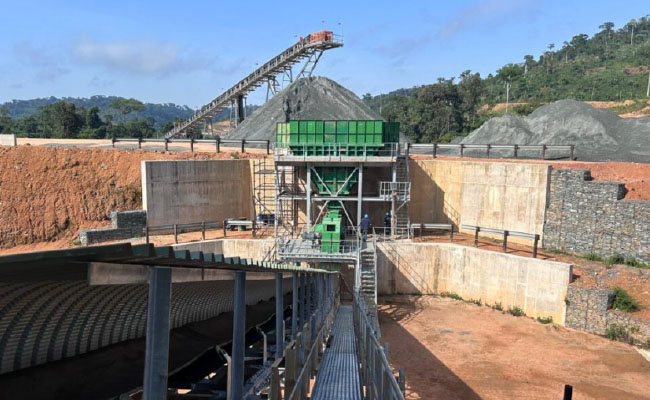
Top image: Alphamin’s Mpama South development. Picture: supplied.
Sign up to Currency’s weekly newsletters to receive your own bulletin of weekday news and weekend treats. Register here.