
If you want to understand good investing, Homer is as useful a guide as anyone from modern finance.
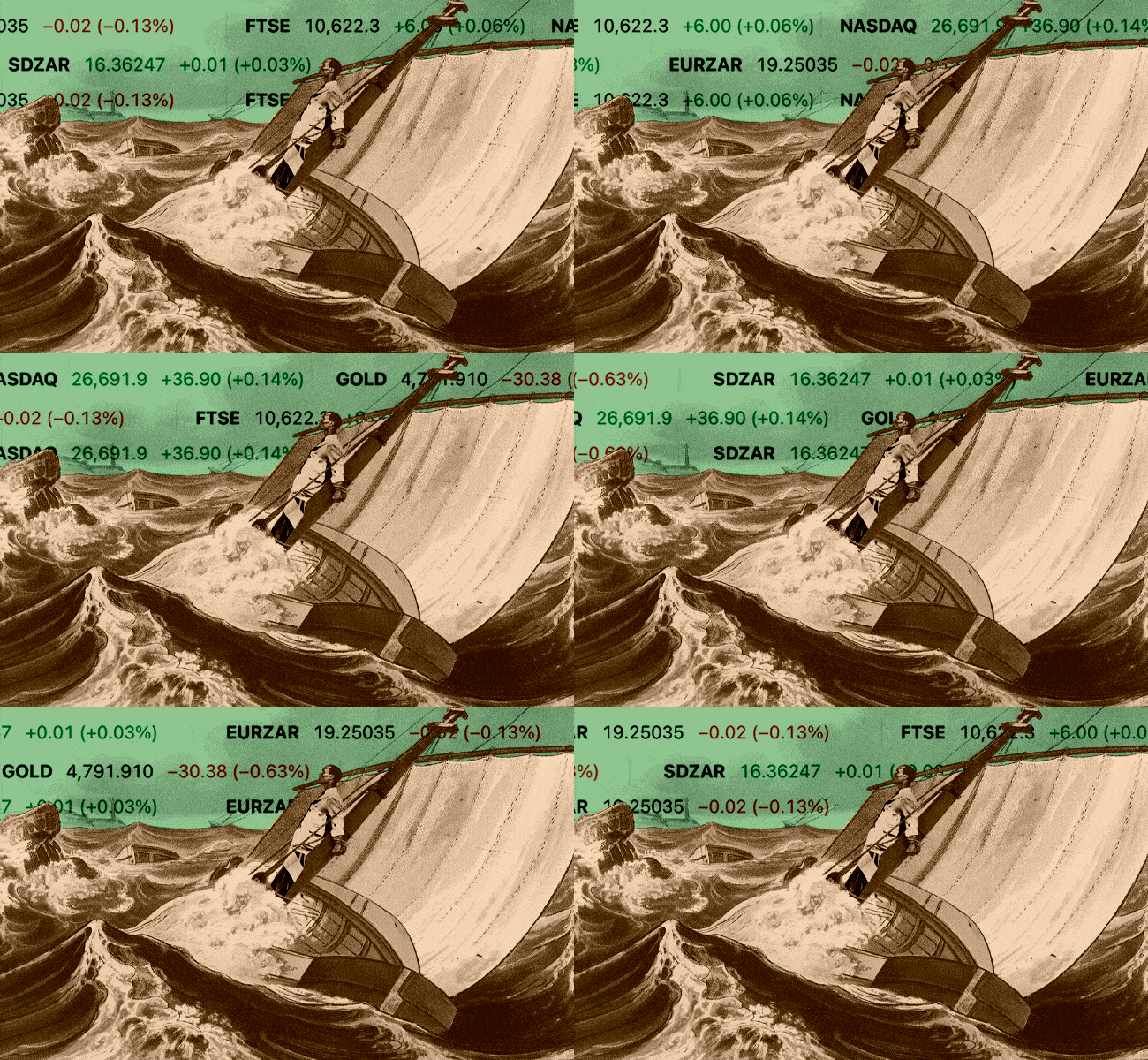
In The Odyssey, on his long route home from Troy, Ulysses knew that when he sailed past the Sirens, he would not be able to trust himself. In the calm of preparation, he could see the danger clearly. In the heat of temptation, he would not. So, he had himself tied to the mast and had his crew fill their ears with beeswax. He did not rely on his future self to be stronger. He assumed, correctly, that his future self would be weaker, noisier and much easier to tempt.
Investing requires the same modesty.
Most people assume they will behave sensibly when markets become extreme. They imagine that when the time comes, they will hold their nerve, rebalance calmly, ignore the headlines and resist the urge to “just do something”. History suggests otherwise.
The version of you reading this quietly over coffee is not the same version who will be staring at a 25% market fall on a flashing red screen while the news tells you that this time the world may, in fact, be ending.
The problem is not intelligence. It is volatility, both market volatility and emotional volatility. The solution is not willpower. It is structure.
The problem with future-you
We all like to believe that future-us will do the right thing. But future-you will be tired, distracted, busy and surrounded by whatever else life has chosen to throw at you that day. Markets will not wait until you are feeling balanced and reflective. That is why so many bad decisions are not failures of analysis but of timing, context and self-control. You cannot outsource self-control to your future self. That is a losing strategy.
The point of an ‘investing constitution’
An “investing constitution” is a simple rulebook created by your calm, rational self for the benefit of your future emotional self.
Want to be a better investor? Make your decisions ahead of time.
It might set out your target asset allocation, when and how you rebalance, how often you review your portfolio, and what sits outside your circle of competence. Most investors think they have principles. Very few have written commitments.
That matters. A written rule changes the character of the decision. Instead of asking, in the middle of a turbulent week, “What should I do?”, you are asking: “What did I already decide to do when I was thinking clearly?” A surprising amount of future stress can be eliminated just by deciding in advance not to do certain things at all.
If, like me, you have long since concluded that you have no edge whatsoever in predicting currency movements – and I have substantial doubts that anyone really does, though I certainly know that I don’t – then write it down: thou shalt not take currency positions. It is mildly absurd. It is also useful. In one sentence, you remove an entire class of future temptation.
As with investing itself, do not let the best be the enemy of the good. Start with a few simple rules and add to them over time.
Personal ropes
For example, I only ever allow myself to trade on weekends.
To many people, that sounds like an absurd self-handicap. Surely it means I miss opportunities or exits. Perhaps, occasionally, it does. But while I am around finance all the time and therefore see all the flashing lights, it is not my job to be on top of market details. That means I am particularly at risk of hearing the market Sirens without either the knowledge or the context to respond effectively. Indeed, most people who think they are not in this position are kidding themselves.
My weekend-only rule works for me because it eliminates knee-jerk decisions, forces me to operate on a longer horizon, and includes an automatic pause point since markets are shut. Yes, I might occasionally miss something, but with a long-term portfolio I should mostly be sitting tight anyway, and this set of ropes far outweighs any tenuous advantage I might get from nimble action.
None of this prevents me from hearing the Sirens. It simply stops me jumping overboard when they sing.
This will not be the right rule for everyone. But everyone should think carefully about when and where they permit themselves to make investment decisions.
Professionals, institutions and beeswax
Institutionally imposed rules are one reason professionals often behave better than individuals. Not the only reason, and certainly not always in ways that improve outcomes, but it matters. Mandates, sign-off procedures, risk limits, cooling-off rules, and other small frictions stop people from acting on every passing market mood. A constitution gives you some of that discipline without requiring you to become a professional.
The ropes are not the whole story. Ulysses also had his crew fill their ears with beeswax. Investors need beeswax, too. The Sirens of investing are your portfolio app, your news feed, your favourite doom-monger, the friend who has suddenly become an investing genius because one stock doubled, and the illusion that all of this requires an immediate response.
A good constitution should govern not just what you do, but what you allow in.
Constitutions should move slowly
A constitution is not a prison. It is a framework, and the whole point of a constitution is to constrain impulses. Of course, it can evolve. But one rule matters above all: never change a constitutional rule just to wave through a decision you already want to make.
Constitutions, by design, should change more slowly than the decisions they are there to govern. If the rules bend every time you feel strongly, they are not ropes at all. They are decoration.
The uncomfortable solution
The best investing decisions are often the ones you make before you need them.
Write the rules while you are calm. Put some beeswax in your ears. Then, when the next bout of volatility arrives – and it will – you won’t need courage. You will need compliance. And following a rule is far easier than summoning courage.
That is not a weakness. It is one of the few forms of self-knowledge in investing that reliably pays.
This article is part of an ongoing Currency series on how behavioural finance can help investors make better decisions.
If you’d like the full framework behind these ideas, including tools to align investing strategies with your financial personality, Greg B Davies’ CPD-accredited course,The Art of Behavioural Investing, created with 42Courses and Oxford Risk, walks you through the approach step by step.
ALSO READ:
- The four rules of investing (and why simple is so hard)
- Beyond the ‘big five’: Where disposition meets conditioning
- The portfolio you can stick with is the only one that counts
Top image: Rawpixel/Wikimedia commons, John William Waterhouse (Ulysses and the Sirens)/Currency collage.
Sign up to Currency’s weekly newsletters to receive your own bulletin of weekday news and weekend treats. Register here.