
The Phala Phala incident was deeply embarrassing to President Cyril Ramaphosa, so the ANC quickly swept it under the carpet. The Constitutional Court on Friday unswept it.
The result is a small avalanche of questions about what happens next, on what basis the decision was made, and most crucially, whether there is a chance Ramaphosa might actually be successfully impeached.
To answer those questions in reverse: successful impeachment is technically possible – that is the maximal outcome – but it remains unlikely. There is no question, however, that the process from here on out is going to be deeply embarrassing.
As it stands, the independent panel chaired by former chief justice Sandile Ngcobo found, prima facie, that Ramaphosa may have a case to answer over allegations that he failed to report the theft of foreign currency from his Phala Phala farm properly under anti-corruption law, used presidential protection resources improperly, and exposed himself to a conflict between his official duties and private business interests.
Specifically, the panel found prima facie evidence that he may have violated section 96(2)(a) of the constitution – which bars members of the executive from acting in ways inconsistent with their office or exposing themselves to conflicts between their duties and private interests – and section 34(1) of the Prevention and Combating of Corrupt Activities Act, which makes it an offence not to report certain crimes.
The Phala Phala incident is so unusual, and the circumstances so peculiar, that it is impossible to know whether more information may emerge – and what it might be. Since Ramaphosa is now almost certain to face an impeachment inquiry, the chances that further facts will come out are heightened.
How it all started
The case began with the February 9 2020 burglary at Ramaphosa’s Phala Phala farm, where foreign currency was stolen. Arthur Fraser, a former State Security Agency director-general and former correctional services commissioner, later alleged that the money involved was far larger than Ramaphosa admitted, had been improperly brought into South Africa, hidden in furniture, and then quietly investigated outside normal police channels.
Ramaphosa denied this, saying the money was $580,000 from a cash sale of 20 buffalo to a Sudanese businessman named on the receipt as Mustafa Mohamed Ibrahim Hazim – later publicly identified as Dubai-based businessman Hazim Mustafa.
The African Transformation Movement (ATM) then initiated a section 89 process, which sets out how parliament can remove a president from office, alleging serious constitutional and legal breaches. Speaker Nosiviwe Mapisa-Nqakula appointed an independent panel chaired by Ngcobo, with former judge Thokozile Masipa and advocate Mahlape Sello as members. The panel found enough initial evidence to justify further investigation.
The three-member panel’s concerns included the unclear route by which the dollars entered the country, the lack of records, the strange buffalo-sale arrangements, the storage of the cash in a couch, the absence of a normal South African Police Service case at Bela-Bela, the discreet investigation by major-general Wally Rhoode, and the unauthorised cross-border operation into Namibia in pursuit of the suspects.
Ramaphosa no longer has a political shield
At this point, the sweeping under the carpet began. On December 13 2022, the National Assembly voted 214 to 148, with two abstentions, not to proceed. Most ANC MPs protected Ramaphosa, bar five who failed to toe the party line, including then co-operative governance minister Nkosazana Dlamini-Zuma, who later faced internal disciplinary action. The report therefore never reached the impeachment committee.
Friday’s Constitutional Court judgment was contested, with three separate judgments delivered. Chief justice Mandisa Maya, delivering the majority judgment, found that rule 129I of the National Assembly rules was unconstitutional because it allowed the assembly to block the process after an independent panel had already found sufficient evidence for a section 89 inquiry to proceed. In other words, the rule allowed a political majority to stop the process before the facts had been properly tested.
The court’s temporary fix is crucial: where the independent panel finds sufficient evidence, the matter must now be referred to the impeachment committee. Parliament may no longer hold a preliminary political vote to kill the inquiry at that stage.
The deeper constitutional point is accountability. The court held that parliament has a duty not merely to have impeachment rules, but to have effective ones. It is not enough to table, debate and vote away a prima facie case. There must be an inquiry “of some proportion” into impeachment motions that are not plainly unmeritorious.
In a separate concurring judgment, justice Steven Majiedt said the impeachment committee is the stage at which evidence is tested, credibility assessed and the seriousness of the allegations evaluated. If the process is stopped before that stage, the public never gets the fuller factual ventilation that section 89 – the Constitution’s impeachment clause – requires.
So, the legal finding is procedural but politically explosive: parliament’s shield worked too early. The court has now removed that shield.
Where the real danger lies
What happens now? Parliament has to create a specially constituted National Assembly committee to conduct the real section 89 inquiry into whether the president has committed a serious violation of the constitution or the law, serious misconduct, or is unable to perform the functions of the office.
Section 89’s procedure is straightforward enough. An MP initiates it by substantive motion. The speaker refers the motion and evidence to a panel of three independent legal experts. If the panel finds sufficient evidence, the matter goes to a specially constituted impeachment committee, which investigates and reports back to the National Assembly.
After the committee reports, the house must schedule the report for debate and decision. If the committee recommends removal, the National Assembly votes. A president is removed only if two-thirds of MPs support the recommendation.
The National Assembly has 400 members. The ANC has 159 seats, the DA 87, MK 58, the EFF 39, the IFP 17, and smaller parties hold the rest. Two-thirds of 400 is 267. Even if every non-ANC MP voted to remove Ramaphosa, that would be only 241 votes. At least 26 ANC MPs would still have to vote against him. Abstentions would not help, because the constitutional threshold is two-thirds of members, not two-thirds of those present.
The political danger for Ramaphosa is therefore not only the final vote. It is the spectacle: a sitting president, already politically weakened by the ANC’s loss of its majority, forced back into the sofa-cash labyrinth in public, under oath-like parliamentary scrutiny, with every oddity of the buffalo sale, the couch, the dollars, laid out again like exhibits in a very expensive national awkwardness museum.
ALSO READ:
- Real Politics: There is logic in Ramaphosa’s madness
- Real Politics: Why Ramaphosa has to depend on flawed alliances
- Birth pains of the GNU: Fears of Ramaphosa’s resignation
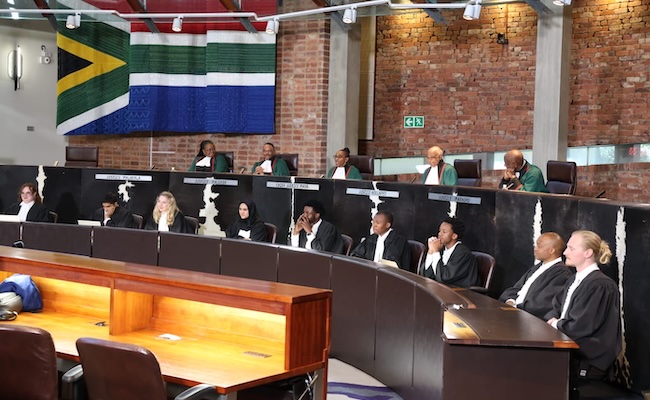
Top image: Legal personnel during the delivery of the judgment on Phala Phala at Constitutional Court on May 8. Picture: Gallo Images/Luba Lesolle.
Sign up to Currency’s weekly newsletters to receive your own bulletin of weekday news and weekend treats. Register here.