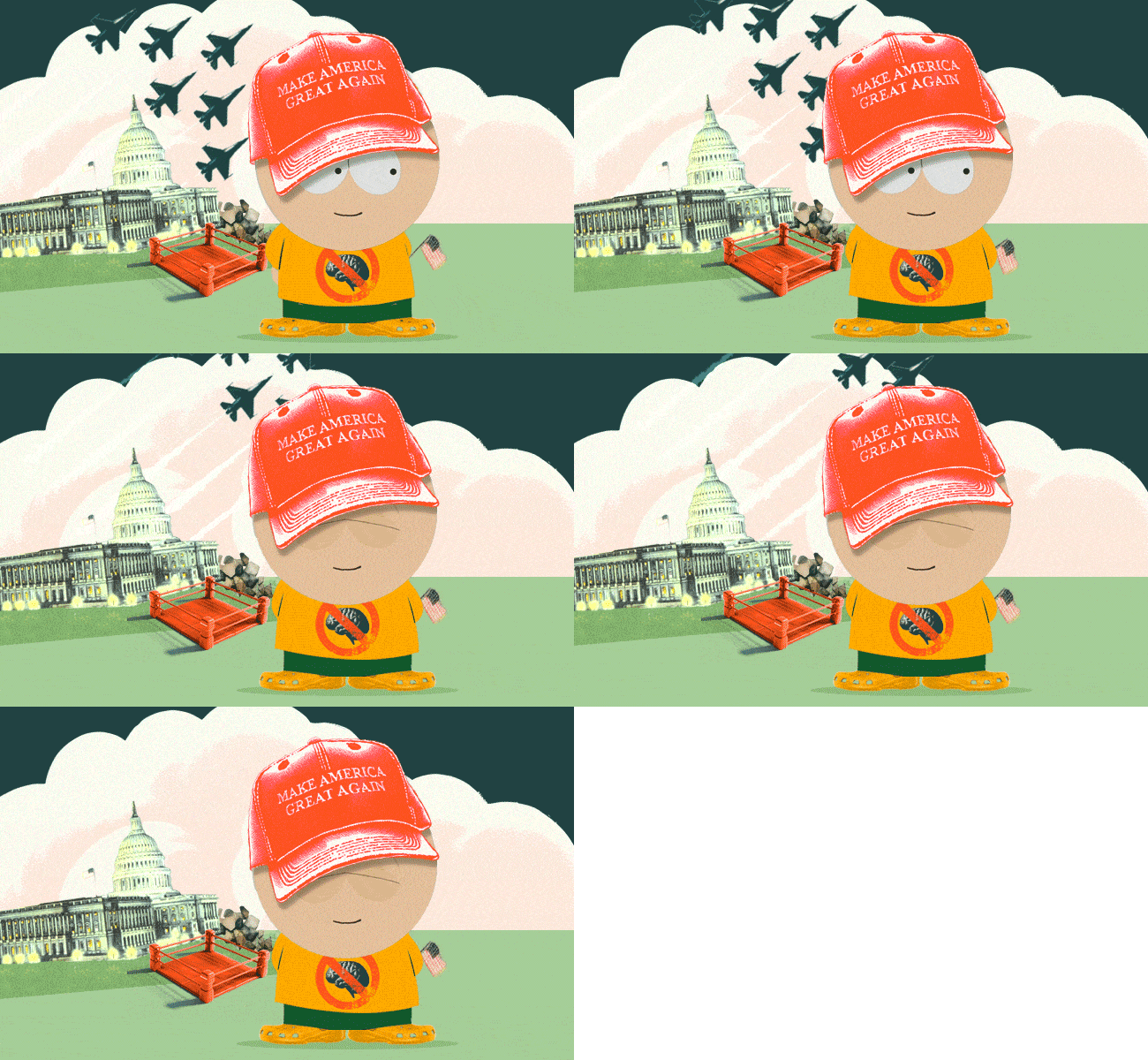


When the ANC voted to squash justice Sandile Ngcobo’s report to parliament on the Phala Phala scandal on December 13 2022, it was to be its final use of its majority to defend an ANC leader against parliamentary accountability.
It was a desultory moment for democracy. Here was President Cyril Ramaphosa, whose stature derived from his co-authorship of South Africa’s constitution, the nation’s most powerful instrument of accountability, using a parliamentary majority to stop an impeachment inquiry into the Phala Phala affair.
This was all the more so because, in the greatest of ironies, Friday’s judgment took place 30 years to the day since the constitution that Ramaphosa had shepherded into law was adopted on May 8 1996.
On that occasion, Ramaphosa said in his address to the Constitutional Assembly: “Co-operation, accountability, responsiveness and openness are entrenched as the principles of government at all levels in South Africa.”
Some 30 years later, it fell to the Constitutional Court to remind Ramaphosa of what he and his fellow negotiators had wrought – a constitution that prizes genuine accountability over the use of institutions to sweep criticisms of the head of state under the carpet.
Ramaphosa’s 2022 gambit was the outcome of hubris. The ANC, then with a parliamentary majority, believed it had saved itself from the decline of the Jacob Zuma years. Instead of seeing the impeachment process through and using its majority to protect Ramaphosa, it chose the path well-trodden by Zuma of turning parliament into a mechanism to avoid accountability.
Now the ANC has lost its majority, and all the cards are stacked against Ramaphosa. It is the opposition that will set the terms of the impeachment process and determine its pace and, finally, its outcome.
Surviving scrutiny
The hearings promise to be brutal. Ramaphosa’s version of events has a man from a foreign country bearing a suitcase full of US dollars arriving at his farm on Christmas day to buy animals. He leaves the cash, never takes delivery of the animals and, when the money (stuffed into a couch rather than placed in the safe) is stolen, he fails to inform the police and uses his security operative to recover it in Namibia.
It is a story that would not survive scrutiny in a second-year law school moot, never mind before a committee dominated by opposition MPs.
For there is no guarantee that the DA, the ANC’s leading partner in the GNU will back Ramaphosa. It’s new leader, Geordin Hill-Lewis, has made it clear that he wants the impeachment process to proceed uninhibited.
“We will uphold the rule of law as Phala Phala moves to the impeachment process. This is a serious moment for parliament, for the presidency, and for South Africa’s constitutional democracy. The president must have the opportunity to account fully,” he said.
The Constitutional Court judgment has placed Ramaphosa’s political survival in the DA’s hands. While the ANC can block impeachment, which requires a two-thirds majority, it cannot on its own stop a vote of no confidence if this is brought before parliament after the impeachment hearing.
Questionable company
It is not just on the Phala Phala front that Ramaphosa’s presidency is imperilled. In yet another moment of irony, Ramaphosa has dispatched Roelf Meyer, the man he negotiated the constitution with, to the US to try save South Africa’s fragile relationship with Washington following a series of foreign policy missteps.
But, even as Meyer was set for this most difficult of tasks, Ramaphosa blundered his way into fresh controversy with a visit to Zimbabwean President Emmerson Mnangagwa’s farm, where he walked about admiring the produce as if he was at a school fete organised by the nuns of the Holy Rosary.
Yet another irony was on display. Here was the man whose entire reputation rests on his role in the drafting of South Africa’s uniquely progressive and fundamentally democratic constitution, fawning over a man who is in the process of unilaterally amending Zimbabwe’s constitution to extend his term in office.
It was just a few weeks ago that the Zimbabwean human rights lawyer and campaigner for democracy and the rule of law, Tendai Biti, was arrested for daring to criticise these constitutional amendments.
Ramaphosa’s pally-pally visit and his silence on the treatment of Biti – and indeed other African democrats currently suffering repression in Tanzania and Uganda – was a strong signal of his approval for Mnangagwa’s power-grabbing constitutional manoeuvres.
It was Johann Wolfgang von Goethe who said: “Tell me with whom you associate, and I will tell you who you are.”
If there is any truth to this aphorism, President Cyril Ramaphosa is exposing himself as a man of shallow and malleable principles. Either that, or as a president who doesn’t know what he’s doing. Consorting with Mnangagwa was bad enough, but there was further embarrassment at the entourage that accompanied him.
One of those at Ramaphosa’s side on this farm walkabout was none other than wealthy Zimbabwean Wicknell Chivayo, whose brother, Joachim, is wanted in South Africa for money-laundering.
Sitting on his hands
Back home, Ramaphosa’s weak leadership was further exposed as the Joburg metro was warned that it is sinking into bankruptcy by the finance minister, Enoch Godongwana, in a leaked letter to mayor Dada Morero.
The slow-motion implosion of Joburg has been widely reported on for years, and Ramaphosa, using his well-worn tactic of not solving a problem by further investigating it, set up the presidential Joburg working group on May 7 2025.
It was supposed to “strengthen governance and financial sustainability”, improve delivery, including water provision, and tackle urban safety and security.
On all these fronts, Joburg has continued its rapid deterioration while, in a boardroom somewhere in the bowels of the Union Buildings, this working group has been sucking on peppermints and failing to take any meaningful decisions.
The cause of this malaise is Ramaphosa’s inability to take decisions that will alienate one or another of the ANC’s many factions, upsetting the well-worn patronage paths that have been trodden under its rule.
The signal that Ramaphosa would not act was made shortly after the 2024 election when, after being forced into a coalition government at national level with the DA and other parties of the broadly defined “centre”, he failed to extend this agreement to the Gauteng province and to the key metros.
The result has been a continued governance disaster, with the EFF now holding the Gauteng finance portfolio and the hapless Panyaza Lesufi failing to deal with his province’s teetering governance and finance problems.
In Tshwane, Ramaphosa allowed the ANC to sink the coalition with the DA and install a government riddled with corruption.
The city’s deputy mayor, Eugene Modise, was slapped lightly on the wrist and docked two months’ wages for not declaring his interest in a company making millions out of contracts with the council.
The council tellingly decided on the fine in a closed-door session where, according to EWN, “the ANC-ActionSA-EFF coalition used its majority in council to vote in favour of the report and recommended that Modise be fined two months’ worth of wages”.
Tshwane’s CFO, Gareth Mnisi, has been suspended after facing damaging questions at the Madlanga commission of inquiry, which looked into dodgy contracts.
Instead of extending the government of national unity model with the DA – which has improved the country’s governance and caused some optimism that there is now new impetus to deal with the country’s manifold crises from electricity to transport – Ramaphosa sat on his hands and allowed Gauteng, Joburg and Tshwane to sink further into mismanagement.
The chickens, as they say, will come home to roost when the residents of these metros cast their votes in November.
But, before that, the chickens of Phala Phala will roost in parliament.
President Ramaphosa has few cards to play, and opponents inside and outside the ANC are circling as his presidency implodes. Once a distant scenario, there is now the very real prospect of the ANC’s populists going for the jugular in alliance with the populists of the EFF and the MK Party. The doomsday scenario is back from the dead.
Ray Hartley and Greg Mills are with the Platform for African Democrats.
ALSO READ:
- Political suicide for the ANC in Joburg
- Real Politics: The ANC rebels out to kill the GNU
- Real Politics: Why Ramaphosa has to depend on flawed alliances
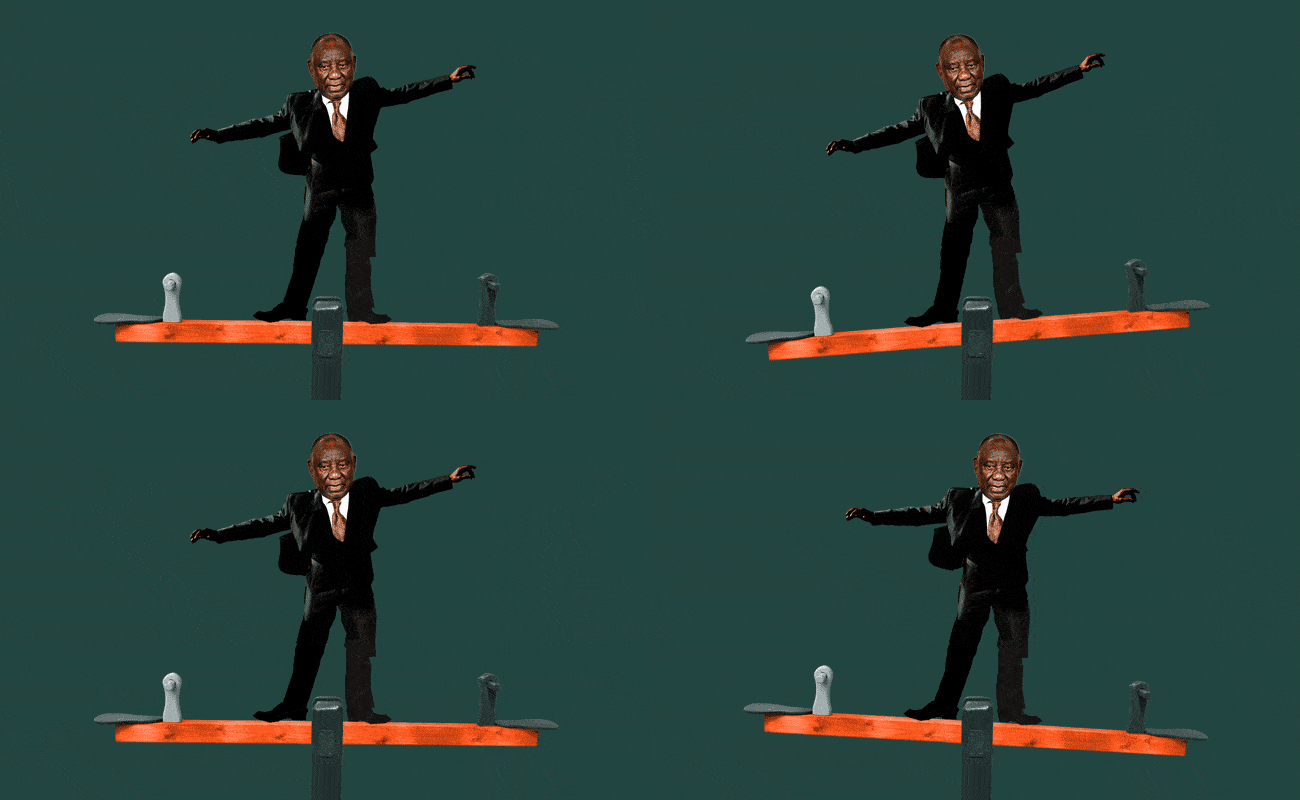
Top image collage: Frennie Shivambu/Gallo Images via Getty Images (Cyril Ramaphosa); Photka/iStock/Getty Images Plus; Pexels/Rene Madrid; Rawpixel; Currency.
Sign up to Currency’s weekly newsletters to receive your own bulletin of weekday news and weekend treats. Register here.