


Cyril Ramaphosa is scenario-gazing – and it’s pretty likely he doesn’t like what he sees.
The president has three options ahead of him after last week’s Constitutional Court ruling put the possibility of impeachment back in play. He could litigate to keep his job, accept the indignity of impeachment, or resign as the nation’s leader.
This is the view of Richard Calland, emeritus professor of public law at the University of Cape Town, partner at the Paternoster Group and co-author of The Presidents: From Mandela to Ramaphosa, Leadership in the Age of Crisis. It is the first option – lawfare – that he believes is most likely.
The issue dates back to 2022, when National Assembly speaker Nosiviwe Mapisa-Nqakula constituted a Section 89 panel to investigate the theft of $580,000 stuffed into a couch at Ramaphosa’s Phala Phala game farm. The panel, chaired by retired chief justice Sandile Ngcobo, found Ramaphosa had a prima facie case to answer – but parliament, where the ANC still held an outright majority, shielded him by voting down the report.
The Constitutional Court has now found that decision wanting, meaning the report should be referred to an impeachment committee and then, if necessary, to a parliamentary debate and vote. (See Tim Cohen’s explainer here.)
Only, Calland reckons Ramaphosa is most likely to attempt to arrest the process by reinstating a petition to the court to review and set aside the Section 89 panel report.
In early 2023, he made such an application to the Constitutional Court, believing the panel report to be unlawful and to contain errors of law. The top court dismissed it in March 2023, finding it didn’t have exclusive jurisdiction; Ramaphosa formally dropped further legal action that May, with his spokesperson Vincent Magwenya saying the matter had become moot as a result of the parliamentary vote. But his legal team explicitly reserved the right to revive it should circumstances change – which is now arguably the case.
Says Calland: “So we’re back to that point now … It’s very relevant again. I think he can go back to that matter and reignite the case and seek a stay on proceedings in the National Assembly.”
A legal challenge would certainly be preferable to dragging himself through the indignity of impeachment proceedings in the legislature. Particularly given the number of questions still swirling around the event – starting with exactly how much was actually stolen; the mysterious buffalo sale; the source of the cash; why the cash was allegedly held undeclared for 44 days in breach of exchange-control rules; and the role of Ramaphosa’s former special adviser Bejani Chauke, who travelled to Namibia in June 2020 to meet then president Hage Geingob in what he later told the public protector was a “national security” matter, News24 reports.
“It’s an uncomfortable story to have to tell, and I don’t think he’s comfortable telling it,” political analyst Ralph Mathekga tells Currency. “I don’t think he’s comfortable being questioned and facing intense scrutiny, and so I think it’s something that both personally and politically … he will do pretty much anything to avoid that.”
Still, it’s not a foregone conclusion that an impeachment committee would find grounds to recommend impeachment, says Citi head of South Africa research Gina Schoeman. After all, investigations by the South African Reserve Bank (SARB), South African Revenue Service (Sars) and the public protector have all cleared him – though that “clearance” is itself contested, with a recently declassified Independent Police Investigative Directorate report raising fresh questions about the conduct of presidential protection service head major-general Wally Rhoode.
And even then, parliament would have to vote on the report – and with the ANC holding 40% of the seats, the two-thirds threshold of 267 MPs cannot be reached unless a substantial bloc of ANC MPs breaks ranks.
But it will be a drawn-out process – it will take months to collect information, get people to testify and the like – inflicting ongoing damage to Ramaphosa’s credibility. “It almost doesn’t make political sense to inflict that kind of indignity of a committee, and the brutality of questioning – ruthlessness and brutality,” says Susan Booysen, political analyst and emeritus professor at Wits University.
Falling on his sword
On December 1 2022, Ramaphosa was a worried man. The Section 89 panel had submitted its report to parliament, recommending that the matter be referred to an impeachment committee. The president was on the brink of publicly resigning; he’d reportedly tendered his resignation to the ANC top seven, his resignation speech was drafted, and TV stations were cued for a sombre “family meeting”. It was the intervention of trusted advisers that saw him step back from the ledge.
But things were different then. The top echelons of the ANC were divided, and Ramaphosa had a more tenuous grasp of the party leadership ahead of the ANC elective conference later that month.
Since then, he’s been handed a decisive mandate to lead the party, he’s got a united top seven behind him, he remains popular with the electorate, and with the government of national unity (GNU) and local government elections ahead, stability and consistency are key (making a party recall unlikely).
He’ll be acutely aware of all this. “There are plenty of people who are telling him that the country needs him, or the government needs him; his reforms need to stay in place – not fall off track; and that there’s been a sense of real turnaround in the past few months and he needs to finish the job,” says Calland. Certainly, captains of industry and business leaders “will be communicating with Ramaphosa to let him know that they expect him to stick around”.
Adding to the impetus to stay put, adds Booysen, is that resigning will look like an admission of guilt. Not to mention throwing the SARB, Sars and the public protector under the bus.
Still, Mathekga believes it’s a very real possibility. This opens the door to the presidential office being occupied by Paul Mashatile, a man with more than his share of corruption allegations hanging over his head, including accusations of undeclared properties and of family members benefiting from public tenders. And don’t forget the spectacle of his blue-light brigade apparently muscling its way through traffic in the oncoming lane.
“Imagine Mashatile standing as president … telling people that he’s pursuing corruption,” Mathekga says. “Even the picture of Ramaphosa sitting on the sofa with those US dollars around him is better than having Mashatile’s presidency.”
It would be deeply destabilising for the country – not least because of Mashatile’s antipathy to the GNU. Mathekga believes that if Ramaphosa leaves, his successors will make a concerted effort to dismantle his legacy – including the GNU.
In addition, while the DA has been able to work with the centrist ANC, it’s less clear that it would collaborate with a more hardline ANC under Mashatile – not to mention how vocal the DA has been about the deputy president’s alleged corruption.
Says Mathekga: “The scenario that things will be better if Ramaphosa leaves office at this point, in this way, is highly, highly unlikely. It’s like we’re choosing between the least disastrous, to disastrous, to more disastrous scenarios.”
Markets shrug – for now
If the options ahead look deeply unpalatable, the immediate effect on the economy has so far been muted. As Schoeman notes, the world is so distracted by goings-on in the Middle East, that “the markets haven’t really taken it on”.
Looking ahead, though, the manner and speed with which parliament moves will determine whether markets are rattled. “The public relations management of the parliamentary process will affect market sentiments,” says Iraj Abedian, chief economist at Pan-African Investment & Research Services.
Ultimately, it’s about retaining stability through an ordered, managed process. Having Ramaphosa step down without any due process would introduce uncertainty, increasing system volatility. Rather, he should go through the process, accounting for improper actions if they exist, he says.
But while a resignation would trigger a short-term negative response, investors will settle down as the political situation normalises. “For long-term investors, the structural and policy reforms are far more important than the personality of the president,” Abedian says.
However, capital flight is possible, he adds. If the president were successfully impeached amid “political uncertainty, driven by GNU infighting, and the prospect of a populist and corrupt coalition taking control of the government”, that equation may change.
That doesn’t negate the importance of process. While the court made no pronouncement on the merits of the Phala Phala matter, its ruling did serve as a warning to parliament against using its majority to suppress accountability. It should call sitting presidents to account for alleged wrongdoing, following due process and ensuring even-handed application of the rule of law. “Setting up such regulations, protocols and processes is essential for our democracy,” Abedian says.
After all, this ensures the kind of institutional stability that investors – and the broader public – seek out. Which does raise the question of whether parliament has lost credibility in being overruled by the court.
Not so, says Calland. “This is good constitutional democracy at work, where one bit of a system is correcting another bit of a system and, together, they are generating the kind of practice and principles that you need in a healthy democracy.”
Good news for democracy. Less so for Ramaphosa.
ALSO READ:
- Buffaloed: Phala Phala comes charging back
- Real Politics: Phala Phala ruling opens ANC leadership race
- Real Politics: Why Ramaphosa has to depend on flawed alliances
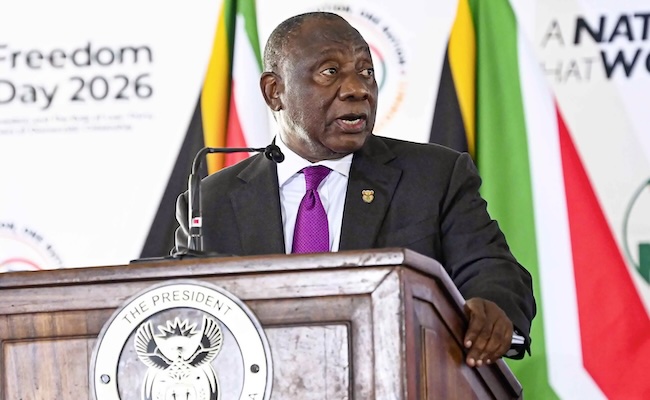
Top image: President Cyril Ramaphosa. Picture: Gallo Images/Volksblad/Mlungisi Louw.
Sign up to Currency’s weekly newsletters to receive your own bulletin of weekday news and weekend treats. Register here.



I just can’t comprehend why someone who is already a billionaire… and one of the world’s best-paid Presidents to boot, with all the perks and benefits that comes with that position, would need to indulge in dubious activities of this nature. Please explain that to me. What is the psychopathic mentality that compels people to steal when they have NO NEED to do so?
But who says the money was for himself? What if it was ANC money, donated by Sudan in exchange for not going to UN about their civil war and genocide? What if it was part of the Gaddafi millions, remnants from Zuma and that’s how Arthur Fraser knew about it? The ANC is not rolling in the riches like they used to… unlike Ramaphosa… maybe he is serving as the piggy bank on behalf of the party. Will we ever find out the truth!