


Well, it was always expected that the latest amendments to the Companies Act would throw up some horrendous, and perhaps not entirely appropriate, wage-gap figures.
And the first of the large listed companies to release its annual remuneration report in terms of those amendments has done just that.
In this context, Vodacom’s 2026 annual report is indeed history-making – and not in a good way. Which is probably why some of the remuneration data has been camouflaged a little.
The new amendments require companies (and state-owned enterprises) to disclose the remuneration of their highest- and lowest-paid employees. In Vodacom’s case, CEO Shameel Joosub, who has held the post since 2012, received a total single-figure remuneration of a staggering R137m for the 2026 financial year.
Scratch through the footnotes in the remuneration report, and you’ll find the lowest-paid worker received a mere R63,600. That’s an eye-popping gap of 2,174 times. It means one of the lowest-paid workers in the cohort would have to labour just over 2,000 years to earn as much as the CEO earns in one year.
The thing is, the R63,600 figure is the total remuneration of the lowest-paid employee if all employees, including temporary workers, contractors and learners, are included in the net, which may not be what the drafters of the amendments had in mind. It is misleading and skews the calculation far too much in the CEO’s favour. But they probably did intend that contractors be included. Certainly, the trade unions have long argued that contractors should be treated as company employees.
As it happens, Vodacom does provide a figure for the lowest-paid worker, excluding temporary workers, contractors and learners. That figure is R272,541. It’s not great, but it’s four times better than the lowest of the low-paid outside the permanent Vodacom-employment net. And it takes the gap to 504 times. So, a worker in this cohort will require 504 years to earn what Joosub earns in one year.
Muting the outrage
Inevitably, remuneration committees will move smartly to explain why these comparisons are misleading. And will try to avoid the stark comparison between the very top and very bottom.
The only ratio the Vodacom remuneration committee provides is of the highest 5% to the lowest 5%, which is a rather benign 16. That is based on a figure of R6m for the average total remuneration of the top 5% and R369,489 for the lowest 5%.
As for Joosub’s eye-watering pay, the remuneration committee seems intent on muting the outrage. It uses a figure of R81.6m instead of the R137m, stating (but not explaining) that the “payroll basis is used rather than the accrual basis”. Much of the difference appears to relate to Joosub’s share awards.
Similarly, elsewhere it points out that a hefty R61.8m of the R137m goes to the South African Revenue Service. This means the CEO’s post-tax remuneration is R75.6m.
Salomé Teuteberg, a corporate governance researcher at the Labour Research Service, tells Currency that, with increased scrutiny following the recent amendments, she expects more companies to focus on the post-tax figure to make the gap seem less outrageous.
The Eskom effect
Getting back to Joosub’s R137m – a hefty R75m was down to his long-term share incentives (LTIs). The LTI share awards were allocated to him in June 2023 and vested in June 2026.
The comparative figure for his LTIs in 2025 was just R25m. If the near tripling in his LTI awards is excluded, Joosub’s remuneration for 2026 would look significantly more modest, with an increase of about 15%, taking it to about R100m. Instead, the sharp increase in his LTI value has meant the year-on-year increase in his total remuneration is a massive 75%.
What the remuneration committee appears not to have taken into consideration is that the increase in LTI value had as much to do with Eskom as with Joosub. Between 2022 and 2024, the Vodacom share price experienced a rather precipitous decline, dropping from a high of R162 in April 2022 to a low of R88.65 in April 2024.
The share fell out of favour with investors for a variety of reasons, including a revised dividend policy, higher interest rates, currency volatility and, most significantly, load-shedding-related costs. By June 2023, when the LTIs were allocated to Joosub, the share was trading at about R122; by June 2026, when they vested, it had recovered to R147.
The great news for the CEO is that, assuming the remuneration committee continues to ignore the impact of external factors on the share price and there are no crippling external developments, his LTIs are set to deliver generous rewards in 2027. That’s because in June 2024, the share was trading below R100, its lowest level since about 2012.
As you can see, long-term investors have not done nearly as well out of Vodacom as Joosub has.
Bumper 2027 loading
Ideally, this would be an excellent opportunity for investors to test the second leg of the recent amendments: the part where they get to vote against the binding remuneration resolutions. Regarding the amendments, the remuneration votes are no longer merely advisory; they are binding. This means they need more than 50% shareholder support. Failure to secure that backing means the remuneration committee members must stand for re-election.
But here’s the really wonderful news for all the members of the Vodacom remuneration committee – not so much for the minority investors. Vodafone (UK) owns 64% of Vodacom, so there’s absolutely no chance that the remuneration report or the implementation report will fail to secure the necessary support.
So, assuming there’s no major adverse external event in the next nine months, Joosub is in line for another bonanza next year.
ALSO READ:
- JSE CEOs: caviar pay, sardine results
- The gravy train economics of CEO pay
- The long wait for fair pay rules
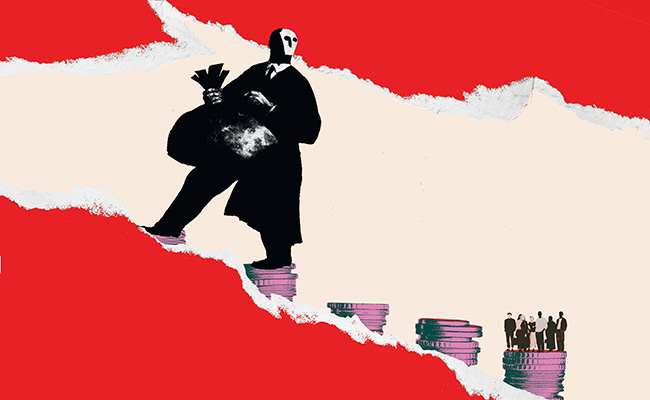
Top image collage: vodacom.com (Shameel Joosub); Rawpixel; Currency.
Sign up to Currency’s weekly newsletters to receive your own bulletin of weekday news and weekend treats. Register here.









Well as much as I dislike this, it is a private company.
Articles like this drive me mad!
Just to clarify, I dislike Vodacom and think their products are overpriced and mediocre.
So back to the article topic…, the CEO earns multiples of the lowest-paid worker. So what!?! How much value is he adding to the business vs what he is being paid?
How much value is the entry-level employee adding to the company, earning a cost-to-company package of R22,711 per month! I know small business owners who earn less than that consistently. I would guess that more than half the entry-level employees at Vodacom do not add R22,000 worth of value and are spending more time learning, more than they deliver in value to Vodacom. And those are the good ones! The bad ones do as little as possible and are entitled moaners for how little they think they are getting paid, partly fueled by ignorant articles like this!
The issue isn’t simply whether a CEO earns more than an entry-level employee. Most people accept that greater responsibility, risk, and impact usually justify higher pay.
The real question is whether the gap between executive compensation and frontline wages is proportionate. Entry-level staff may not individually generate millions in value, but collectively they keep the business running. Without customer service agents, technicians, retail staff, and support teams, even the best CEO cannot deliver results.
At the same time, it’s unfair to assume every entry-level employee is underperforming or “entitled.” There are outstanding employees and poor ones at every level including executives.
focus should be on whether pay across the organisation fairly reflects contribution, responsibility, and long-term value, rather than assuming one side deserves everything and the other deserves very little.
For doing what???
The individual in question serves as the Group CEO of Vodacom Africa, and his compensation is comparatively lower than that of CEOs managing single-entity organizations. I believe his current remuneration is appropriate.
The issue isn’t simply whether a CEO earns more than an entry-level employee. Most people accept that greater responsibility, risk, and impact usually justify higher pay.
The real question is whether the gap between executive compensation and frontline wages is proportionate. Entry-level staff may not individually generate millions in value, but collectively they keep the business running. Without customer service agents, technicians, retail staff, and support teams, even the best CEO cannot deliver results.
At the same time, it’s unfair to assume every entry-level employee is underperforming or “entitled.” There are outstanding employees and poor ones at every level including executives.
focus should be on whether pay across the organisation fairly reflects contribution, responsibility, and long-term value, rather than assuming one side deserves everything and the other deserves very little.