
Anglo American and the Botswana government appear to have differing ideas about how close the sale of De Beers is to being wound up – and, more particularly, whether a buyer has already reached the front of the queue.
Botswana’s government told parliament earlier this month that Anglo had selected the Global Diamond Consortium, led by former De Beers CEO Gareth Penny, as the preferred bidder for the mining company’s 85% interest in the diamond group.
But Anglo CEO Duncan Wanblad gave a distinctly less conclusive account during a media call accompanying the company’s interim results on Thursday.
“I don’t really want to comment on any particular consortium,” he said. “We are not exclusive with any particular consortium at this particular point in time, and there is certainly more than one in the process.”
This is not necessarily a flat contradiction. A seller can designate a preferred bidder without granting that bidder exclusivity, especially in a transaction whose terms remain conditional and where another shareholder has extensive pre-emptive and change-of-control rights.
Material differences
But it is a material difference in description. Botswana presented the contest as having produced a winner, albeit one still subject to negotiation. Anglo presented it as a live process involving more than one potential buyer, presumably in an effort to not weaken its negotiating position.
Wanblad said separately that the sale was “pretty much in the final stages”, but described this as one of its most difficult phases because of the number of parties that have to be aligned. The miner is hoping to reach a conclusion in the second half of 2026.
Botswana, of course, is not merely another bidder. It already owns 15% of De Beers and 50% of Debswana, the joint venture that operates the country’s diamond mines. It also has rights relating to a change of control and pre-emptive rights over Anglo’s disposal of its 85% holding.
Any sale needs the Botswana government’s approval, which means that Anglo cannot simply choose a buyer and hand over the keys. Diamonds generate roughly 80% of Botswana’s export revenue, and the country is the world’s top diamond producer by value – which is why its pre-emptive rights aren’t a formality.
The uncertainty only intensified this week after a Bloomberg report suggested that Anglo has set a sale price of $1bn for its 85% stake, where Penny’s Global Diamond Consortium will pay $750m upfront and a further $250m later, supplemented by payments linked to the future performance of De Beers. The consortium would also inject about $500m into the business.
Penny ran De Beers between 2006 and 2010, and his consortium includes diamond-sector investors, as well as the governments of Namibia and Angola. Its plan is said to involve returning De Beers’ focus more firmly to mining and the marketing of natural diamonds.
Going for a snip
The $1bn price tag for Anglo’s interest underlines just how far the company’s fortunes have fallen – and is less than half its February carrying value of $2.3bn. It’s also miles off what Anglo paid the Oppenheimer family for their 40% stake in 2011. Back then, the deal valued De Beers at almost $13bn.
The discount reflects the funding that a buyer would have to provide after acquisition. De Beers is confronting weak Chinese luxury demand, competition from sharply cheaper lab-grown stones, swollen inventories across parts of the diamond pipeline and pressure to continue investing in long-life mines despite depressed prices.
Anglo’s interim figures out this week illustrate the strain De Beers is under: first-half production jumped 46% to 14.9-million carats and it sold 12.4-million carats, but its average prices fell from $155 to just $105 a carat, dragging revenue down to $1.58bn.
The division recorded an underlying earnings before interest, tax, depreciation and amortisation (ebitda) loss of $113m, an improvement from last year’s $189m loss, but only thanks to some nifty inventory trading.
For Anglo, therefore, the sale is not merely about maximising the headline price. It is also about securing a buyer capable of financing De Beers through a brutal downturn without weakening its mines, brands or relationships with producing governments.
Copper to the rescue
Still, Anglo’s broader interim results were much healthier than its bottom line initially suggested.
An attributable loss of $858m is largely due to a reduction in the carrying value of its steelmaking-coal business, after agreeing its sale to private UK group Dhilmar for $3.875bn.
Continuing operations, which still include De Beers for accounting purposes, generated revenue of $9.93bn, up 11%, and underlying ebitda of $4bn, an increase of 35%. Net debt is slightly lower, at $8.2bn, and Anglo hiked its dividend to US23c a share, compared with US7c in the corresponding period.
Anglo shares were more or less flat on the results, but they have gained 60% over the past year, comfortably outperforming the FTSE all share, driven by copper, its merger with Teck Resources, and the steady shedding of non-core businesses (platinum, coal and nickel).
Copper was the standout, delivering earnings of $2.94bn at a 60% margin. Quellaveco in Peru is now Anglo’s largest cash-flow contributor, and has repaid its original investment, according to Wanblad.
Iron ore, meanwhile, brought in a further $1.17bn, though earnings were lower because of the stronger rand, and higher diesel and freight costs.
A $53bn reinvention
The next stage of Anglo’s reinvention is its $53bn all-share merger with Canada’s Teck Resources. Strictly speaking, the companies are not yet integrating: they must continue operating independently until the transaction closes.
China’s antitrust approval is the final outstanding regulatory milestone, and Anglo still expects to wind up the merger sometime between September and March 2027.
The combined group, to be called Anglo Teck, will be headquartered in Vancouver, with Anglo shareholders owning approximately 62.4% and Teck shareholders 37.6%. Wanblad will be CEO, with Teck chief executive Jonathan Price becoming deputy CEO.
All in all, Anglo is close to completing a transformation forced upon it by BHP’s unsuccessful takeover approach in 2024: platinum has been demerged, coal has found another buyer, nickel is waiting for European approval, and Teck is approaching the regulatory finishing line.
De Beers remains the most politically complicated piece. Anglo may have a preferred buyer, as Botswana insists, or it may still have several runners in the race, as Wanblad says. Either way, the sale is not done – and choosing a buyer may prove considerably easier than persuading all the other parties that the choice is theirs too.
ALSO READ:
- Duncan Wanblad’s unlikely reinvention of Anglo American
- From millstone to option value: how South Africa has changed for Anglo
- De Beers fails to dazzle as more buyers withdraw
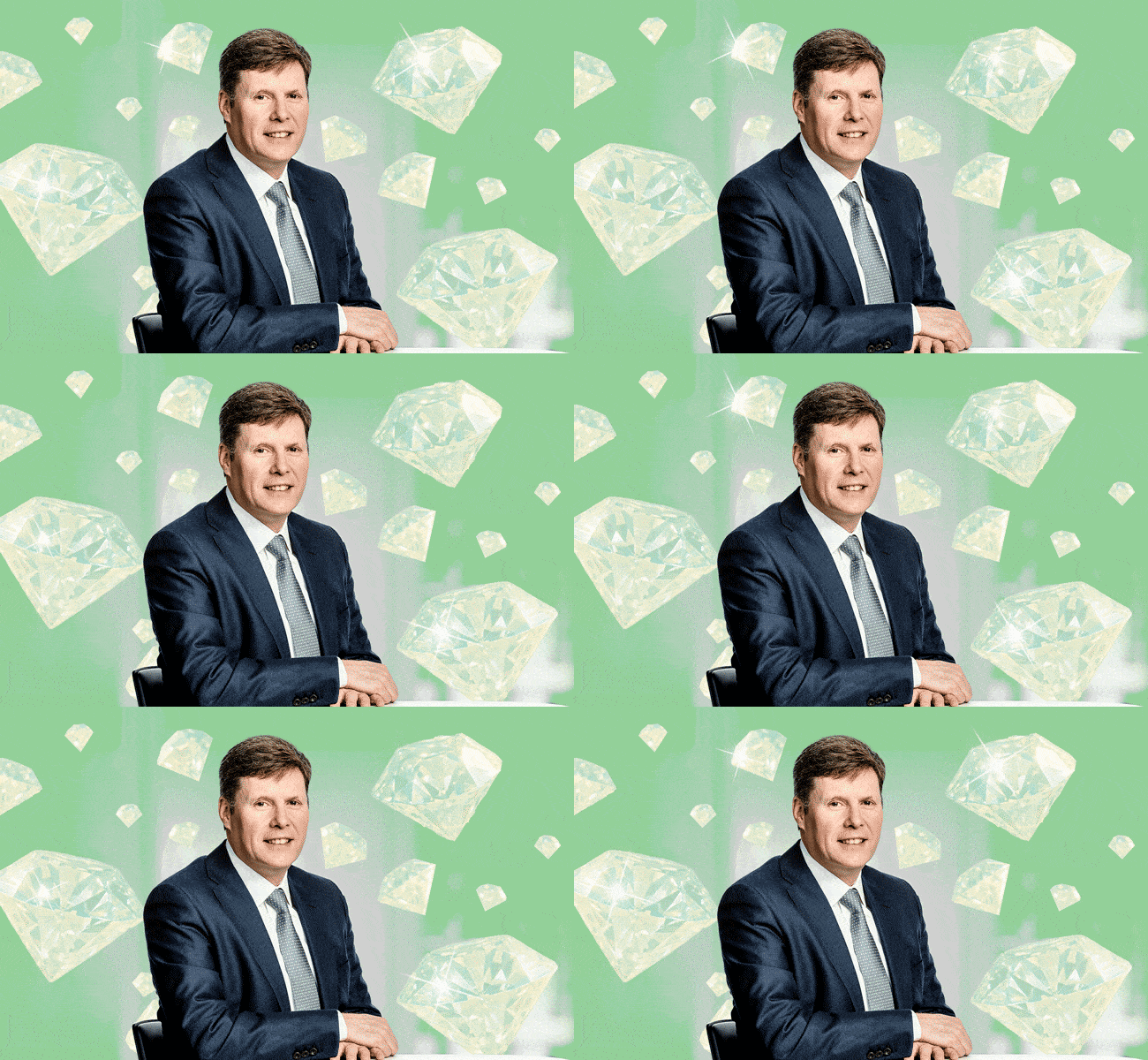
Top image: Anglo American CEO Duncan Wanblad. Picture: supplied.
Sign up to Currency’s weekly newsletters to receive your own bulletin of weekday news and weekend treats. Register here.