

Unemployment above 40% should be a national emergency. In South Africa, it has become normal.
The latest Stats SA Quarterly Labour Force Survey (QLFS) reports unemployment, including discouraged job-seekers, in excess of 40%. In fact, our expanded unemployment rate crossed the 40% threshold almost six years ago, with the arrival of Covid, and hasn’t fallen below it since.
While the hard facts of our jobs crisis are widely accepted, there is far less agreement on its causes and the policies needed to address it. Explanations range from labour market regulation, weak economic growth, education outcomes and skills mismatches, to spatial exclusion and low levels of investment. The list goes on.
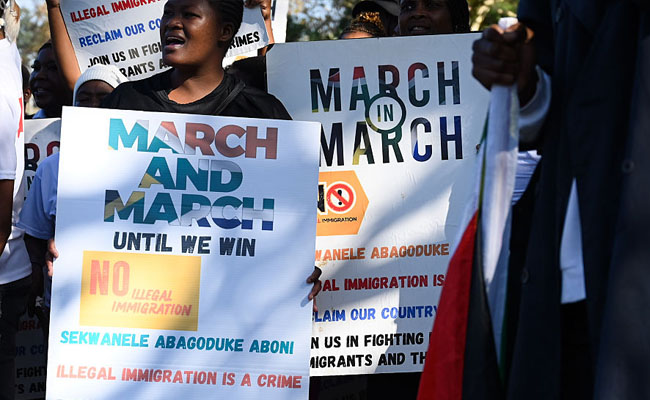
Noticeably absent from most explanations is the role of immigration and foreign employment. Yet this issue has become a political lightning rod in the wake of the March and March civic movement, which is demanding the mass deportation of undocumented migrants by June 30, alongside broader immigration reforms.
So what does the evidence suggest about the role of foreigners in South Africa’s labour market? Are migrants contributing meaningfully to our unemployment crisis? Or are they being used as scapegoats for deeper structural problems?
First, it is worth reflecting on public perception.
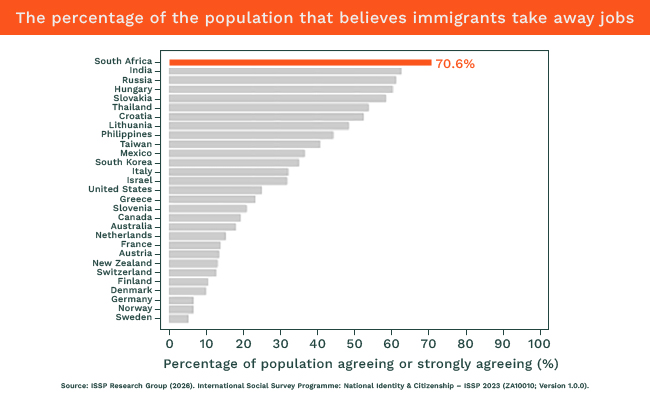
Our analysis from the International Social Survey Programme – a cross country survey of social attitudes – suggests that the overwhelming majority of South Africans (70%) believe that “immigrants take away jobs from people born in this country”. This is higher than any other country participating in that survey.
Alarmingly, 75% of South Africans also believe that immigrants increase crime rates – once again higher than any other participating country.
These perceptions help explain why there has been widespread support for anti-immigrant protest. This narrative should not be dismissed lightly.
For many people, the connection between immigration and unemployment therefore appears self-evident. But the fact is, public perceptions do not always align with reality.
The formal economy
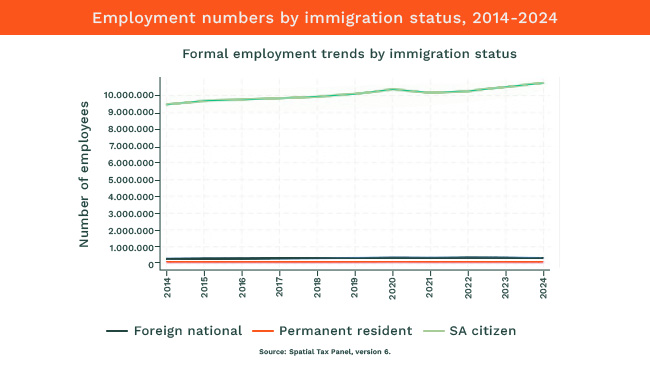
To understand whether foreigners are in fact displacing South African workers, we need to move beyond anecdotes and examine the evidence. The graph below presents evidence about levels of foreign employment in formal jobs from tax data.
Jobs for South African citizens are the overwhelming majority. Less than 415,000 formal employment opportunities were occupied by foreigners in 2024. That’s a tiny 3.7% share of the total 11-million formal jobs.
What is more, the foreign employment share has remained almost unchanged for more than a decade. So it’s also not an emerging issue, in addition to the reality that we’re speaking about a very low base anyway.
The implication is that tightening up immigration laws and controls over formal companies will inevitable impose costs without achieving much in practice. And a perverse outcome might be to chase away foreign skills and investment.
The informal economy
Of course, much of the concern centres on the informal economy, where undocumented migrants are presumed to seek employment.
It is admittedly much harder to establish the facts with certainty for the informal economy, which is, by its nature, less visible. Nevertheless, Stats SA collects information on informal employment through the QLFS, which periodically includes a migration module (most recently in 2022).
Here, the migration module asks respondents about their country of birth and employment status. Not all foreign-born workers are foreign nationals, however, as some will have subsequently acquired South African citizenship. So what this means is that the estimates presented here should be interpreted as an upper-bound rather than a precise measure of foreign employment.
Using this data, we estimate that foreign-born workers account for about 18.3% of informal employment, equivalent to roughly 700,000 workers.
Some policymakers may think that this number is too high – even as a minority. A 20% share would imply that foreigners sometimes compete with locals in the informal sector.
Yet many informal jobs also offer little more than a pathway into working poverty. It is hardly a game-changer for unemployment and poverty.
Macro picture
This perspective becomes clearer if we consider a back-of-the-envelope calculation of the impact of removing foreigners from the South African labour market.
Using the QLFS data reveals that if all foreign-born workers, whether in informal or formal employment, were removed from the workforce and their jobs were immediately taken up by unemployed South Africans, the expanded unemployment rate would fall from 43.6% to 37.6% – only six percentage points lower.
This is, of course, a highly simplified calculation. It assumes, for instance, that every job occupied by a foreign-born worker would automatically be filled by an unemployed South African.
In reality, migrants also contribute to economic activity. A World Bank study found that immigration into South Africa was actually associated with higher employment among South African workers.
The reason is simple: migrants do not only compete for employment; they also create demand, start businesses, make investments, bring critical skills and generate jobs for others.
Perhaps most importantly, South Africa’s economic future depends on trade and investment with the rest of Africa. We cannot champion continental trade and integration on the one hand, while allowing hostility towards African migrants to erode our credibility on the other.
A stark disjuncture
Immigration has never been the primary driver of South Africa’s jobs crisis. Few economists would argue otherwise.
However the disjuncture between public perception and reality on this matter is striking. Acknowledging this disconnect is an important starting point in building a better narrative.
The danger of blaming migrants is that it distracts attention from the deeper structural problems that have left millions of South Africans without work. Until those problems are addressed, the search for easy scapegoats will continue.
Justin Visagie is an associate professor in the Southern Centre for Inequality Studies at Wits University.
ALSO READ:
- PODCAST: ‘Sharp Sharp’ – are South Africans really xenophobic?
- Jobs market looks grim – and the Iran shock is still coming
- Real Politics: these Zulu regiments come with a warning
Top image: People protest against illegal immigration on May 20 in Durban. Darren Stewart/Gallo Images via Getty Images.
Sign up to Currency’s weekly newsletters to receive your own bulletin of weekday news and weekend treats. Register here.







A neglected aspect of the discussion is remittances. Without these, Zimbabwe would not be able to buy nearly as much from us as it does. Our trade with Zimbabwe is R4bn.
Your analysis is a contribution to existing knowledge, it doesn’t break any new ground and equally fails to understand the issue at hand. Reducing the ongoing mobilization to just jobs, and not other issues relating to security including the trafficking of drugs and persons, unrecorded illicit flows, and displacement is myopic at best.