
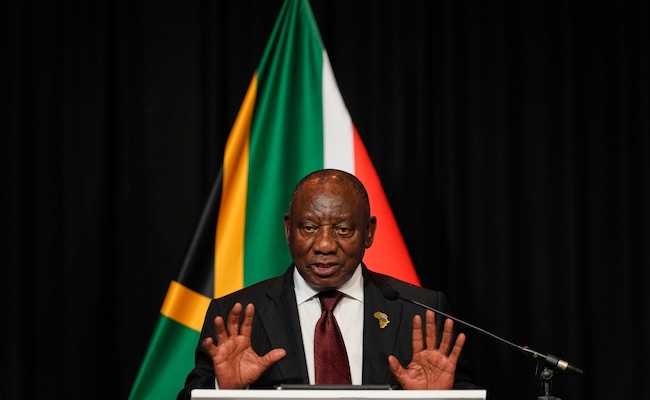

For eight years, business largely gave Cyril Ramaphosa the benefit of the doubt. It overlooked the flip-flops and excused the pottering about. CEOs were in and out of the Union Buildings for one working group after the next. They stood on stages alongside Ramaphosa to talk up hopes of a “new dawn”.
That sun is about to set. With his term drawing to an end, the Phala Phala scandal still simmering, and his unwillingness to act against politicians implicated in dodgy dealings, the private sector is betting that Ramaphosa isn’t the man to finish what he started.
“You look at what’s happening, and you’re not surprised anymore,” the chair of one of South Africa’s largest companies tells Currency, speaking on condition of anonymity. “[When] what you say and what you do are completely two different things … that’s where the lack of confidence comes from.”
Ramaphosa is fast running out of political capital, he adds.
It’s not just that he’s been slow to move; it’s that when he has acted – like appointing the disgraced Dina Pula as minister of social development – it has raised a big middle finger to those to whom he promised accountability and clean governance. To some, it looked like an attempt to deflect from the fallout surrounding the $580,000 stuffed into a couch on his Phala Phala farm, and the calls for impeachment that followed.
Pule was fired by Jacob Zuma, of all people, in 2013 amid a scandal in which she, as minister of communications, channelled money meant for a conference to her boyfriend and then lied about it to parliament. Remembered for the red-soled Louboutin shoes, Pule is now the deputy secretary-general of the ANC Women’s League.
But to put someone who lied to the country in charge of a R293bn purse that distributes welfare to 26.5-million people – more than 40% of the population – seems like a reckless use of presidential power.
“I find it very disconcerting that the ANC’s pool of available leadership is so shallow that it has to recycle [Pule],” says political analyst Susan Booysen, research director at the Mapungubwe Institute for Strategic Reflection. “The ANC’s reputation is so fragile, it can really not afford to be seen to be relying on this category of leadership.”
Look wider, and you’ll see that the institutions that Ramaphosa promised to strengthen are now floundering, too.
Take the state-owned Public Investment Corporation (PIC), which manages R3.7-trillion in government pensions. Having pressed the reset button in Ramaphosa’s energetic first year as president, it has again hit a wall. Last week, its CEO Patrick Dlamini was suspended, and its board, just 10 months old, is in tatters.
The National Student Financial Aid Scheme is also a mess, and is now under administration for the third time since 2018, while municipalities are in such bad shape that the National Treasury is withholding funding.
“Countries that deal successfully with corruption do not only talk about it; they act against it,” says Kganki Matabane, CEO of the Black Business Council (BBC). “If people are perceived to be compromised, they should be removed and replaced with people regarded as clean. The president has not done that sufficiently.”
Initially, the BBC believed that Ramaphosa would advance transformation, having chaired the BEE Commission that led to the empowerment laws of 2003. “I was in parliament when Ramaphosa delivered his ‘Thuma Mina’ speech, and people believed things would move,” Matabane says, referring to the 2018 state of the nation address that quoted Hugh Masekela’s “send me” anthem.
Instead, unemployment has risen from 26.7% when Ramaphosa took office to 32.7%, and growth has averaged less than 1% a year. His much-trumpeted investment drive – R1.5-trillion in pledges by 2023 – consists mainly of routine capital expenditure or projects already in the works. Only 42% of that money has been realised. Opposition to BEE has also become more vocal.
Publicly, CEOs are still pledging support. But when you look at what they spend, it’s a different story. Gross fixed capital formation – total spending on fixed assets such as infrastructure, machinery and buildings by businesses and the state – has been stuck below 15% of GDP for the past five years, according to Reserve Bank data, peaking at just 14.9% in 2023 before slipping to 14.5% in 2024. That is less than half the 30% the government’s National Development Plan targets by 2030.
Time, Matabane says, has all but run out for Ramaphosa. “The president has only a limited period left in office, so I do not think he will be able to do much more,” he says.
Meddlesome politicians
The president’s signature clean-up initiative of late has been the Madlanga commission. Convened last year to unmask the extent of criminal infiltration of the police and get to the bottom of why the country has failed to get on top of a rampant crime rate, the revelations have been eye-opening and horrifying.
But even in launching this commission, Ramaphosa’s hand was forced by KwaZulu-Natal police commissioner Nhlanhla Mkhwanazi, who last year accused police minister Senzo Mchunu of disbanding the province’s political killings task team to shield politically connected suspects.
And confronted by the evidence, Ramaphosa has dithered.
Mchunu has been on special leave since July 2025; national police commissioner Fannie Masemola remains suspended over a R360m South African Police Service health tender; and so many other compromised officials are still in purgatory.
Matabane concedes that politicians are harder to nail than government officials – instructions are verbal, and courts work on facts, not perceptions – but there still must be accountability. “When a government says it will tackle corruption and then behaves differently when something involving politicians looks suspicious, people stop believing it,” he says.
Chris Hattingh of the Centre for Risk Analysis is more scathing about Ramaphosa’s inability to cleanse the public sector of poor leadership.
“This is not one bad appointment,” he says of Pule. “It is the near-total collapse of the leadership layer Ramaphosa specifically promised to rebuild after state capture.”
What galls many business leaders most is that the fix for ailing state entities has been under the ANC’s nose for years. The Presidential Review Committee on State-Owned Entities, chaired by Riah Phiyega, recommended in 2013 that an independent body appoint – and fire – boards of state-owned companies. Nearly a decade later, the Zondo commission reiterated this, warning that appointments “can no longer be left exclusively in the hands of politicians”.
Yet the ANC’s practice of deploying cadres remains as entrenched as ever. This has made it harder to hire competent professionals who could do the job, since they fear the reputational damage of being part of a state entity where politicians routinely meddle.
Between 2018 and 2022, Eskom’s board contained no single engineer, while Dudu Myeni, a schoolteacher, chaired SAA. “You can go into an institution, take a principled stand, and then be overruled by someone who may not have a quarter of your knowledge,” Matabane says.
If you want to see a real-time cautionary tale, take the PIC.
Six years ago, a commission of inquiry under judge Lex Mpati was appointed by Ramaphosa to examine how politically tied dodgy deals worth billions had compromised the PIC’s governance. Mpati provided 306 recommendations to fix this once and for all. Today, all those recommendations have been implemented except one – that the PIC’s board is not chaired by a politician.
The government just ignored that recommendation. Deputy finance minister David Masondo still chairs the PIC, an arrangement that has since been codified through a 2021 amendment to legislation that the ANC used its majority to push through.
As it stands, five of the top six executives at the PIC are in acting roles, and the board is a mess, split between finance minister Enoch Godongwana’s camp, and that of his deputy Masondo. There is no mechanism to break this deadlock.
“It’s a political appointment sitting inside what should be a professional money manager,” says Hattingh. Of the 10 non-executive directors appointed in September 2025, only two had asset management experience. Both have quit.
If you want a counterpoint of how it could be done, look to Megawatt Park. There, Eskom has undergone a major turnaround under chair Mteto Nyati, a mechanical engineer who ran Altron, MTN South Africa and Microsoft South Africa. Nyati insisted on independence and stressed accountability. And load-shedding has ebbed, if not vanished.
Still, there is good news when it comes to political interference.
An amendment to law, gazetted in April, will for the first time strip ministers and the president of any discretion over appointments below the level of head of department. Accounting officers must now hold an honours degree and have 10 years’ senior experience – 95% of sampled departments comply, MPs heard in June – while municipal appointments will be merit-based.
But there’s a catch. Every appointment from Pule to the PIC chair, the police minister, and the head of the Investigating Directorate Against Corruption sits above the level those reforms reach. A 2023 DA bill that tried to close the gap by criminalising political interference in appointments was blocked by the ANC.
“Until that discretion is constrained by law rather than convention,” says Hattingh, “each cycle of appointments will keep testing whether Ramaphosa applies a standard – and business will keep pricing in the answer.”
Stalled reforms
For those who doubt Ramaphosa is burning his political capital, Hattingh counters with three damning pieces of evidence: Pule, the Madlanga commission and, now, the chaos at the PIC. “The record now speaks for itself rather than needing interpretation. Three governance failures have landed inside a matter of weeks,” he says.
Other elements of the scorecard are equally troubling.
The Business Leadership South Africa Reform Tracker, run by Krutham, puts the overall reform score up 27% since March 2024 – almost entirely thanks to private sector-driven fixes in electricity, logistics and finance. Governance has been dead flat at about 54 out of 100 for two quarters, the weakest of the three pillars.
This suggests an immense squandering of goodwill, since business confidence had risen since the 2024 elections ended ANC dominance and ushered in the government of national unity (GNU). Finance minister Enoch Godongwana’s latest budget also convinced investors that National Treasury was getting a grip on spending and debt.
Not all of this has been Ramaphosa’s fault. Donald Trump’s second term sparked global chaos, from willy-nilly tariffs to the decision to bomb Iran. This threw central bank interest rates trajectories, including South Africa’s, into turmoil.
The RMB/BER business confidence index, which hit its best reading since 2015 in the first quarter of this year, plunged in the three months to July, largely because of Iran. Three expected interest rate cuts this year turned into possible rate hikes.
Nonetheless, says Hattingh, governance failures “add a domestic risk premium on top of an already elevated external one at precisely the moment investors need reassurance that the state can execute”.
Support for Ramaphosa “was always conditional and increasingly transactional”, he argues. Business has shifted its allegiance and now backs the GNU and what it has been able to achieve – the slow improvements at ports and freight rail, and exiting the Financial Action Task Force’s greylist – more than the president personally.
Heading into the November 4 local government elections and the ANC’s national elective conference next year, the question that business is asking is not whether Ramaphosa survives – his term as ANC president ends in December 2027 and, as with Thabo Mbeki and Jacob Zuma, his time in the Union Buildings will likely end with it – but whether the GNU ends with it.
It is here, close to the end, that Ramaphosa is fumbling the ball more than ever, says political analyst Ralph Mathekga. “A cabinet reshuffle such as this, which has got Dina Pule, cannot pass as an indication of a willingness to push reforms.”
The Madlanga commission, Mathekga says, “cannot finish its job now – that’s very clear … the rot is still very deep; it hasn’t even gotten to where we wanted to get to”.
Whoever inherits the Union Buildings – be it Paul Mashatile, Patrice Motsepe or someone else entirely – inherits an anti-corruption project that is, at best, half built.
ALSO READ:
- Inside the PIC’s meltdown
- Real Politics: stuck with a president fighting for himself
- Growth hides deep investment slump
Top image: President Cyril Ramaphosa. Picture: AP Photo/Themba Hadebe.
Sign up to Currency’s weekly newsletters to receive your own bulletin of weekday news and weekend treats. Register here.






The biggest problem in all of this lack of accountability, is the weakness of the National Prosecuting Authority. Ramaphosa appoints the top 16 people in the NPA – NDPP, DNDPPs(4), DPPs (10), head of ID(1) – with minimal qualification requirements (fit and proper, and right of appearance). Even countries like Zambia have an open and transparent process and strict requirements (admission to the Bar and 10 years’ litigation experience for the NDPP). The NPA Act urgently needs reform before the next NDPP is appointed in 18 months.