
South Africa’s industrial policy has always had the air of a committee trying to assemble a Boeing from a leftover Meccano set, three slogans and a strongly worded cabinet statement.
The latest contraption is the new industrial development strategy, or IDS, which arrives just as manufacturing has once again reminded everyone that it is not in the mood to be the cavalry. The economy grew by 0.5% in the first quarter, a number so modest that in any country with normal self-esteem it would be called “barely moving”, but which in South Africa was greeted with the relief normally reserved for locating a missing child at the mall. Agriculture and finance did well. Manufacturing, the chosen instrument of national resurrection, fell again.
Into this scene steps the department of trade, industry and competition (DTIC), sleeves rolled up, diagrams under one arm, nouns under the other. It has a new plan. Not one of the old plans, you understand. Those were master plans. This is an Industrial Development Strategy. Completely different, in the way that repainting the same bakkie makes it a new transport policy.
Enter the abstract noun
The old master plans were the policy fashion of Ebrahim Patel for years: sector by sector, industry by industry, problem by problem, everyone gathered around the table until the table itself presumably applied for a production incentive. There was a poultry master plan, a sugar master plan, a clothing and textiles master plan, a steel master plan, an automotive master plan, and so on, all based on the idea that if government, business and labour could agree on the correct diagram, reality would feel obliged to comply.
Now the DTIC has discovered themes. The new incantation is “decarbonisation, digitalisation and diversification”. This is very modern and global and sounds like something that could appear on a lanyard at Davos if Davos ever needed a cheaper venue with worse port performance. The sectoral master plan is out; the thematic master plan is in. We have moved from “let us fix poultry” to “let us digitise decarbonised diversification”, which is progress of a kind if your preferred economic unit is the abstract noun.
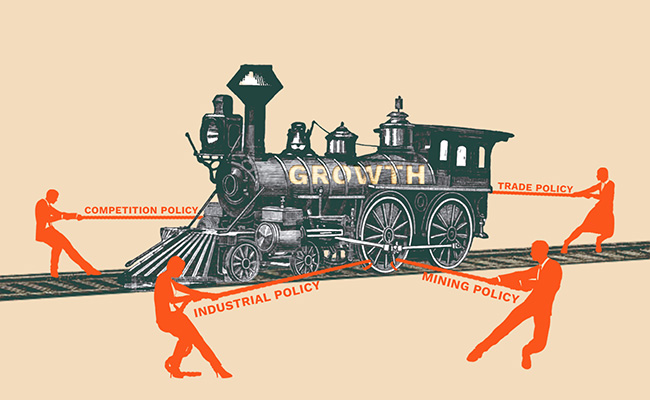
The trouble is that beneath the new language lies the same old mistake. South African industrial policy keeps assuming that the central problem is insufficient choreography. If only departments would co-ordinate; if only incentives would align; if only business would stop being suspicious; if only labour would accept the bigger picture; if only Eskom, Transnet, water affairs, mineral resources, environment, municipalities, regulators, financiers and customs officials could be made to hold hands in the correct order, the machine would begin to hum.
What co-ordination?
This is why the IDS is, unintentionally, ironic. One of its core insights is that government departments must work together better. This is true, of course, in the way that “aircraft should remain attached to their wings” is true. But almost immediately, the strategy demonstrates the problem it claims to solve. In a document calling for better interdepartmental co-ordination, the DTIC floats the idea that beneficiation conditions should be attached to mining rights – only for mineral resources director-general Jacob Mbele to be put on the spot at the Junior Mining Indaba and describe the idea as “a proposal”.
The IDS says mining legislation should be reviewed so the government can attach conditions facilitating beneficiation to the allocation of mineral rights. It says the shift is crucial because it would allow beneficiation objectives to be embedded in mining licensing decisions. Mbele, who had earlier argued that South Africa’s mining problem was not policy uncertainty but administrative weakness, suddenly had to answer for another department’s ambition to wander into his licensing kitchen and start rearranging the knives. Asked whether this was the DTIC’s domain, he said no, but that it was a proposal it was putting forward.
There, in one exchange, was the South African state: one department calling for co-ordination, another discovering the co-ordination live on stage.
The mining industry is not being precious about this. The issue is not whether beneficiation is desirable. The question is whether the government can make beneficiation commercially rational by fixing the conditions that make it possible, or whether it intends to staple beneficiation onto mining rights like a note from the headmaster.
Diagnosis rather than decree
Chrome is where the argument becomes most revealing. South Africa has lots of chrome. It also used to have much more ferrochrome capacity. The DTIC looks at this and sees a crime scene: ore leaving the country, value added elsewhere, jobs lost, industrial opportunity squandered. And in one sense it is right.
But the industry’s answer is just as obvious: the problem is not that miners have hidden all the chrome under the mattress. The problem is electricity. Ferrochrome smelting is brutally energy intensive. If power is too expensive or unreliable, smelters close. You can impose a chrome export tax, declare a quota, create a special economic zone, summon a task team and issue a strategy document bound in tasteful blue, but the furnace still needs electricity at a price that makes arithmetic possible.
The IDS may yet be useful if treated as a diagnosis rather than a decree. South Africa does need to arrest industrial decline. It does need to use its minerals more intelligently. It does need to exploit critical minerals, green energy supply chains and African markets.
But it will not get there by making every miner negotiate the meaning of beneficiation with every department that owns a stamp. It will get there when the state learns the first rule of industrial policy, which is also the first rule of medicine: stop injuring the patient while designing the cure.
So why does South Africa keep getting industrial policy wrong? Because it cannot resist confusing ambition with capacity.
This story first appeared in the Financial Mail. Currency and the Financial Mail are part of the Financial Mail Group.
ALSO READ:
- Mining DG cool on DTIC’s forced mining beneficiation plan
- This train goes to a castle in the air
- Eskom’s tightrope: jobs vs chrome revenue
Top image collage: Wikimedia Commons/MN Forney (Catechism of the Locomotive); Currency.
Sign up to Currency’s weekly newsletters to receive your own bulletin of weekday news and weekend treats. Register here.