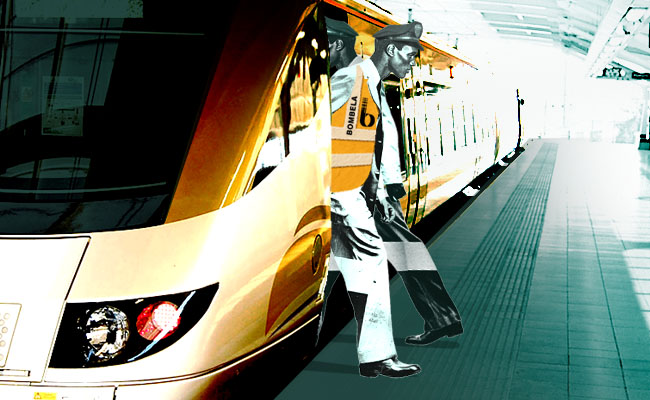

Late last month, the department of transport released for public comment its draft national master plan to revitalise, modernise and expand South Africa’s rail system, covering freight rail, commuter rail, long-distance passenger rail and high-speed rail. I’m not a transport policy expert, but since the document is out for public consultation, and I’m a member of the public, allow me to spout forth. I love the fact that it’s very ambitious. I also worry that it’s very ambitious. And this is not a contradiction.
A quick diversion into history. South Africa’s first great inland trunk railway project was the Cape Town-Kimberley railway, built in stages after the discovery of diamonds transformed Kimberley from geological accident into fiscal destiny. In the early 1870s, the government of the Cape colony took over and extended the existing Cape Town-Wellington railway inland; the through-route to Kimberley was opened in 1885. At 1,040km, it was a substantial project by international standards – not one of the great transcontinental monsters, but a huge undertaking for a small colony. Adding the relevant sections together, it appears to have cost roughly £5m in capital expenditure, about three and a half times the Cape colony’s annual revenue in the early 1870s. The Cape was prepared to borrow and build at a scale that now looks almost indecently bold.
So, in a sense, the seemingly enormous figure in the rail master plan – R2-trillion in public and private investment over about 30 years – is not that huge. What South Africa will get from that, according to the department of transport, is a 3,600km expansion of freight and passenger networks. But it adds that the private sector will have to carry a large part of the funding burden because the state cannot realistically fund this alone.
Still, in another sense, the rail plan is very ambitious because one official calculation cited at the launch was that if the plan were paid for over 10 years, it would imply about R190bn a year, equivalent to about 70% of the government’s current infrastructure funding across all departments. So what the department of transport is suggesting is that rail should absorb a thunking portion of the government’s infrastructure spend.
As a development enthusiast, this seems totally laudable to me. The reason rail has exploded over the world in the past century is its obvious efficiency. One train can move huge tonnage with fewer drivers, less fuel per ton and far lower road damage. According to a 2025 Agbiz logistics presentation, in South Africa rail is 11%-44% cheaper than road. Obviously, this is very variable; some products can only realistically be transported by rail, and in some places, including in South Africa, truck transport is actually much cheaper.
Vote-catching policy
So that’s the positive ambition, if you like. What about the negative ambition?
First, take the proportion of the government’s infrastructure budget the rail plan suggests. You could ask why the government’s infrastructure budget overall is so small compared, just from a historical perspective, with that of the Cape colony, which was spending about half its budget every year on infrastructure.
The answer is obvious: the government, in thrall to the unions, has ratcheted up state salaries to such an extent over the years that they’ve eaten into the infrastructure budget. Likewise, the exploding social spend. To set aside, let’s call it R300bn a year for infrastructure, or 10% of the total budget, is actually pretty small for a country such as South Africa. And there is more.
Transnet’s underperformance has turned road into the default mode. An analysis by logistics consultancy GAIN Group, using South Africa’s freight demand model, estimated that in 2022, rail carried only 39% of land freight and road 61%. It said an optimal system would give rail about 68% of land freight.
The draft rail master plan itself says more than 100Mt of freight have been switched to road, with rail now moving about 165Mt against estimated market appetite of about 280Mt. The plan’s 2030 target is 250Mt a year. The fact is that Transnet’s freight volumes fell from a peak of 226Mt in financial 2018 to 152Mt six years later, with equipment shortages, maintenance backlogs, cable theft and vandalism as major causes.
Seen from this perspective, the master plan mimics several other super-ambitious plans, such as National Health Insurance or even the expansion of BEE. They are so ambitious, and the delivery is so perilous, you can’t help wondering if these are “plans” at all or are just attempts at vote-catching by a party that’s in the process of losing power.
And if that is true, it actually makes the situation worse, not better, because it further undermines public trust in the governing process.
There is nothing wrong with being ambitious; it’s great. But if your ambition is so far beyond your demonstrable ability to deliver, you are just digging yourself into a deeper hole. And in that case, the international law of hole excavation should apply: if you find yourself in a hole, the first thing to do is to stop digging.
This story first appeared in the Financial Mail. Currency and the Financial Mail are part of the Financial Mail Group.
ALSO READ:
- Full steam ahead, or just more smoke?
- Transnet seeks R50bn bailout
- How a 100-year-old railway is becoming an African lifeline
Top image: Rawpixel; Currency.
Sign up to Currency’s weekly newsletters to receive your own bulletin of weekday news and weekend treats. Register here.