

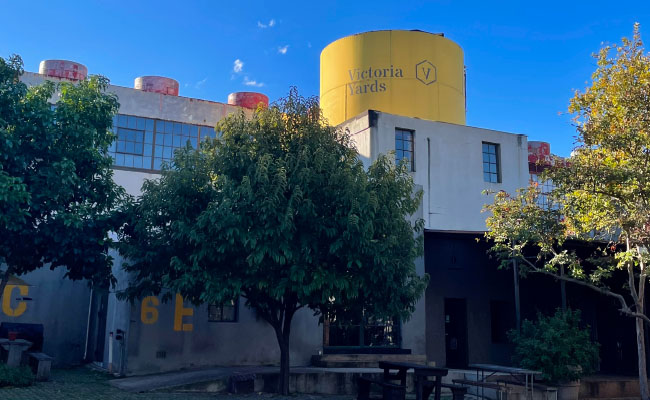

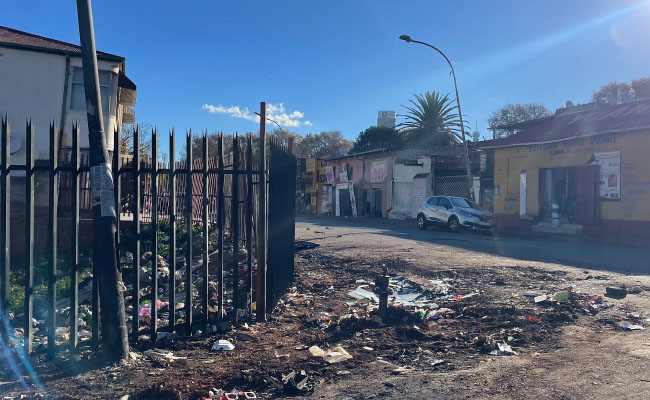
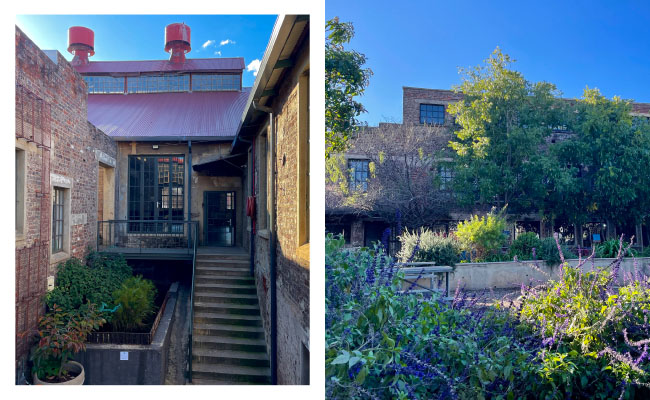
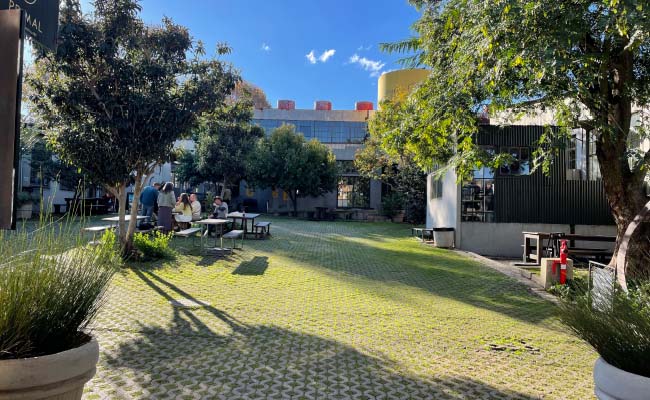
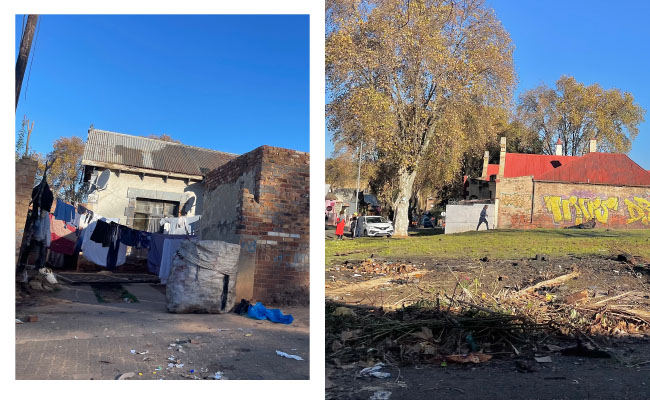
Take a drive through some of Joburg’s oldest suburbs – like Bertrams, Berea and Bez Valley – and you’d be forgiven for thinking you’ve wandered onto the set of 2009 sci-fi flick District 9, or perhaps the 1980s classic Blade Runner. But, suddenly, nestled among crumbling apartment blocks, cracked streets and tire-filled lots is a lush oasis known as Victoria Yards, now one of Joburg’s most popular weekend spots.
This century-old property became a creative hub for artists, small businesses, artisans and urban farmers thanks to the efforts of 44 Stanley founder Brian Green, who was shown the property by long-term developer Brian Azizollahoff back in 2016, and who teamed up with the Brozin, Berman and Enthoven families to develop the precinct.
Even then, it was a contrarian and risky move to plough money into one of Joburg’s most neglected areas, but it brought a spark of life to the Lorentzville neighbourhood (in which Brozin’s global food empire Nando’s maintains its South African head office) and has become what Green describes as “a sort of mother to the neighbourhood”.
But four months of consistent power outages at the hands of Joburg’s shambolic City Power have pushed the project and its tenant businesses to breaking point.
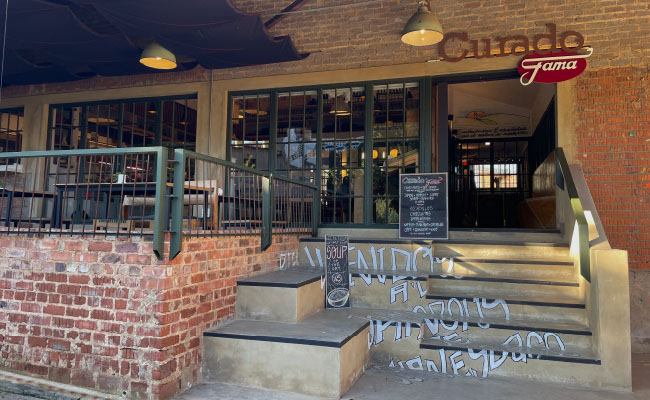
“Every time they cut the power, it’s [off] for three, four days. It’s never quicker than that,” says Nuno Fernandes, who runs the Fama Delicatessen at Victoria Yards.
The entire ward has been affected by the outages, the longest of which was almost two straight weeks. It’s a catastrophe not only for Victoria Yards, but the area’s residents and the few businesses left that continue to stumble on.
Left in the dark
Victoria Yards tenants and the local ward councillor, Carlos Da Rocha, say that City Power refuses to disclose what the problem is. “The updates are generic,” says Da Rocha. “The information they are giving me to send out to the residents is copy and paste stuff.”
Says Fernandes: “And then you compare it to where we stay, for example. When the power goes off, we get constant communication and it’s all sorted within a day.”
Asked for clarification, City Power tells Currency that the repeated trips in the area are caused by a variety of factors such as “ageing infrastructure, historical damage to underground systems, cable theft, vandalism, illegal connections and network overloading”.
However, when asked why these reasons aren’t communicated to residents, City Power is less willing to answer the question. “The nature of underground electricity infrastructure means that some faults cannot be immediately diagnosed,” it says.
It does venture that it “first has to wait for tunnels to be declared safe for entry, especially after fires, flooding, or equipment failures”.
Victoria Yards general manager Kian Degenaar says it has gotten to the point where, when outages occur, tenants at Victoria Yards will drive to the local substation to fetch workers and show them where the power issues are.
“This week I was the first person to go to Observatory power station and ask why the power was off,” says Gabriel Fine, a tenant and manufacturer at Victoria Yards. “And they said that the power was on, when we hadn’t had power for three days.”
City Power additionally confirms that the Observatory substation sustained severe damage from a major fire incident. But that was back in 2023. Three years later and the substation is still not fully restored, due to “budget availability and the complexity of repairs required”.
The latest reports on City Power’s chaotic finances suggests that “budget availability” will remain a pipe dream for the foreseeable future. The entity – whose well-paid but woefully inept CEO left under a cloud in March – made a loss of almost R4.4bn in the 2024/25 financial year, with its liabilities exceeding its assets by a staggering R22bn. The entity is owed R11.5bn by residents, businesses and large power users, and owes contractors R1.3bn, according to News24. And it also loses about 40% of the power it buys from Eskom.
A recipe for collapse
These outages are not just occasional nuisances.
Fama, which provides meat supplies for restaurants in the city, has lost substantial sums of money from major suppliers in the past four months due to the blackouts.
Fresh meat will go off after two or three days, Fernandes explains, and it has been a massive issue for the team to try and figure out a way to keep the meat cold when the fridges are off. On top of that, the heavy machinery needed to process the meat cannot run on Victoria Yards’ solar power system, bringing the whole production line to a standstill.
Fernandes has considered putting in solar for the business, but it would cost about R450,000, which is money he simply doesn’t have.
“Most businesses can’t afford it,” says Degenaar. Solar power systems that could handle the machinery needed by most of the businesses would cost hundreds of thousands of rands, and generators are even more expensive thanks to the recent spike in diesel prices. “And a lot of them only have funds for this month to next month.”
For now, Fernandes hasn’t had to cut staff but, he warns, “it’s becoming a second thought”.
Mounting losses
Fine explains that in his manufacturing business, for the power to go out mid-cycle means that a particular batch of product is completely wasted. “And that’s three weeks of preprocessing that we lose.” In the most recent instance, one power cut cost the company about R72,000.
Victoria Wigzell, who runs Pulp Paperworks at Victoria Yards, explains that she can’t allow the outages to create a backlog of work.
“The problem is I employ all of these people, and I need to take on new work to be able to pay them next month, so I have to figure out how to complete the other stuff and take on new work,” she says. “It makes us feel so much less efficient. We’re never able to catch up, ever.”
If this continues, it’s only a matter of time before these entrepreneurs will have to initiate job cuts.
“Unfortunately, the next steps for businesses that end up paying salaries with no money is layoffs,” Degenaar warns. “And after layoffs, it’s closing the business.”
How to kill a precinct
As Green explains, Victoria Yards was meant to have a symbiotic relationship with the local community, uplifting them and providing them with stable work and access to fresh food. It is Victoria Yards’ policy that any business on the property must employ Lorentzville locals.
“It is a social project, but a social project that needs to run like a business,” Green says. To thrive it needs to be profitable, and without access to the basic utility of electricity, Victoria Yards’ business (and its tenant businesses) cannot run efficiently enough to break even. With these current power cuts, Green estimates it pushes back any profitability of the precinct “by a number of years”.
It’s yet another own goal for the city’s administration, which still seems keen to talk up inner-city rejuvenation. Yet government-run projects such as the Kopanong Precinct Project (the creation of a walkable, green-technology based government precinct in the CBD), or the Lilian Ngoyi street upgrades, have been plagued by delays, high costs, contractor issues and broken infrastructure.
Victoria Yards, in contrast, is a stellar example of real rejuvenation without either city funding or gentrification. Yet the lack of care from City Power and the wider Joburg administration shows a clear disconnect between idealised government aims and their ability to provide the services needed to fulfil their policies.
No incentives
Then there’s the loss to the fiscus.
“As a business, if I run, I generate revenue, and I can then pay tax. But when the city fails on service delivery, I can’t run, I can’t generate income, and I can’t hire people in the local community,” says Fine.
Says Wigzell: “This has made me want to stop being a small business owner, period.”
Fine agrees. “I can honestly say in the last week I’ve thought about whether it makes sense to operate a business in the city. There is no incentive to start or run a business in Joburg. There are no tax breaks, there are no hiring incentives, there’s just nothing.”
As ward councillor, Da Rocha has long warned City Power that “things are tense on the ground”, he says.
Whether anyone is listening is as doubtful as the utility’s ability to keep the power on.
ALSO READ:
- Robbing a city blind
- Borrow now, pay later: Joburg’s budgetary balancing act
- Why Godongwana had to rebuke Morero on Joburg’s debt crisis
All images: Ruby Delahunt.
Sign up to Currency’s weekly newsletters to receive your own bulletin of weekday news and weekend treats. Register here.








This is sooooo vital a story. When the infrastructure fails, businesses suffer and then job losses result. In a country with a unemployment rate as high as ours, this is absolutely unacceptable. This is why Helen Zille says putting the DA in power will create jobs. Not through the city administration itself (there should be job cuts there), but by creating a well-run city that people want to visit and spend money in. A city IS like a business and should be run as such. Make it appealing, clean, welcoming, responsive and customer-friendly and it will succeed.